Workforce shortage is biting. Wages will have to be increased to keep migrants from leaving for villages.
Business leaders and corporate executives told ET that the problem is already evident in sectors such as construction, consumer goods and ecommerce, and may hit the major manufacturing sectors once these resume full-scale operations after the lockdown ends.
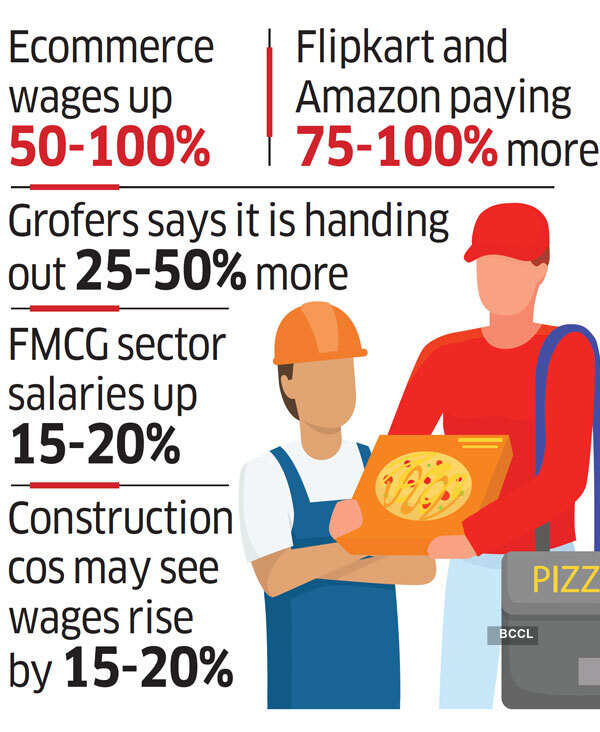
Wages for ecommerce delivery and warehouse staff have increased 50-100% so far, and though the situation has normalised, there has been no across-the-board improvement, said executives. Flipkart and Amazon are shouldering wage increases of 75-100% while Grofers said it was paying 25-50% more.
“Depending on location and function, payouts are 25-50% higher than pre-Covid days,” Grofers CEO Albinder Dhindsa said. He said that while the availability of workers has improved, the e-grocer is continuing to pay hazard pay (hardship allowance) and higher wages.
These wages are expected to persist through the summer, the executives said.
Ecomm Marketplaces may Not Hire More
While online grocers have managed to grow their business during the lockdown, horizontal marketplaces Flipkart and Amazon that employ millions of workers are expected to see little to flat growth this year. This could result in large marketplaces not expanding their onground workforce — a big shift, considering the 40% increase they have been clocking for the past two years.
BigBasket and Grofers are together looking to hire 15,000 more during the course of the lockdown. These workers may also be made permanent, the executives said.
FMCG & ELECTRONICS
Consumer companies are seeing a cost escalation of 15-20%, particularly in transportation, thanks to shortage of drivers and loaders.
Company executives said they have to pay overtime to employees who are working for extended hours to compensate for the staff crunch. “With most migrant workers not expected to return anytime soon, we expect this issue to worsen in the near future. We have to bear the additional cost to keep our factories and supply chain running efficiently, but margins have shrunk,” said B Krishna Rao, senior category head at Parle Products, the country’s biggest foods company.
Smartphone and consumer electronics manufacturers haven’t felt the pinch yet, as plants have not started production and warehouses (most of which are in red zones) are closed.
CONSTRUCTION
The construction sector has been hit hard. Workers in this sector usually leave for their villages around monsoon due to relatively low activity at construction sites. This time, however, there has been a massive exodus and labour mobilisation is proving difficult. On average, a construction worker earns Rs 500-700 per day depending on the nature of work and skill required.
“We are trying our best to retain some labourers with higher wages and incentives, but the fear psychosis is so strong that they want to leave,” said Satish Magar, president of CREDAI National — the apex real estate body. “Labour shortage will result in wages going up by 15-20% not only in the short term, but even after the pandemic is over, because not many who are leaving now will be keen to return,” he said.
Rajeev Talwar, chairman of Naredco, said there is a health emergency in the country and things will normalise once the fear is over. “Wages will increase in the near term, and for developers of projects nearing completion. Apart from wages, developers will have to bear additional cost of keeping labourers safe and well-fed as they will not be able to leave construction sites or labour camps.”
SMALL BUSINESSES
Small business owners are a worried lot, but not everybody is affected. And manufacturing has not been affected yet since companies have only partially resumed operations. However, the situation could worsen as they ramp up operations, several people told ET.
Gurgaon-based Matrix Clothing’s MD Gautam Nair said the problem is localised so far. “Currently, we are not facing this problem. We have resumed work to 50% strength. Most of my workers are migrants and we have started counselling sessions to get them to stay here,” he said.
One industrialist cited the example of Sinnar, a small industrial town near Nashik, where over 3,500 workers have registered to go back to their villages. “They may not come back for at least six months,” said Sudhir Mutalik, managing director of Positive Metering Pumps. “How many workers would be there in Nashik and the entire state? In the coming days, the micro, small & medium enterprises, and in fact, all industries, will be paying very high wages to the available labourers.”
 aniltikotekar4sme.com