India’s largest standalone health insurer seeks to raise Rs 7,249 cr from its IPO; In a Q&A, Dr S Prakash and Anand Roy dwell on its performance and business plans, and the health insurance market
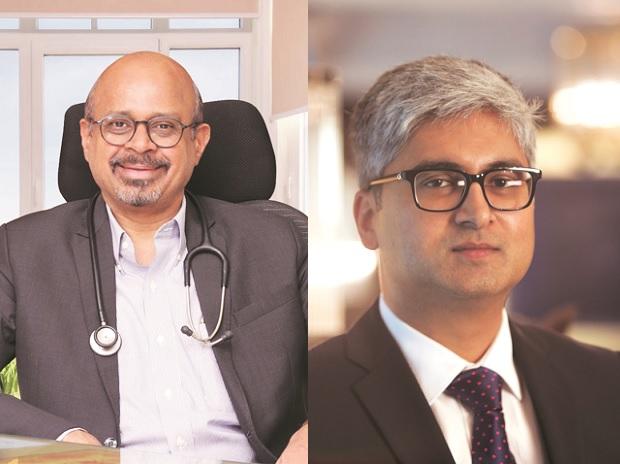 S Prakash (left) and Anand Roy of India’s largest standalone health insurer Star Health — the Rs 7,250-crore IPO of which is opening on Tuesday
Star Health and Allied Insurance, India’s largest standalone health insurer, is looking to raise Rs 7,249 crore from its initial public offering and has set a price band of Rs 870-900. It will be the fourth non-life insurer and seventh insurer to list on the bourses. Before the IPO, Dr S Prakash and Anand Roy, managing directors of the insurer, spoke to Subrata Panda on the company’s performance, its business plans, and the health insurance market. Edited Excerpts:
This is going to be the third-biggest IPO of the year, after Paytm and Zomato. Post Paytm fiasco, are there some concerns?
S Prakash: We have a different business model, we are from a different industry, so it cannot be equated. Our valuation is dependent on a very fundamental analysis of our performance done by a group of investment bankers, and discussions we had with investors, both domestic and international. Investors look into our past records, our projections, and they do comparison and benchmarking with our peers who are listed in the market. IPO markets are always volatile and difficult to predict. So, we were not looking at timing the market. We thought we were ready so we had to be there.
Anand Roy: We believe the customers and potential investors do understand the importance of health insurance in today’s time in the Indian context. We are the largest standalone health insurance company and have provided good service to our customers over the years. Irrespective of what has happened, Star Health will be viewed positively by the potential investors.
Your profitability, combined ratio, and solvency has suffered because of higher claims. How soon do you see that stabilising?
S Prakash: Since we look at the Covid-19 related outgo as a one-time event, naturally, whatever dent it created on the profit and loss book of the company should also be a one-time issue. The fresh offer is only to take care of the future solvency requirements. The entire Rs 2,000 crore will be towards boosting our solvency.
Anand: As we move into Q3 and Q4 we expect the business growth to continue and claim ratios to come under control.
Do you think growth in the health insurance segment is sustainable or will it taper down once the fear of covid goes away?
S Prakash: The pandemic has given a signal to the citizens of this country that healthcare expenses are costly. So, naturally, the impact of the pandemic on demand should continue. During the peak of the pandemic there was a knee jerk reaction and we saw very high growth. But, going forward, the growth may not be as high as it was during the first wave or the second wave but compared to the pre-pandemic period the growth should be more.
What is the current trend in covid claims and how much have you shelled out so far?
S Prakash: Of late, the covid related claims are very less. It used to be more than 50 per cent of our claims during the peak of the pandemic. But, now, it is hardly 4-5 per cent of the claim numbers. In FY 21, we have incurred more than 163,000 covid claims amounting to Rs 1,625 crore. In H1FY22, the incurred covid claims was 211,000, amounting to Rs 1,750 crore.
But the non-covid claims have spiked…
S Prakash: Yes, there is an increase in the non-covid claims, particularly, those related to dengue, malaria, and chikungunya. Usually, these are monsoon related ailments. This year it is a bit higher than what we saw last year.
Average claim amount has gone up. If this sustains, will it result in a premium hike?
S Prakash: Increase in health insurance premiums cannot be based on the overall average increase in claim size. It has to be mapped product wise. If a particular product is loss making and the loss ratio is more than the threshold we have determined while designing the product then it warrants a price revision. None of our products have crossed the threshold so far. Overall, it is marginally close to the threshold. When they cross the threshold, we may look at revising premiums. But, right now, we are not looking to revise premiums for any of our existing products.
Would you like to grow your group health business?
Anand: Group health is a reasonably big portion in our portfolio, about 10 – 12 per cent. We are selective in the group business because we are not so much focused on the large corporates. We are more focused on the medium sized corporates and the SME segment. This constitutes more than 50 per cent of our group portfolio. If at all the large corporate portfolio becomes viable, then we will participate. Having said that, we do have some large corporates, who are our long-term clients.
OPD is one area which has generated a lot of interest. Are you planning to come out with new products in that area?
Anand: We have an exclusive product for OPD care and we also have OPD limits built into our regular products. Most of the offerings are limited to diagnostic, doctor consultation, and pharmacy bills. We have designed products but the uptake is not very high right now. We are re-looking at this segment and doing some surveys to know what exactly the customer demand is and then we will be able to custom make products because OPD has to be bundled along with telemedicine, wellness so that hospitalisaiton is not required.
You mostly rely on your agency force. Are you planning to alter your distribution strategy post this?
Anand: We will have agency as our core business model but we will also do bancassurance and digital sales. We are little behind others in bancassurance because we do not have any joint venture bank partner. We have to fight it out to get a partner. We do have some of the large public sector banks as our partners and we will continue to build that business. But agency will continue to be our focus area because health insurance is an assisted product.
Life insurers want to sell health indemnity products. If that is allowed, what kind of an impact will it have on your business?
Anand: There was a committee formed by the regulator which had representation from the general, health and life insurance companies. The recommendations of the committee are very clear that life insurance cannot enter into the health indemnity space, they should rather become a distributor of a health insurance company, if they are interested. Or, they are free to float a standalone health insurance company by putting in the required capital. I do not believe that regulator would want to disrupt such a large market because a lot of investors invested money looking at the current regulations. So, life insurers cannot be allowed in this segment.
What are the growth plans of the company, going forward?
Anand: We will continue to innovate and bring products which are in demand in the market. We are looking at the rural areas as a big growth driver. As far as corporates are concerned, we are seeing good demand from the large corporates and the SME segment. And, the government programmes will continue.
 aniltikotekar4sme.com