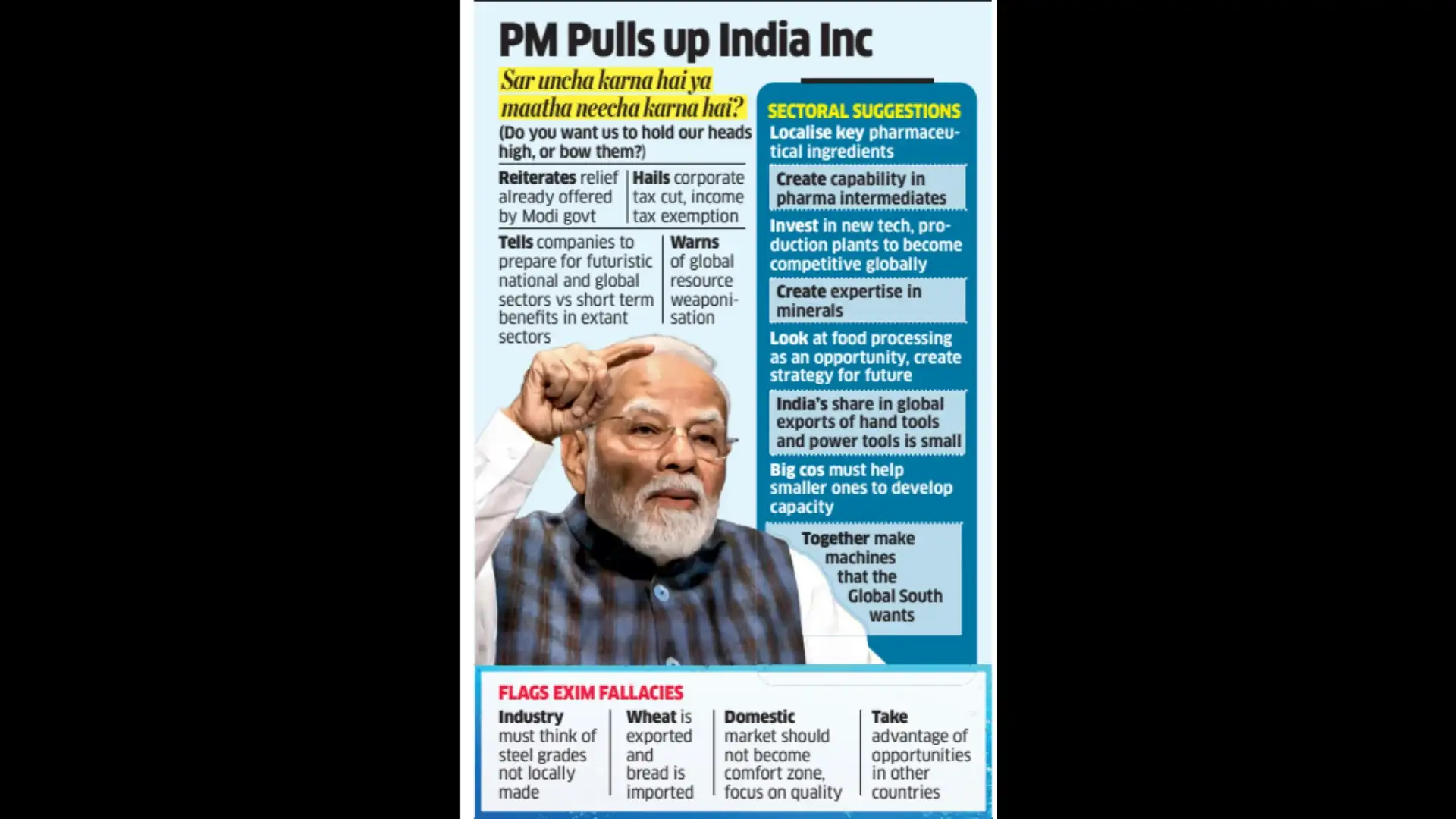
Prime Minister Narendra Modi said companies have failed to meet expectations when it comes to putting ‘India First’ by providing global levels of quality, despite the government having taken several far-reaching steps on tax reforms and the promotion of domestic manufacturing.He also called out the private sector for having an “insatiable appetite” for sops but failing to pass on the benefits of reforms to employees and consumers. Modi assured innovators and business chiefs that his government was willing to carry out whatever policy changes they seek, and exhorted them to reach out to him.
Have no “hesitation or inhibitions” with suggestions, said the PM. Modi was making the inaugural address at the centenary celebrations of the Federation of Indian Chambers of Commerce and Industry (Ficci). He underlined that Indian industry should not wait for “another 100 years” to bring about growth and work to achieve targets over the next two decades.
The right policies followed in the last 12-13 years have made a difference, the Prime Minister said, appealing to industry leaders to make India First the foundation of every long-term investment decision they take for the next 20 years. This will make the country self-reliant and will also open up new opportunities for growth, he said.
Companies have failed to pass on gains from reforms in income tax, GST and corporate tax. “If I speak of industry, in recent years, the government’s focus has been strongly on ease of doing business,” he said. “In 2014, the basic corporate tax rate was 30%, we reduced it to 22%,” he said. “Today, there is no income tax on earnings up to Rs 12 lakh in India. I know you will not clap, because however much one gives, your appetite never seems to be satisfied. I have exempted income up to Rs 12 lakh from tax. Did you increase the salaries of your employees? Did you increase the number of employees? No. The attitude remains: ‘Modiji, you do it, we will see’.”
Under previous governments, tax refunds would take eight months while now it happens in a week.
“Do they arrive or not? Then at least clap! Because I am unable to understand whether what we are doing is useful to you or whether we are doing it for no reason,” Modi said, adding that GST reforms have led to a decrease in levies on many products, boosting demand and in turn benefitting industries and business houses.
He criticised the industry’s attitude of providing assurances of “export quality” to customers. “My citizens are entitled to good quality,” the Prime Minister said, adding that the mindset of global standards being only for foreigners should change.
The trade agreements signed with many countries in the last few months have opened the doors for Indian industry and it should tap these opportunities.
“There cannot be a greater historic opportunity than this,” he said. “If you do not benefit from all these efforts of mine, then who will? I am doing this for you, and through you, for the nation. You are a very important medium. Recognise your strength. We have a domestic market of 140 crore people, and sometimes I feel that this itself has become your problem. Because you know that whatever you manufacture, someone will buy it. If one person in a big city does not buy it, someone in a smaller city will.”
Modi also underlined that authorities and manufacturers should both have respect for the Indian consumer. “No country progresses without respecting its farmers, its small entrepreneurs, its industries, its wealth creators, and its taxpayers. A nation does not progress by insulting them day and night,” Modi said.
Emphasising that industrialists should strive to make India self-reliant, the Prime Minister invoked the words of Mahatma Gandhi on swadeshi. “One hundred years have passed, but in 1930, Gandhiji came to you and said the same thing, and after so many years I am still having to say the same thing. Is this your success or your failure? Do not listen to me, at least listen to Gandhi. He too spoke about swadeshi. He too spoke about what we today call Atmanirbhar Bharat. Yet you have completed 100 years and things remain where they were,” he said.
The Prime Minister also encouraged Indian industrialists to prepare for the demands that will emerge in the future at both the national and global levels. “We must work on those capabilities that — in this era of the weaponisation of resources — have become everybody’s responsibility, to secure the nation’s future,” he said.
The Prime Minister emphasised that his government stands with industry leaders and is willing to listen to their views.
“Today I want to speak openly. I have not come here merely for formality. I have come to meet you wholeheartedly. And I have come because I respect you. But your experience with previous governments has been so bitter that I am paying the price for it. This is not that old government. This is a friendly government. And this government knows how to maintain friendships,” he said.
PM’s Posers to India Inc
ON REDUCTION IN CORP TAX RATE FROM 30% TO 22%: However much one gives, the industry’s appetite never seems to be satisfied. Did the industry increase salaries and employment?
ON INDIA’S VARIOUS FTAs: Have you made any plans to seize those opportunities, or will I have to come here and explain that as well?
PHARMA INDUSTRY IMPORTS: India imports APIs, bulk drugs and drug intermediates worth billions of dollars every year
WHY EXPORT WHEAT BUT IMPORT BREAD? Call for greater value addition in India
GOAL FOR NEXT 20 YRS: How can you increase your contribution to Developed India and an Atmanirbhar Bharat?
ON SWADESHI AND ATMANIRBHAR: In 1930, Gandhiji talked about Swadeshi, and after so many years, I am still having to say the same thing. Is this your success or your failure?
QUALITY PRODUCTS FOR INDIAN CONSUMERS: The domestic market of 140 cr people has become the industry’s problem. Industry knows that whatever it manufactures, someone will buy it. Are Indians not entitled to quality products?
CORPORATE INVESTMENT: In every long-term investment decision over the next 20 yrs, make ‘India First’ your foundation.