The Income Tax Department offers special relief to certain senior and super senior citizens from filing Income Tax Returns under Section 194P. However, not every taxpayer above 75 or 80 years automatically qualifies for exemption, making it important to understand the latest ITR filing rules for AY 2026-27.
 Individuals are generally not required to file ITR if their annual taxable income remains below the basic exemption limit.
For many elderly taxpayers, annual income tax filing can often become complicated and stressful. Under the latest rules for Assessment Year (AY) 2026-27, the government continues to provide special relief to certain senior and super senior citizens — but the exemption is not automatic for everyone above 75 or 80 years of age.
The key relief comes under Section 194P of the Income Tax Act through Form 125, which allows a limited category of elderly taxpayers to avoid filing Income Tax Returns (ITR) entirely.
Here is a clear breakdown of who is exempt from filing ITR in India and which super senior citizens still need to file returns.
Who is normally exempt from filing ITR?
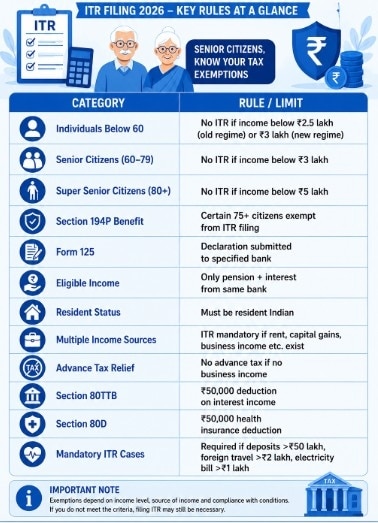
Individuals are generally not required to file ITR if their annual taxable income remains below the basic exemption limit.
For AY 2026-27:
Individuals below 60 years:
Old regime: ₹2.5 lakh
New regime: ₹3 lakh
Senior citizens (60–79 years):
₹3 lakh exemption limit
Super senior citizens (80 years and above):
₹5 lakh exemption limit under old regime
However, exemption from tax does not always mean exemption from filing ITR.
MUST READ: Investing in stocks? Don’t miss how GST can quietly raise your trading cost
What is Form 125?
Form 125, earlier known as Form 12BBA, is meant for certain resident senior citizens aged 75 years and above.
Under this facility:
Eligible individuals submit a declaration to their bank
The bank calculates taxable income
Applicable deductions and rebates are applied
Tax is deducted and deposited on behalf of the taxpayer
Once this process is completed, the individual is exempt from separately filing an income tax return.
Exemption under Section 194P?
The exemption applies only if all conditions are satisfied.
The individual must:
Be 75 years or older
Be a resident Indian
Have only pension income and interest income
Receive both pension and interest from the same specified bank
If income comes from any other source, the exemption does not apply.
This includes:
Rental income
Capital gains
Multiple bank deposits
Business income
Dividend income
Interest from different banks
Tax experts say many super senior citizens may still need to file returns because they often have multiple investments or income sources.
Are super senior citizens exempt from e-filing?
Eligible taxpayers under Section 194P can avoid filing ITR completely. Additionally, senior and super senior citizens who still need to file returns may choose paper filing instead of mandatory e-filing in certain eligible cases. However, online filing remains available for those comfortable with digital systems.
Advance Tax Relief
Another important benefit is that senior and super senior citizens without business or professional income are exempt from paying advance tax.
This means they are not liable for interest penalties under Sections 234B and 234C for non-payment of advance tax.
MUST READ: Tax alert: Credit card spending can invite notices — How to avoid penalties
Key deductions still available
Senior citizens opting for the old tax regime can continue claiming higher deductions, including:
Section 80TTB: Up to ₹50,000 deduction on interest income
Section 80D: Up to ₹50,000 deduction on health insurance premiums
Section 80DDB: Up to ₹1 lakh deduction for specified diseases
Important situations
Even if income is below exemption limits, ITR filing may still become mandatory in cases such as:
- Savings account deposits above ₹50 lakh
- Foreign travel spending above ₹2 lakh
- Electricity bill payments above ₹1 lakh annually
Tax experts say elderly taxpayers should carefully evaluate their income sources and eligibility conditions before assuming they are exempt from ITR filing under the latest rules.
MUST READ: Not just Rs 12 Lakh: How Rs 14.65 lakh salary can be tax-free from this year

