
Listen to this article in summarized format
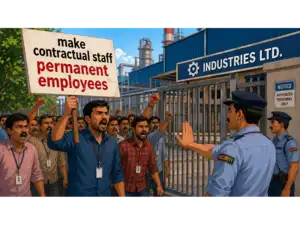
Recently, the Supreme Court of India ruled that if people hired through a contractor receive the same benefits and status as regular employees, it would basically endorse a completely arbitrary process. This is due to the lack of clear guidelines in any contract about how the contractor chooses or employs individuals, apart from the basic requirement of having relevant knowledge.
Income Tax Guide
Income Tax Union Budget FY 2026-27 LiveIncome Tax Slabs FY 2025-26Income Tax Calculator 2025
This point was raised during an appeal from a government corporation where its contractual employees wanted full pay parity with regular employees and wanted to be transitioned to full-time permanent positions.
The employees argued that they have been working for years doing the same work as the permanent employees and yet they get less salary than them. The government countered that this isn’t feasible since these contractual workers were hired through a contractor and not through competitive exams.
The contractual employees’ lawyer said in the Supreme Court that all they are asking for is some relief, as the minimum time pay scale for regular positions shouldn’t be seen as giving them (contractual employees) something that isn’t deserved or excessive.
Ultimately the contractual employees won the case in the Supreme Court but the court clarified that this judgement cannot be a precedent for other cases and can only apply to this unique case.
This means that contractual employees might not always become permanent employees depending on their specific circumstances.
Can contractual workers claim direct employment with the company after working with a contractor employed by the company for a long time?
Mayank Parashar, Legal Associate, Clasis Law explained to ET Wealth Online that contractual workers generally cannot claim direct employment or equal benefits simply by working for a long time through a contractor. Long service does not establish an automatic employer-employee relationship.
Parashar says: “The law is clear that length of service alone is not determinative. As held in the past, absorption or regularisation can be claimed only if the contract labour arrangement is proved to be a sham, camouflage, or a device to avoid statutory obligations.”
Parashar explains by using an example. For instance, when a factory in a remote locality engages a security agency through a transparent tender process and the agency recruits local personnel for reasons of cost efficiency and availability, the arrangement would ordinarily be bona fide.
If, upon expiry of the contract, a new contractor is appointed through a fresh tender and, for similar operational reasons, engages the same local personnel, such continuity by itself is not decisive; the court will assess, on the basis of evidence and settled legal tests, whether the arrangement is genuine or a device to evade statutory obligations.
Can continuation of the same workers under different contractors prove that the contract system is a sham?
According to Parashar, Indian courts have held that the same workers under different contractors prove that the contract system is a sham and merely a device to avoid statutory obligations.
Parashar says: “However, the mere continuation of the same set of workers under successive contractors does not, by itself, establish that the contract labour arrangement is a sham or camouflage. Practical and commercial realities must also be considered.”
Which factors determine whether a contractor arrangement is genuine or merely a sham or camouflage?
Parashar says that a contract labour arrangement can be treated as a sham in law when the written contract between the principal employer and the contractor does not reflect the real, de facto working relationship, and the actual control and supervision vest with the principal employer rather than the contractor.
However, as Parashar says, there is no straightjacket formula for determining the genuineness of a contractual arrangement. The determinative test has evolved through judicial precedents and is primarily centered on whether the contractor functions as an independent employer in substance, or is merely a name-lender acting as an intermediary to camouflage a direct employment relationship.
In assessing this aspect of sham or not, courts typically consider the following factors:
- Who has control & supervision
- Who has hiring & firing authority
- How payment of wages are done
- Test of independence of contractor via which contractual employees are employed
- What is the nature of work
- Continuity of workforce
- Integration with establishment
If the same workers continue under successive contractors, can the principal employer be treated as the real employer?
Parashar says that mere continuation of the same workers under successive contractors does not automatically make the principal employer the real employer. However, if such continuity is coupled with evidence for above discussed factors and the contractor lacks genuine independence, courts may treat the principal employer as the real employer in substance.

