
Listen to this article in summarized format
When the parents of two young adults noticed that their children were in love and doing well in school. they decided to marry them off, even though both were unemployed at that time. The parents figured that if the kids were as bright as they believed, they would eventually land a government job. So, on May 18, 2019, the marriage took place at Pachavali Road, Etawah.
Income Tax Guide
Income Tax Union Budget FY 2026-27 LiveIncome Tax Slabs FY 2025-26Income Tax Calculator 2025
Before they got married, both were preparing for competitive examinations. However, soon after the marriage, the girl secured a government job in the Allahabad High Court in the post of Additional Private Secretary, while, the boy despite being as good in studies, couldn’t secure a government job. To have a backup, he was also studying law on the side while preparing for competitive exams. In the end, he did not pass the exam, completed his LLB degree and got enrolled as an Advocate with the Bar Council of Uttar Pradesh.
Unfortunately, their marriage hit a rough patch when he claimed that after she got the government job in Allahabad High Court, she changed. He accused her of fighting and being disrespectful towards him and his mother, trying to cut him off from his family and even launching false criminal prosecution against him and his family members by influencing the police.
Things got worse when she began mocking him for being unemployed and even humiliated him in front of her colleagues at her work place. Eventually,she started filing FIRs based on made-up story against him, allegedly to ruin his career.
Ultimately, he could not survive any longer without a source of income and decided to take her to court, asking for maintenance money. He argued that he was maintaining himself by taking loans from his friends and relatives.
He claimed that he has to travel thousands of kilometers each month to attend court proceedings for various cases she had filed against him, and because of this, he has developed serious health issues like high blood pressure, sugar, high cholesterol, urinary problems, heart and kidney diseases.
To counter his allegations, her lawyer said before the high court that he comes from a political family and is a registered advocate with the Bar Council of Uttar Pradesh. She also told the court that he has started his legal practice before the Allahabad High Court as a junior for a senior advocate.
She further argued that his uncle was the a Member of Lok Sabha from Etawah constituency while his mother was a Gram Pradhan and his family also had a construction business. Therefore, she accused him of being a fraud, a compulsive liar and a greedy man who is also addicted to alcohol and other bad habits; she believes he seeks free money to support a debauched lifestyle.
To back up her claim, she cited an incident which took place on November 10, 2020. On that day, she says that he told her that he wanted to buy a plot of land and took a personal loan of Rs 11.5 lakh from her salary account. On October 6, 2022, he took another personal loan of Rs 13.56 lakh with an EMI of Rs 26,020 for a 6-year term) which was paid from her salary account.
This second loan was also taken for buying a plot of land, but he allegedly transferred all the money to his personal account though UPI and ultimately spent all the money on alcohol, a lavish lifestyle, and other questionable activities.
According to her version of the events, when she confronted him about this money, he initially dodged her questions and then started inflicting cruelty. The loan was taken on the pretense of buying a plot of land and when she insisted on visiting the plot, he became aggressive and subjected her to mental and physical cruelty.
Thereafter, he left her at her maternal home and stopped contacting her. After some days, she went to their rented house in Kalindipuram, Prayagraj and came to know that he had run away with all the household articles, jewellery and her Vitara Brezza car that she had bought with her own money.
She told the high court that when she asked him to return her car, he shamelessly demanded Rs 10 lakh from her. Upset with this, she lodged an FIR against him on March 7, 2024 (Case Crime No.0043 of 2024), under Sections 406, 506 IPC, at P.S. Cantt, Prayagraj.
In response to the FIR, he filed a Criminal Misc. Writ Petition No.4930 of 2024 with the prayer to quash the FIR. The court dismissed this petition with the observation that the FIR prima facie disclose commission of cognizable offense and the prayer to quash the FIR cannot be entertained.
Even after lodging an FIR, he refused to return the car, and she felt forced to file Criminal Misc. Writ Petition No.14344 of 2024 with the prayer to direct to the police to recover the vehicle registered in her name and hand it over to her. This petition was dismissed as ‘not pressed’ with the understanding that the matter would be settled out of the court in mediation proceedings.
Ultimately on May 20, 2025, he filed another case time asking for maintenance money from her. On September 15, 2025, the family court allowed his application under Section 24 of the Hindu Marriage Act, directing her to pay Rs 5,000 per month as an interim maintenance and Rs 10,000 towards litigation expenses.
Against this order she has filed a review application which is pending for adjudication before the learned Principal Judge, Family Court, Prayagraj.
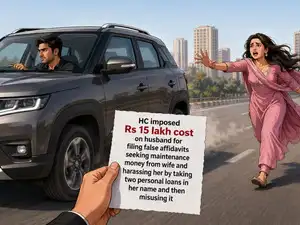
On April 23, 2026, the Allahabad High Court imposed Rs 15 lakh cost on him for filing false affidavits in his application under Section 144 BNSS seeking maintenance from her, as reported by Livelaw.
Allahabad High Court order
The high court observed that he had forced her to take two personal loans and then took the money for himself and claimed to be unemployed and then filed false affidavits before the Court regarding his income
The high court observed that economic abuse within marriage operates in insidious ways, through control over income, coercive appropriation of assets, and the gradual erosion of financial independence. The aggrieved spouse, often acting in good faith and with the expectation of marital stability, may tolerate such conduct until the harm becomes irreversible. In such circumstances, limiting compensatory costs to direct financial loss fails to capture the full extent of the injustice.
To help with the case, the high court had appointed an amicus who told the court that he (husband) is in a habit of filing false affidavits.
The court analysed his various affidavits which he filed in other cases and his income tax return (ITR), salary statements and observed that he had concealed his material income from the family court as well as the high court. It also observed that a petition to expedite was filed soon after filing the maintenance case.
The court also observed after speaking with her that she was mentally and physically abused by him. It noted that the maintenance proceedings had been stayed by another bench of the Allahabad High Court itself in a Transfer Application filed by the wife for transfer of case to Prayagraj.
The high court said that they are not a window shopping forum and he has approached them numerous times with incorrect and misleading facts and swearing false affidavits in support of the petitions and applications.
Thus the court said that his conduct in suppressing material facts and pursuing parallel remedies, while seeking equitable relief, disentitles him from any indulgence by the court.
The court said that she being a young professional woman, who, after qualifying for the competitive exam, secured a government job, and whose financial and personal resources have been systematically depleted by him, may initially endure such deprivation in the expectation that the marital relationship will eventually stabilize and fulfill its intended purpose of mutual support.
Allahabad High Court says: “However, where this expectation is frustrated, and the relationship instead becomes a vehicle for sustained economic and emotional exploitation, the law cannot remain indifferent.”
The high court said they must therefore move beyond viewing marriage as a private sphere insulated from rigorous legal scrutiny. Instead, they should recognize that power imbalances within marriage can give rise to legally cognizable harm. By expanding the scope of remedies to include compensatory and restitutionary elements, the law can better address the full spectrum of injury suffered by the aggrieved spouse. Such an evolution would not undermine the institution of marriage; rather, it would reinforce its foundational values by ensuring that it cannot be misused as a tool for exploitation.
Accordingly, dealing with the false affidavits filed by him and his harassment of her by taking loans against her salary and misusing the money, the Court imposed a cost of Rs 15 lakh on him, to be paid to the wife.
 aniltikotekar4sme.com