The Income Tax Department has launched a nationwide verification drive to check whether restaurants have under-reported sales after officials detected suspected billing manipulation through a software platform. The action follows a tax survey in Hyderabad and analysis of massive transaction data that reportedly revealed large-scale suppression of restaurant sales.
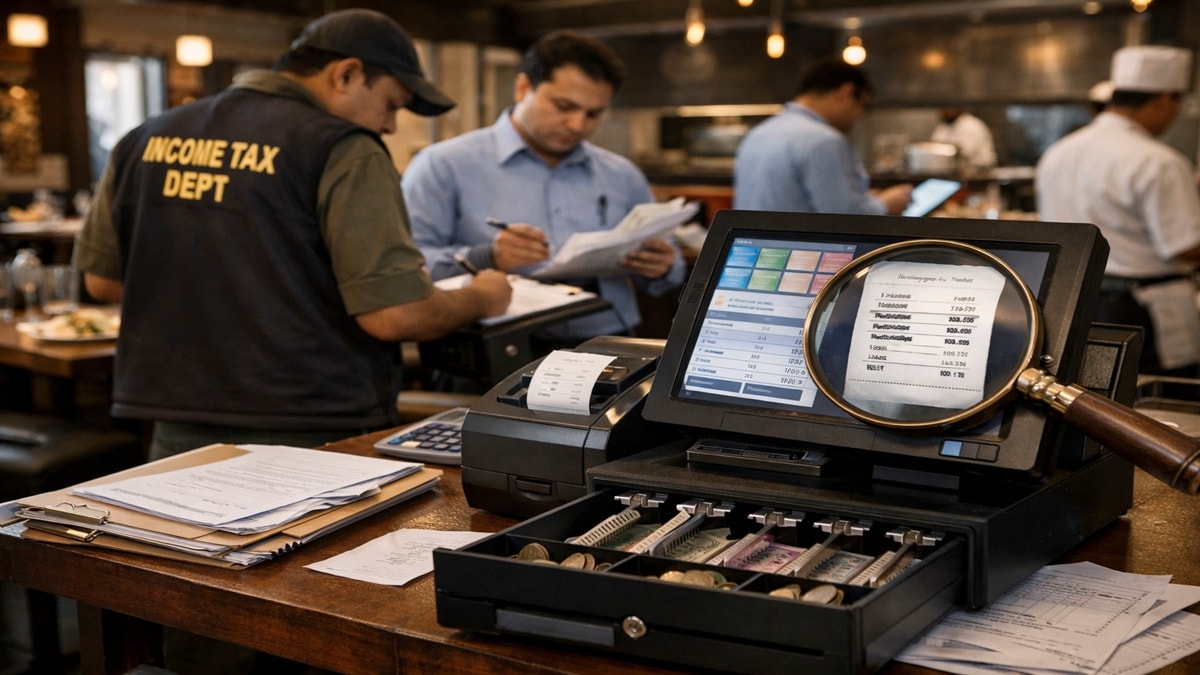 Income Tax Dept begins nationwide checks after probe finds software helping restaurants hide sales (AI-generated illustration for representational purposes)
The Income Tax Department has launched a pan-India verification drive targeting restaurants suspected of under-reporting sales, according to a report by CNBC-TV18.
The move comes after tax officials recently detected alleged manipulation of billing data that allowed some restaurants to suppress their actual sales and reduce tax liabilities.
Sources told CNBC-TV18 that the tax department has directed its field units across the country to carry out sample checks to identify cases where restaurants may have under-reported their revenue.
Verification drive to detect under-reported restaurant sales
According to the report, the Income Tax Department has initiated a nationwide verification exercise focused on the restaurant sector.
Field formations have been instructed to conduct sample verification checks to identify whether businesses are reporting their full sales figures in tax filings. The verification campaign is expected to be completed within the next fortnight, the report said.
Probe triggered by survey at Hyderabad software company
The nationwide exercise follows a tax survey conducted at a Hyderabad-based software company. During the survey, officials allegedly found that the company had developed billing software that enabled restaurants to under-report their sales.
Authorities have already taken action against some restaurants in Hyderabad and Jaipur that were reportedly using the software to manipulate their billing records, according to the report.
How billing software manipulation came to light
Media reports suggest that the investigation into the alleged tax evasion racket began with a probe into popular biryani chains in Hyderabad.
However, as the investigation progressed, tax officials reportedly uncovered a much larger nationwide network of suspected tax evasion in the restaurant and food industry.
Reports citing officials estimate that suppressed sales may have reached around Rs 70,000 crore since FY20.
AI and big data analysis used in the investigation
According to media reports, the tax department analysed around 60 terabytes of transaction data linked to a billing software platform used by over one lakh restaurants across India.
The software reportedly controls around 10% of the restaurant billing software market and contained data associated with 1.77 lakh restaurant IDs nationwide.
Investigators used advanced big data analytics and Artificial Intelligence tools, including Generative AI, at a digital forensic and analytics lab in Hyderabad to analyse billing records, GST numbers and transaction trails.
The data was reportedly accessed from the software provider’s data centre in Ahmedabad, according to media reports.
Selective deletion of cash bills flagged
Officials reportedly found several suspicious patterns in the data analysis.
One of the major red flags was the selective deletion of cash invoices from billing systems.
In some cases, restaurants allegedly retained only part of the cash transactions while deleting others, which reduced both income tax and GST liabilities.
Investigators also reportedly found instances where billing records for up to 30 days were deleted in bulk before tax returns were filed, leaving only a portion of the actual sales in official records.
Five states emerged as major hotspots
According to media reports, the investigation identified Tamil Nadu, Karnataka, Telangana, Maharashtra and Gujarat as the top states where suspected evasion was detected.
Among them, Karnataka reportedly saw deletions worth around Rs 2,000 crore, Telangana recorded about Rs 1,500 crore, and Tamil Nadu reported around Rs 1,200 crore. Out of the estimated Rs 70,000 crore suppressed turnover, about Rs 13,317 crore was linked specifically to post-billing deletions in the software, according to the reports.
 aniltikotekar4sme.com