
Listen to this article in summarized format
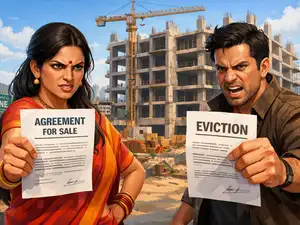
The Bombay High Court has ruled that a homebuyer cannot be evicted from his purchased apartment just because of claims of unpaid sale price under Section 6 of the Specific Relief Act. The builder had taken this case to court under a summary (quick) remedy provision under Section 6 of the Specific Relief Act to reclaim the apartment from the homebuyer, citing non-payment of the full amount. In its order dated February 13, 2026, the high court said this was not the right Section to file this type of case.
Income Tax Guide
Income Tax Union Budget FY 2026-27 LiveIncome Tax Slabs FY 2025-26Income Tax Calculator 2025
As a result of this legal mistake, the builder lost this case, but he can still file a new case to recover of possession based on the property’s title.
Background details of this Pune apartment bought in 2004 for Rs 3.55 lakh
The respondent, Mr Sarode, is a developer, who constructed a building on a land in Haveli talika of Pune district after acquiring development rights from the land owners.
Smt Babar (the applicant) had agreed to buy flat No.4 in the building and accordingly, a registered agreement for sale dated August 25, 2004 was executed between the Applicant (Babar, the homebuyer) and Respondent (Sarode, the builder) for purchase of flat no. 4 on the first floor of the building.
The flat measured 500 sq.ft. plus adjoining terrace of 40 sq.ft. and was sold for a total consideration of Rs 3.55 lakh excluding expenses for stamp duty, registration and electric connection. The charges for electricity connection were fixed at Rs 20,000.
Smt Babar (the homebuyer) claims she paid the builder (Sarode), several times during the construction of the building and even took out a loan from ICICI Bank. The builder (Sarode) also gave his NOC for a mortgage on the flat. So, Smt Babar claimed to have paid a total of Rs 4.23 lakh to Mr Sarode.
 |
|
Upgrade to ETPrime for expert insights & exclusive stories
Special Offer ends in 00 : 04 : 22


 1M+ Subscribers Trust ETPrime • 60k Joined Today
However, on December 10, 2004, a dispute arose between Smt Babar and Mr Sarode. On that date, she came to know from the Pune Municipal Corporation that Rs 46,000 was pending from her side due to extra work done in the flat. She thought that since she had paid the full amount of Rs 4.23 lakh, she should have received an occupancy certificate (OC) by the municipal authority.
So, on November 18, 2006 she filed a consumer complaint in the Pune consumer commission regarding the non grant of possession of flat no.4. According to the judgment of the Consumer Forum, Pune, the complaint was partly allowed and the builder was ordered to refund Rs 3,43,643 with an interest @ 9% per annum from August 1, 2004.
After losing the case in consumer commission, Sarode, the builder filed a new case in court (Special Civil Suit No. 1444/2009 in the Court of Civil Judge Senior Division, Pune). He claimed that the Agreement for sale was terminated on January 8, 2007. He also claimed that on June 2, 2009, he came to know that she (Smt Babar) had illegally entered the flat without his consent and started occupying it. So, he filed a police complaint on this date.
Sarode had filed this case under Section 6 of the Specific Relief Act for restoration of possession of the flat, for injunction, for recovery of compensation of Rs 1.15 lakh and for recovery of mesne profits and future compensation. Smt Babar countered this suit by filing a written statement.
The case filed by Sarode was subsequently renumbered as Regular Civil Suit No. 1261 of 2012 and on March 14, 2022, the trial court delivered its judgement on this matter. The Trial Court proceeded to decree the suit, ordering Smt Babar to restore possession of the flat within 3 months in Sarode’s favour and also prohibited her from creating any third-party rights in the flat.
Additionally, the trial court ordered her to pay a compensation of Rs 84,000 per year from the date of dispossession till the date of restoration of possession. However, the builder’s prayer for mesne profits was rejected.
Unhappy with the trial court’s judgment, Smt Babar filed a Revision Application in Bombay High Court. On 7 June 2022, the Bombay High Court recorded a statement made on behalf of Sarode about non-prosecution of the execution proceedings. This arrangement has been extended periodically and is still in effect today.
On February 13, 2026, Smt Babar won the case as the builder chose the wrong legal provision to file this case. However, the court clarified that he (Sarode, builder) is not barred from filing another case with the correct legal provision.
Why did the homebuyer win the case?
Prof. (Dr.) Rahela Khorakiwala, BITS Law School said to ET Wealth Online: The homebuyer won the case based on Section 6 of the Specific Relief Act, 1963 (SRA). Section 6 provides details for a summary suit for recovery of possession based on prior possession and dispossession.
Per the reading of the Bombay High Court, the remedy available under Section 6 is a special and summary remedy aimed at a definitive objective. Therefore, the Court proceeded to conduct a summary enquiry only in respect of following three areas:
- (i) Whether the plaintiff was in possession at the time of dispossession;
- (ii) Whether dispossession has occurred within 6 months prior to filing of the suit; and
- (iii) Whether dispossession is after following due process of law or with the consent of the
- plaintiff
The Court further held that if in addition to the grievance of loss of possession, plaintiff (in this case, the builder) wanted to pursue any other right or relief, he had to necessarily file a substantive suit, as grant of any additional remedy would be beyond the ambit of Section 6 of SRA. Therefore, no other relief other than restoration of possession can be sought in a Section 6 suit. The moment additional relief is sought in the suit, the same would travel beyond the ambit of Section 6 of SRA.
In the present case, the plaintiff had, apart from the relief of restoration of possession, had also prayed for an injunction (from creating third party rights), compensation including future compensation and mesne profits. Therefore, the very presence of such reliefs would preclude the suit from being qualified under Section 6 of the SRA as it travelled beyond the ambit of the same.
Moreover, since the plaintiff’s prayer for seeking recovery of possession was also based on his act of termination of the Agreement for Sale, the suit was not for restoration of possession only but rather premised on an assertion that the sale transaction did not fructify and that the Agreement for Sale was terminated.
Section 6 cannot be used as a tool to evict a purchaser over payment dues. It has a very specific purpose connected to forceful or unlawful possession/dispossession by the buyer.
Bombay High Court analysis and discussion
According to LawBeat, the Bombay High Court examined Section 6 of the Specific Relief Act and said that this Section tells that a special and summary remedy is intended only to restore possession of a property/asset to a person who has been dispossessed without consent and otherwise than in due course of law.
Thus, Bombay High Court said that for the purpose of Section 6 of the Specific Relief Act, the possession must contain an element of animus possidendi i.e., intention to possess. The high court held that occupation of a property by a caretaker, servant or agent, even for a long time would not elevate him to the status of possessor. Possession needs to be effective and undisputed.
The high court said that the case’s framing showed that Sarode (builder)’s primary contention was not about dispossession of the property but the alleged failure of the homebuyer to pay the remaining amount of money and so he wanted termination of the sale agreement for non-payment of dues.
The high court also said that Sarode’s other prayers namely injunction against creation of third-party rights, compensation for mental agony and loss of goodwill, and future mesne profits transformed the nature of the suit from beyond the scope of Section 6 of the Specific Relief Act which cannot give any relief other than restoration of possession.
The high court also observed from the contentions of both Sarode and Smt Babar and also from the trial court’s order that a detailed enquiry had in fact been conducted into payment of consideration and the validity of termination of the agreement for sale. The high court said that these issues can only be decided in a substantive civil suit.
The high court said that such an exercise is not allowed in a summary proceeding under Section 6 of the Specific Relief Act.
The high court said that it is difficult to hold that disputes relating to possession of a flat by the purchaser with the developer can be adjudicated under Section 6 of the Specific Relief Act.
The Bombay High Court said that this provision is aimed at merely discouraging recovery of possession without following due process of law. The provision is aimed at ensuring that the person desiring recovery of possession sets law into motion, files a suit and thereafter recovers the possession.
The high court said: “It discourages taking law into the hands by dispossessing the possessor unlawfully.”
Therefore, for maintaining a suit under Section 6 of the Act, the Plaintiff must be in some sort of settled possession of the property in question. The provision is not for settling the disputes between the developer and flat purchaser relating to possession.
The high court said: “If the transaction of sale is not complete and/or there are disputes relating to termination of agreement for sale and flat purchaser claims possession, the remedy for the developer is not to file a suit under Section 6 of the Specific Relief Act.”
The high court explained that this is because the nature of enquiry in such circumstances can never be summary. The Court adjudicating the disputes over possession relating to flat sold by developer is bound to conduct enquiry into the nature of transaction between the parties which enquiry is not envisaged under Section 6 of the Specific Relief Act.
The high court taking a note of the facts of the case said that in this case the dispute is over non-payment of an insignificant amount of Rs. 36,000 + Rs.10,000, which Sarode demanded fromSmt Babar via a letter dated December 10, 2004.
The high court said that under the Agreement for Sale, the agreed amount of consideration was Rs 3.55 lakh. According to the Plaintiff (builder), the total amount payable including all expenses was Rs 4.1 lakh.
The high court said: “Therefore, even if the story of Plaintiff is to be believed, it is an admitted position that Applicant-Defendant paid Rs 3,74,000 to the Plaintiff, which represents over 90% payment. Applicant-Defendant is a lady who is residing in the flat for the last 17 years even by going by Plaintiff’s theory of taking possession on 2 June 2009. Considering this position, in my view, grant of relief of restoration of possession of the suit flat to the developer in Section 6 suit was unwarranted.”
Thus the high court held that the trial court had acted with material irregularity in exercising jurisdiction and allowed the revision application, set aside the decree and dismissed the suit, while clarifying that the builder would be at liberty to institute a substantive suit for recovery of possession based on title.
Why disputes relating to possession of a flat by the purchaser with the developer cannot be adjudicated under Section 6 of the Specific Relief Act?
Khorakiwala from BITS Law School explains:
1) The enquiry is not “summary” in nature
The court held that the sine qua non for maintaining a suit under Section 6 of the Act is that the plaintiff must be in some sort of settled possession of the property in question. The provision is not for settling the disputes between the developer and flat purchaser relating to possession. If the transaction of sale is not complete and/or there are disputes relating to termination of agreement for sale and flat purchaser claims possession, the remedy for developer is not to file a suit under Section 6 of SRA. This is because the nature of enquiry in such circumstances can never be summary. The Court adjudicating the disputes over possession relating to flat sold by a developer is bound to conduct an enquiry into the nature of transaction between the parties which enquiry is not envisaged under Section 6.
The relationship between a builder-purchaser is contractual in nature, therefore, possession given under such a contract cannot be an illegal possession. The non-payment of dues (in this case) does not automatically convert a lawful possession (by contract) into a wrongful dispossession. Therefore, the summary remedy of Section 6 was not available.
2) Developer was not in ‘possession’ of the said Flat
Based on various judicial precedents the Court concluded that possession must contain an element of animus possidendi, i.e., intention to possess rather than just physical possession. Therefore, possession needs to be effective and undisputed. On the basis of the above, the Court was of the opinion that it would be difficult to countenance a situation where the developer is permitted to seek recovery of possession from the flat purchaser on the ground that he was forcibly dispossessed, without having followed due process of law. This constituted an additional ground for holding that the suit filed by the Respondent–Plaintiff (the builder in this case) was not maintainable under Section 6.
Khorakiwala says: “Section 6 protects possession; it does not resolve sale disputes. Builders must use title suits for payment defaults.”
Can the builder still file a substantive case for recovery of possession based on title?
Khorakiwala says: “Yes, the builder can file a substantive suit for recovery of possession based on title as permitted with the leave of the court, wherein complex questions of ownership, agreements, and rights would be examined comprehensively, and he would get all of his other claims and reliefs substantially adjudicated.”
Khorakiwala says that Section 6 (4) of SRA itself states that parties can file a suit based on title. Therefore, the dismissal of the suit under Section 6 does not bar the plaintiff (builder) from filing a regular civil suit.
 aniltikotekar4sme.com