Under Rule 162 of the Draft Income-tax Rules, 2026, if a person who has been allotted a PAN is required to intimate his Aadhaar number under section 262(6) but fails to do so, the PAN will become inoperative.
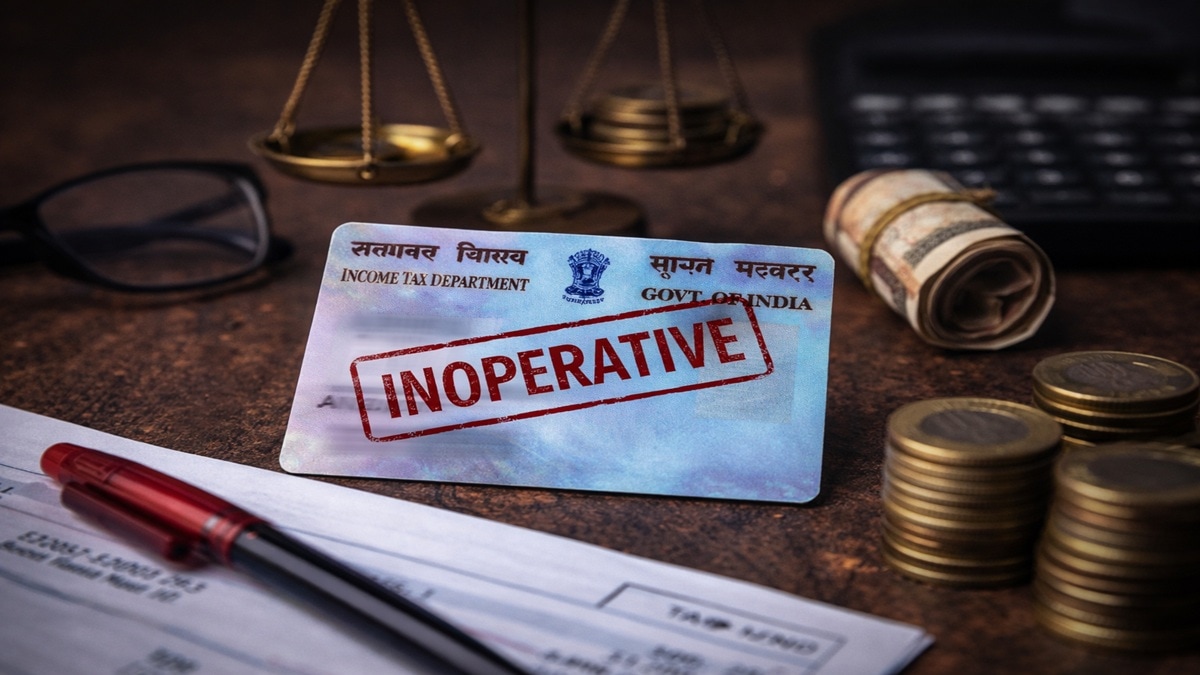 PAN inoperative? No tax refund, higher TDS – draft income tax rules spell out severe consequences (AI-generated image for representational purpose)
If you thought not linking your PAN with Aadhaar was just a technical lapse, the newly released Draft Income-tax Rules, 2026 make it clear — the consequences can directly hit your pocket. From blocked tax refunds to higher TDS, the draft rules clearly spell out what happens when your PAN becomes inoperative.
The draft rules, framed under the Income-tax Act, 2025, largely carry forward the existing framework but make the operational consequences more structured and explicit. For taxpayers, this means one thing: ignoring Aadhaar-PAN compliance is no longer risk-free.
What happens when PAN becomes inoperative?
Under Rule 162 of the Draft Income-tax Rules, 2026, if a person who has been allotted a PAN is required to intimate his Aadhaar number under section 262(6) but fails to do so, the PAN will become inoperative.
Once PAN becomes inoperative, three major consequences follow:
-No tax refund will be issued for the period during which PAN remains inoperative.
-No interest will be paid on such refund for that period.
-Higher TDS/TCS will apply, as tax will be deducted or collected at a higher rate in accordance with section 397(2).
This effectively means that even if excess tax has been deducted from your salary or income, the refund will not be processed until the PAN becomes operative again. And even after activation, you won’t get interest for the blocked period.
That makes the financial cost very real.
How can you reactivate an inoperative PAN?
The draft rules also clarify the revival process.
If a person later intimates his Aadhaar number after PAN has become inoperative, and pays the prescribed fee, the PAN shall become operative within 30 days from the date of intimation.
The draft rules also reiterate that a person who failed to intimate Aadhaar earlier is liable to pay a fee of Rs 1,000 at the time of subsequent intimation.
So practically speaking link your Aadhaar, pay Rs 1,000 fee and wait up to 30 days for PAN to become operative. Only then will refund processing and normal TDS rates resume.
Existing framework under the Income-tax Act, 1961
The concept of “inoperative PAN” is not entirely new. Under the earlier Income-tax Act, 1961 regime, PAN had to be linked with Aadhaar under section 139AA. Failure to do so resulted in PAN becoming inoperative after the notified deadline.
However, the Draft Income-tax Rules, 2026 bring greater procedural clarity by:
-Explicitly stating refund blockage
-Clearly denying interest on delayed refund
-Linking higher TDS consequence to the inoperative status
-Providing a defined 30-day activation window after compliance
While these consequences existed in substance earlier, the draft rules codify them in a more structured manner, leaving little room for ambiguity.
Higher TDS: Why it matters
One of the most serious consequences is higher TDS. When PAN is inoperative, tax deduction or collection at source will happen at a higher rate under section 397(2). This could mean – higher TDS on salary, higher TDS on interest income, higher TDS on professional payments, and higher TCS on specified transactions.
For salaried employees, this may reduce monthly take-home income. For professionals and freelancers, it can impact cash flow significantly.
PAN allotment now tightly integrated with Aadhaar
The draft rules also strengthen Aadhaar-based PAN issuance. Rule 158 provides that a person who has not been allotted PAN but possesses Aadhaar may apply for PAN by intimating Aadhaar. The Director General of Income-tax (Systems) will authenticate the Aadhaar number before allotment.
In short, Aadhaar is no longer just a supporting document — it is central to PAN issuance and operability.
The rules further empower the tax department to lay down formats, standards and procedures for secure authentication and transmission of Aadhaar data. This signals tighter digital integration between PAN and Aadhaar databases.
PAN mandatory for financial transactions
The draft rules continue to require PAN quoting for several financial transactions under Rule 159, such as credit card applications, opening demat accounts, and certain high-value bond investments.
If PAN becomes inoperative, compliance complications can arise in such transactions.
Limited relief for certain non-residents
Interestingly, the draft rules retain exemptions for certain non-residents.
Under Rule 157, specific categories of non-residents investing in specified funds may not be required to obtain PAN, subject to conditions.
This suggests that while compliance is tightened for residents, the government continues to ease entry norms for foreign investors in certain cases.
Why this matters for taxpayers
For many taxpayers, PAN linking felt like a one-time compliance formality. But the draft rules underline that an inoperative PAN directly affects refund eligibility, interest loss can add up over time, Higher TDS can impact liquidity
Reactivation is not automatic — fee and formal intimation are mandatory
In practical terms, even a small compliance delay can turn into a financial inconvenience.
The bigger picture
The Draft Income-tax Rules, 2026 are largely a continuation of the compliance framework under the earlier law, but they bring sharper clarity and stronger procedural backing to the Aadhaar-PAN linkage regime.
By explicitly detailing the consequences of inoperative PAN — no refund, no interest, higher TDS — the government appears to be sending a clear message: Aadhaar-PAN compliance is not optional.
For taxpayers, the takeaway is simple — check your PAN status. Because under the new draft rules, the cost of ignoring it could be more than just paperwork.
 aniltikotekar4sme.com