Does Section 247 of the new Income-tax Act, 2025 give tax officials unlimited powers to access emails and social media using AI? The government has clarified in Lok Sabha that the provision only mirrors earlier search and seizure powers under the 1961 Act and does not grant any new authority.
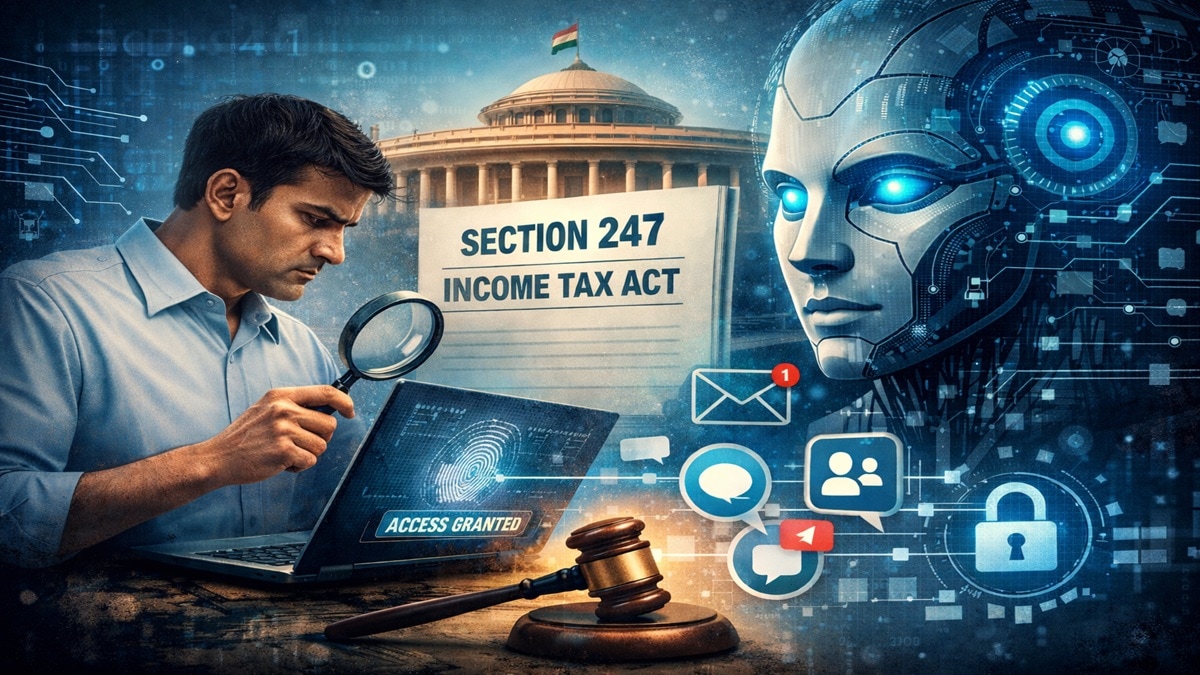 New Section 247 in Income Tax Act gives unlimited power to tax officials to access emails, social media using AI? Govt clarifies (AI-generated image)
The introduction of Section 247 in the new Income-tax Act, 2025 — set to take effect from April 1, 2026 — has once again sparked debate. Over the last several months, taxpayers and industry bodies have continuously been raising concerns that the provision gives “unlimited powers” to tax officials to access personal digital spaces of taxpayers, even as the government and the Income Tax Department have been refuting the claim.
The government has once again clarified in the Lok Sabha that these fears are misplaced and that no new sweeping powers have been granted under the new law.
The clarification came during the first leg of the Union Budget Session in response to a question on whether Section 247 creates confusion by allowing unrestricted access to digital space.
What was asked in Lok Sabha?
In an unstarred question in Parliament, MPs asked “whether it is a fact that the introduction of new Section 247 in the Income Tax Act to be effective from 1st April, 2026 has created a lot of confusion among taxpayers as it gives unlimited power to income tax officials to access digital space using Artificial Intelligence (AI)…”
Responding to the query, Minister of State for Finance Pankaj Chaudhary rejected the claim. He stated that Section 247 of the Income-tax Act, 2025 — which deals with search and seizure — is “in line with Section 132 of the Income-tax Act, 1961.”
He further clarified: “Even though power to override access code to any computer system was already available under section 132 of the Income-tax Act, 1961, specific enablement has been made for the same in the Act considering the evolution of digital space and rapid advances in technology.”
Importantly, the Minister also underlined: “There is no mention of Artificial Intelligence in the provision of section 247 or any related provision.”
The government concluded that Section 247 does not assign any new powers to income-tax authorities.
What exactly does Section 247 allow?
Section 247 deals with search and seizure powers. It allows authorised officers — such as Income Tax Officers, Assistant Directors and Assistant Commissioners — to conduct search operations if they have “reason to believe” that a person possesses undisclosed income, assets, books of accounts or relevant information.
The provision extends to digital records as well. It allows officials to inspect – electronic records, emails, data stored on devices, cloud-based information and other digital communications.
However, the key point is that these powers apply only during formally approved search operations. They do not apply to routine tax assessments, return processing or regular scrutiny cases.
Is this a new power?
According to the government, the answer is no.
Section 247 in the new Income-tax Act, 2025 is equivalent to Section 132 of the Income-tax Act, 1961. The power to override access codes and inspect digital systems already existed under the previous law.
The Finance Ministry clarified that the new law only makes this explicit in view of the evolution of digital space and technological changes. It does not introduce fresh or unlimited authority.
Why did confusion arise?
This is not the first time concerns have surfaced. Last year too, social media posts claimed that tax officials would get sweeping authority to access personal emails and social media accounts from April 1, 2026.
The government had then clarified that Section 247 does not give general or routine access to taxpayers’ digital platforms.
In its pre-Budget memorandum, ICAI had also flagged concerns that the provision, in its present form, could potentially infringe on the fundamental right to privacy. The institute suggested that access should be restricted to official email accounts instead of all electronic communications.
These apprehensions appear to have resurfaced in Parliament.
Does Section 247 mention AI?
One of the key claims was that the law empowers officials to use Artificial Intelligence to monitor or access digital space.
The government has categorically stated that there is no mention of Artificial Intelligence in Section 247 or any related provision.
Therefore, the allegation that tax officers will use AI tools to routinely scan or access personal digital accounts has no legal basis under the provision.
What taxpayers should understand
-Section 247 deals strictly with search and seizure proceedings.
-It mirrors the earlier Section 132 of the 1961 Act.
-Digital access is allowed only during authorised search operations.
-It does not apply to normal tax filing, scrutiny or routine compliance.
-There is no specific AI-based monitoring power mentioned in the law.
While privacy concerns continue to be debated in policy circles, the government’s official position is clear: Section 247 does not grant unlimited or new powers to income-tax authorities.
With the new Income-tax Act, 2025 coming into force from April 1, 2026, more clarifications and detailed rules are expected to further streamline implementation and address stakeholder concerns.
 aniltikotekar4sme.com