
Listen to this article in summarized format
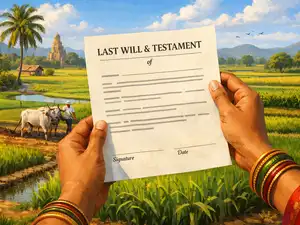
A Will needs witnesses, but it doesn’t have to be officially registered. However, if the witness turns hostile, claiming they know nothing about it or changing their story, then the will won’t hold up in court.
Income Tax Guide
Income Tax Union Budget FY 2026-27 LiveIncome Tax Slabs FY 2025-26Income Tax Calculator 2025
This actually happened in a recent Supreme Court case. A mother made a will, but the only witness denied any knowledge about the will, leading to the Will’s failure. Because of this, the Supreme Court ruled that her property would be passed on according to natural succession laws.
This article explains what happens if a will fails the test in court.
Also read: SC dismisses property inheritance case as key witness disowns will, orders natural Hindu succession to apply after mother’s death
What happens if all witnesses to a will turn hostile?
Divi Dutta, Partner at Khaitan & Co, said to ET Wealth Online: “When all attesting witnesses to a will deny its execution, the will cannot be said to have been proved in the manner required by law.”
According to Dutta, Section 63(c) of the Indian Succession Act, 1925 (ISA) says that a will must be attested by at least two witnesses, each of whom must have either seen the testator sign the will or received a personal acknowledgment of the testator’s signature, and each witness must sign the will in the presence of the testator.
Also read: SC urges women without sons, daughters, husbands to make will to avoid litigation
Dutta emphasizes: “Compliance with this requirement is mandatory, and mere existence of a signed document is insufficient.”
Dutta also mentions that evidentiary requirements for proving attested documents are outlined in Section 67 of the Bharatiya Sakshya Adhiniyam, 2023.
Dutta adds that if all the available attesting witnesses either deny signing or claim they know nothing about the Will’s execution, then this legal requirement is not met.
Even though Section 70 of the BSA allows the court to consider other evidence in certain situations, when an attesting witness can’t prove execution, Dutta points out that this provision is only enabling in can’t be used to completely bypass the need for proof of execution.
Dutta says: “If execution itself is denied by all witnesses, the will necessarily fails for want of proof.”
Also read: Son challenges late father’s Will giving property to aunt and late grandmother; wins case in HC as court allows Will forgery probe to continue
How succession is determined when will fails at the stage of proof
According to Dutta, once a will fails at the stage of proof, it is treated as non-existent in the eyes of law, irrespective of its contents or the intention of the testator.
Dutta says: “The estate of the deceased is then required to be devolved by intestate succession, as if no will had been executed.”
Succession in such cases is determined in accordance with the Hindu Succession Act (HSA).
According to Dutta, if the deceased was a Hindu female, succession is governed by Sections 15 and 16 of the HSA, which lay down the order of heirs and the manner of distribution. Section 15(1) of the HAS provides that the property of a female Hindu dying intestate shall devolve, firstly, upon her sons and daughters and the husband, and thereafter upon other heirs in a statutorily prescribed order.
Dutta says: “If the deceased was a Hindu male, succession would instead be governed by Sections 8 and 10 of the HSA, under which the property devolves primarily upon the Class I heirs.”
Accordingly, where all attesting witnesses deny execution and the Will is held to be unproved, the testamentary scheme collapses entirely, and the property devolves strictly in accordance with the statutory rules of intestate succession under the HSA.
Dutta says: “In such circumstances, the courts give effect not to the expressed intent in the Will, but to the mandatory legislative scheme of inheritance, underscoring the central importance of proper execution and proof of Wills under Indian law.”
What happens in the case of Hindu female?
According to Dutta, when a Will executed by a Hindu female is held to be not proved in accordance with law, the testamentary disposition fails and the estate of the deceased devolves by intestate succession under the Hindu Succession Act, 1956, as if no Will had been executed.
Succession to the property of a Hindu female dying intestate is governed by Sections 15 and 16 of the Hindu Succession Act, 1956 (“HSA”). Section 15(1) of the HSA provides:
“The property of a female Hindu dying intestate shall devolve according to the rules set out in section 16,—
(a) firstly, upon the sons and daughters (including the children of any pre-deceased son or daughter) and the husband;
(b) secondly, upon the heirs of the husband;
(c) thirdly, upon the mother and father;
(d) fourthly, upon the heirs of the father; and
(e) lastly, upon the heirs of the mother.”
 aniltikotekar4sme.com