On January 5, 2026 the Bombay High Court observed that a grand-daughter cannot claim rights in a property once her mother and aunt, both legal heirs, have accepted a family property settlement deal and sold the property to new owners. Thus court held that the grand-daughter, has no legal title or interest and therefore could not be added as a decree holder in the new owner’s execution proceedings for tenant eviction.
This judgement arose from her plea to be added as a decree holder in the execution case filed by the property’s new owners, who had already obtained a tenant eviction order and were seeking possession of the property from unwilling tenants and sub-tenants.
Summary of the judgement
Apurva Agarwal, Founder, Universal Legal, Mumbai, said to ET Wealth Online: “The property originally belonged to Dinkar Balkrishna Vaidya and was leased to tenants in the late 1940s.”
Agarwal says that the property later became subject to mortgage litigation. A final mortgage decree was passed, and in 1957 the property was sold through court auction in execution of that decree, with the Court Nazir purchasing it on behalf of the decree-holder. A sale certificate was issued and possession was taken through court, crystallising ownership through judicial process.
Agarwal says that over the years, eviction proceedings were pursued against tenants. After Dinkar Vaidya’s death, the estate was dealt with through court-recognised family arrangements, under which the property was segregated among three family branches. The portion concerned with the eviction decree fell to one specific branch, which alone pursued execution. Through subsequent lawful transfers, rights in that portion came to Mohini Resort.
According to Agarwal, the granddaughter sought to be impleaded in the execution proceedings, claiming an inherited interest and arguing that partition had not been final.
Agarwal says: “The Bombay High Court rejected this plea, holding that the family segregation had been accepted decades earlier, that the concerned branch was already represented, and that an execution court cannot reopen settled title or partition issues. As she showed no direct nexus to the decree being executed, her impleadment was refused.”
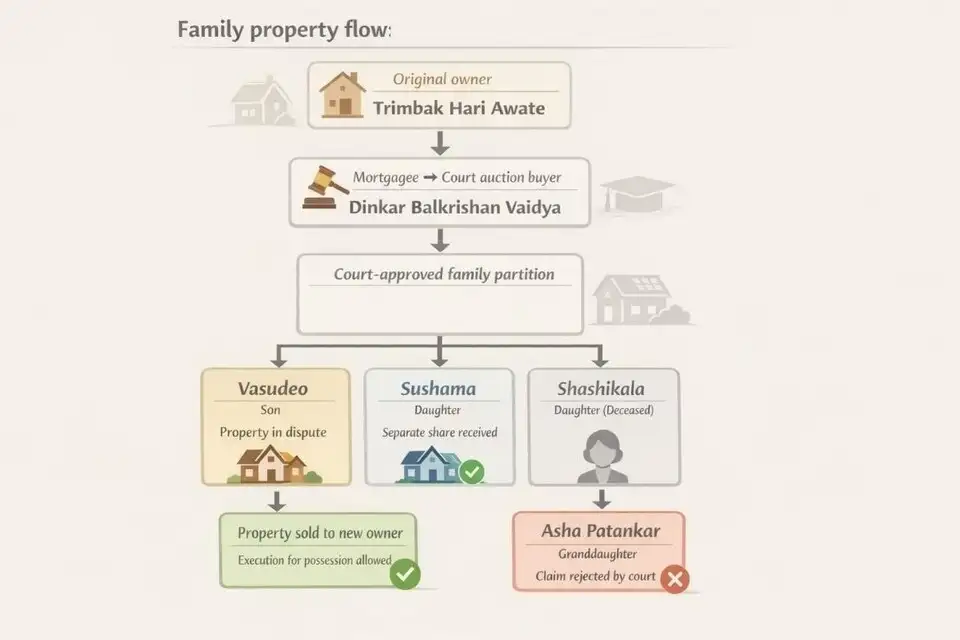
An overview of the property and the family tree
The entire historical timeline of the property follows the judgement of the Bombay High Court dated January 5, 2026.
- March 24, 1947: Mr. Trimbak Hari Awate was the owner of a land and premises standing thereon in Shivaji Nagar, Bhamburda, Pune. He had mortgaged the property by a registered mortgage deed to Mr Dinkar Balkrishna Vaidya.
- July 7, 1948: Mr Awate leased a part of the said property to Mr Shankar Godaji Gore for a term of 25 years by a lease deed.
- July 13, 1948: The son of Mr Trimbak Hari Awate, namely Mr Shankar Trimbak Awate, leased the balance portion of the property to Mr Shankar Godaji Gore for a term of 99 years but the lease deed was registered only on July 14, 1979 that is after 31 years.
- December 12, 1948: Mr. Shankar Godaji Gore, the original lessee of the property, further sub-let the property to Mr Sardar Biwalkar, by way further lease deed which was in turn sub-let to Smt Sulochana Thakur and Smt Sarde.
- November 7, 1949: It is seen that same portion of the property was sub-letted by Mr Shankar Godaji Gore to Smt Sulochana Thakur and Smt Sarde (sub-tenants) who constructed structures on it and sub-let it further to Mr Sardar Biwalkar by a lease deed.
- December 27, 1948 saw the first sub-tenant agreement and on November 7, 1949, the sub-tenancy agreement deepened further. But all these were executed by the tenants and not the owner of the property.
- July 16, 1949: The original owner of the property Mr Trimbak Hari Awate passed away, leaving behind his Will.
- 1952: Mr Dinkar Balkrishna Vaidya (the mortgagee) filed a case before the civil judge, Pune against the executor of Mr Trimbak Hari Awate’s will and testament for recovery of the amount due to him under the Mortgage Deed dated March 24, 1947. The tenants Shankar Godaji Gore and sub-tenants Mr. Biwalkar, Smt. Thakur and Smt. Sarde were also impleaded as parties to the suit.
- January 31, 1953: A preliminary decree was passed in the mortgage case referred to above in favour of Mr Dinkar Balkrishna Vaidya. However, Mr Dinkar Balkrishna Vaidya was declared lunatic under the Lunacy Act in another case (Miscellaneous Application No.363 of 1953) and the Nazir of the District Court was appointed as his Guardian.
- June 26, 1955: The Nazir of the District Court, Pune acting as the Guardian of Mr Dinkar Balkrishna Vaidya, obtained a final decree and seeking execution of the said final decree, filed another case (Special Darkhast No.291 of 1965) wherein the Executing Court auctioned the property held as mortgaged property.
In the said auction, the Nazir of the District Court, Pune on behalf of the Decree Holder as his Guardian, gave the highest bid and purchased the said property.
- December 19, 1957: This sale as referred to above was duly confirmed by the District Court and Sale certificate was issued in the name of Nazir of the District Court, Pune for and on behalf of Dinkar Balkrishna Vaidya. Possession of the said property was taken over by the Nazir of the District Court, Pune through the Court.
However, since the property was occupied by tenants and sub-tenants namely Shankar Godaji Gore, Smt. Thakur and Smt. Sarde, the Nazir of the District Court, Pune for and on behalf of Dinkar Balkrishna Vaidya, filed two court cases against the tenants and the subtenants in the Court of Small Causes, Pune for possession and recovery of rent being (Civil Suit Nos.1139 of 1965 and 1142 of 1965).
- November 5 and 27 of 1968: Both the cases were decreed by the Court of Small Causes, Pune for possession and arrears of rent on November 5 and 27 of 1968 respectively. The tenants / sub-tenants filed separate Appeals in the Court of District Judge, Pune.
- July 31, 1972: The Appeal filed by Sardar Biwalkar was allowed to be withdrawn unconditionally. However, the Appeal filed by the subtenants Smt. Thakur and Smt. Sarde was allowed on July 31, 1972 and the decree passed by the Small Causes Court (Special Civil Suit No.1142 of 1965) was set aside.
The order of Appeal Court was challenged in Bombay High Court by the Nazir of the District Court, Pune on behalf of Dinkar Balkrishna Vaidya by filing a case (Civil Application No.242 of 1973).
- September 11, 1973: Mr Dinkar Balkrishna Vaidya expired and his legal heirs and representatives were brought on record. The Special Civil Application filed by the Nazir of the District Court, Pune on behalf of Dinkar Balkrishna Vaidya and later on prosecuted by his legal heirs and representatives was allowed by Bombay High Court on July 15, 1980 and the judgement and decree of Civil Court in Appeal was set aside while confirming and upholding the decree of possession passed by the Small Causes Court.
Source: ET Online
History of the property settlement
The Bombay High Court said that the records show that Dinkar Balkrishna Vaidya’s wife had predeceased him and he was survived by two sons namely Narayan and Vasudeo and two daughters, Shashikala Patankar and Sushama Bapat.
The record further shows that Narayan, the eldest son of Mr Dinkar Balkrishan Vaidya, was missing since February 9, 1973 and under the law was deemed to have died after seven years. One of the daughters, namely Shashikala Patankar expired on December 25, 1973 leaving behind two daughters — Asha Patankar and Veena Patankar and son Amar.
The Bombay High Court said that the Respondent No.2 in the present Writ Petition is Asha Patankar, daughter of Shashikala. Record further shows that Sushama Bapat, the other daughter of Dinkar Balkrishna Vaidya, was entitled to 1/12th undivided share in the entire estate owned and belonging to late Dinkar Balkrishna Vaidya of which she has already taken the possession as per arrangement agreed before the District Court.
The Bombay High Court said that in this background, the entitlement of three children of Shashikala Patankar, who were grandchildren of Dinkar Balkrishna Vaidya, to 1/12th undivided share in the estate of late Dinkar Balkrishna Vaidya remained.
The property changed hands and subsequently, a resort company was the new owner of the property and they filed and won tenant eviction proceedings. The resort company then filed the execution case of the tenant eviction order and Smt Asha filed another case in Bombay High Court, asking to be included as a party to this execution case.
Bombay High Court analysis and discussion
The Bombay High Court in its judgement (2026:BHC-AS:14) said that on the face of record there are three things which prima facie come to the fore.
- Firstly, admittedly in the Application filed by Respondent No.2 (Smt Asha, grand-daughter) she herself has fairly stated that she has been recipient of two plots of land under the family arrangement before the District Court, but it is argued before me that her branch has received only one property from the Nazir of the District Court. This will however be a separate cause of action.
- Secondly, it is seen that the Decree which has been executed by Petitioner (resort) before the Executing Court is obtained by virtue of transaction with Vasudeo Vaidya and therefore there is no direct nexus whatsoever of Shashikala Patankar (mother of Respondent No.2, grand-daughter)) or any other branch with respect to the same.
- Thirdly it is seen that right, title and interest of Respondent No.2 (Smt. Asha, granddaughter) was duly represented by her father Sadashiv Patankar before the District Court when the joint family arrangement was worked out and allowed by order dated May 27, 1982 and the Suit property came to the share of Vasudeo.
Therefore in view of the aforesaid three prima facie issues which are the undisputed nexus of the Respondent No.2 (Smt. Asha) with the Suit property in Execution proceedings and Suit filed by Petitioner(resort) is not established at all, said Bombay High Court.
The high court also said that it is prima facie seen that the joint family arrangement is not disputed by Respondent No.2 (Smt. Asha) as also by the learned Trial Court.
The Bombay High Court said:“ It is seen that right, title and interest of Sushama Bapat and Shashikala Patankar both daughters of Dinkar Balkrishan Vaidya (grand-father) who were duly represented were determined before the District Court and in so far as right of the Petitioner (resort) is concerned, it flows from the transactional Agreement with Vasudeo Vaidya only which was decreed.”
Granddaughter alleged property partition did not happen fairly
The Bombay High Court said that though it is vaguely submitted that partition by metes and bounds did not take place, the family arrangement which was agreed to by the three surviving branches of Dinkar Balkrishna Vaidya have been duly fructified as per their wishes and Application and appropriate order has been passed by the learned Trial Court.
The Bombay High Court said: “Once this is the position, the Executing Court cannot go beyond that decree which is settled law. The locus standi of Asha Patankar (granddaughter) who is the daughter of Shashikala Patankar (mother) to claim right, title and entitlement in the property which was allotted to the branch of Vasudeo Vaidya is not established at all.”
The Bombay High Court said that once segregation of rights has taken place in the presence of the Court and with mutual consent under the orders of the Court, it is the will of the parties which prevails and therefore the submission advanced on behalf of Asha Patankar that partition did not take place by metes and bounds cannot be accepted by the Court as a ground for Respondent No.2’s (Asha) intervention in the lis between Petitioner and legal heirs of Vasudeo.
Granddaughter’s parents enjoyed the property for 40 years
The Bombay High Court said that the parties have enjoyed the properties and share in the estate coming to their share for a long period of time during which the parties namely Respondent No.2 (Smt Asha) did not take objection whatsoever.
The Bombay High Court said that it can be seen that judgement and decree which has been passed in favour of Dinkar Balkrishna Vaidya (grand-father) has been confirmed right up to the Supreme Court pursuant to which in Execution proceedings, the three branches namely Vasudeo Vaidya, Sushama Bapat and Shashikala Patankar were duly represented before the Court and in the said Execution proceedings, the three branches themselves on their own volition accepted the properties according to their applications coming to their respective shares accordingly.
The Bombay High Court said that in fact this is a case where both the daughters namely Sushama Bapat and Shashikala Patankar (represented by her husband and natural Guardian of children) on their own volition and Application made before the District Court accepted the properties according to their choice and after receiving and enjoying the said properties for over a period of more than four decades.
The Bombay High Court said that at this stage an Application is filed by Asha Patankar (respondent no. 2) to add her as a Decree Holder in the lis between Petitioner and Vasudeo cannot be permitted.
The Bombay High Court said: “The right in the subject property which is the subject matter of Execution belongs to the branch of Vasudeo Vaidya who is the brother of Shashikala Patankar and therefore Respondent No.2 (Smt. Asha) has no right, title or interest therein.”
Judgement: “In view of the above observations and findings, the impugned order dated 07.06.2017 passed by the learned Judge, Small Causes Court, Pune below Exhibit-295 in Darkhast No.1032 of 1980 is clearly unsustainable in law. The same is therefore quashed and set aside. 17. Writ Petition stands allowed in terms of prayer clause (a). 18. No costs. 19. Writ Petition is allowed and disposed.”
History of the eviction case and subsequent execution case
According to facts reproduced by Bombay High Court, Vasudeo had made an Application to the District Court, Pune to deliver possession of the estate to him. The District Court informed Vasudeo that all legal heirs should jointly submit Application determining their shares in the estate.
Accordingly Vasudeo (son), Ms. Sushama Bapat (daughter) and children of Shashikala Patanakar namely Asha, Veena and Amar through their Guardian Sadashiv Patankar (her husband) submitted Application determining their respective shares in the estate of late Dinkar Balkrishna Vaidya to the District Court.
In the said Application which was filed, the daughter (Sushama Bapat) sought relief that all movables / ornaments in the custody of the Nazir of the District Court, Pune be delivered to her in lieu of her share in the entire estate.
On behalf of Shashikala Patankar namely Asha, Veena and Amar through their father and natural Guardian namely Sadashiv Patankar (husband of Shashikala) prayed for certain immovable properties as and by way of their share in the estate of the grandfather.
Vasudeo’s application was for the balance of immovable properties. After considering the Application filed, Vasudeo Sushama and children of Shashikala, the District Court passed an appropriate order allowing the joint Application and granting the estate to Sushama Bapat, legal heirs of Sashikala Patnakar and Vasudeo.
Vasudeo expired on April 1, 1981 before possession of the balance estate was delivered to him. Sushama Bapat was the only legal heir and representative of late Dinkar Balkrishna Vaidya. Record shows that pursuant to the Agreement arrived at between the parties earlier the Nazir of the District Court, Pune acted upon the order and delivered the shares in the properties to the three branches.
It is further seen that three years prior to the demise of Vasudeo, Vasudeo by Visar Pavati dated July 12, 1978 had agreed to sell some part and portion of the said estate which was in his possession and which was allotted to him as his share for a price of Rs 1 lakh and pursuant to the same executed Agreement for Sale dated March 9, 1981 just prior to his demise.
However, Vasudeo Dinkar Vaidya died intestate on April 1, 1981 leaving behind him his sister Sushama Bapat as his only legal heir. Petitioner represented by Mr. Kanhaiyalal Motilal Talera, the purchaser of the said premises reminded Sushama Bapat about the Agreement for Sale and called upon her to apply for necessary permission for transfer the Suit premises and execute the conveyance of the said premises to him.
The Bombay High Court said that however Sushama Bapat did not take any steps forcing Mr Kanhaiyalal Motilal Talera to file a suit for specific performance of the Agreement for Sale dated March 9, 1981 in the Court of Civil Judge, Pune against Smt. Sushama Bapat (Daughter of Dinkar Balkrishna Vaidya) and the Nazir of the District Court, Pune (Manager of the estate of Dinkar Balkrishna Vaidya).
The Bombay High Court said that the record shows that the said Civil Suit No.487 of 1981 was compromised and Defendant No.1 in the said Suit namely Sushama Bapat entered into a registered sale deed with M/s. Mohini Resorts Private Limited (Petitioner herein been the nominee of Mr. Kanhaiyalal Motilal Talera) and Sale Deed was executed between the parties with Mr Kanhaiyalal Motilal Talera being the consenting party.
By virtue of the Sale Deed, right to file execution proceedings and continuing the execution proceedings against the sub-tenants of the said property with respect to enforcing the decree passed by the Small Causes Court Suit Nos.1139 of 1965 and 1142 of 1965 which was upheld by Bombay High Court was given to the Petitioner (Mohini Resorts).
Subsequently respondent no. 2 (Smt Asha) filed a case before the Executing Court alleging that when Special Civil Suit No.487 of 1981 (sale of property to the resort) was compromised by her aunt Sushama Bapat and Nazir of the District Court, Pune at that time, in view of the family arrangement which was arrived at between Vasudeo Vaidya, Sushama Bapat and children of Shashikala Patankar (including the Petitioner- resort herein) through their father and natural Guardian Sadashiv Patankar, the Nazir of the District Court, Pune made an Application seeking deletion of the names of Asha Nagarkar, Veena Patankar and Amar Patankar from the Darkhast proceedings.
The Bombay High Court said that it is stated that this Application filed by Nazir of the District Court, Pune in Darkhast proceeding was allowed by the District Court on September 15, 1982 and accordingly the names of the legal heirs of Shashikala Patankar were deleted.
The Bombay High Court said: “This order is still in subsistence and not challenged by any party.’
The Bombay High Court said that accordingly in view of the above proceedings, Petitioner namely Mohini Resorts filed Application in Darkhast proceeding namely No.1032 of 1980 in the Small Causes Court seeking appropriate relief and then took steps to execute the decrees and file further Application wherein common order in the aforesaid two Applications directing impleadment of the Decree Holder and issuance of possession warrant under Order XXI Rule 35 of the Code of Civil Procedure, 1908.
The property is still occupied by several occupants unauthorisedly who repeatedly filed various proceedings to stall execution and the possession warrant. In the above background, Respondent No.2 (Asha Patankar) through her CA being daughter of Shashikala Patankar filed Application in the aforesaid pending Darkhast proceedings being prosecuted by the Petitioner (resort).
 aniltikotekar4sme.com