Clipped from: https://www.business-standard.com/economy/news/what-lies-ahead-for-the-india-efta-trade-deal-124050701177_1.html
India’s interest in trade and economic partnership with EFTA countries stems from the expertise of affluent member-nations in precision technology, and India’s appetite for foreign direct investment
)
ILLUSTRATION: AJAY MOHANTY
Minutes before India and the European Free Trade Association (EFTA) countries signed a free trade agreement (FTA), on March 10, there was the ceremonial gift exchange between Swiss state secretary for economic affairs, Helene Budliger Artieda, who led the negotiations for EFTA, and India’s trade minister, Piyush Goyal. Artieda presented Goyal with a candid picture showing their first meeting on the sidelines of the G20 in Bali in 2022.
Impressed with the wrapping of the framed picture, Goyal quipped, “We should get the packaging technology also to India.”
Click here to follow our WhatsApp channel
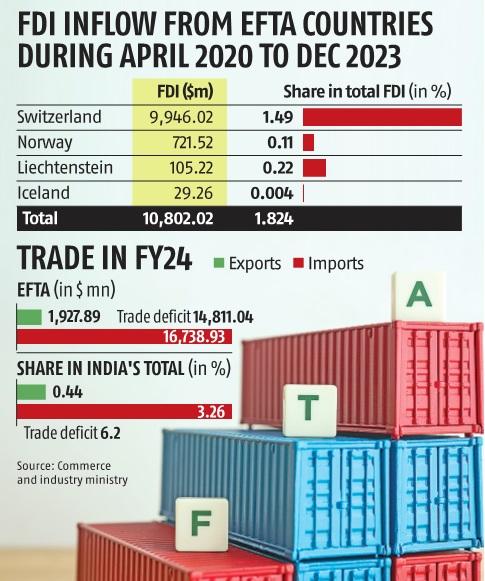
On the face of it, the Trade and Economic Partnership Agreement (TEPA) with the EFTA countries makes little sense. EFTA includes Switzerland, Iceland, Norway, and Liechtenstein, with a combined population of 15 million. The export potential is negligible ($1.9 billion exports in 2023-24).
But the expertise of these affluent nations, especially Switzerland, in precision technology and India’s hunger for foreign direct investment tipped the scales in favour of the agreement.
Balancing the deal
India was keen to include easier immigration rules for Indians to EFTA countries in return for market access to its 1.4 billion people to make the deal balanced. However, migration is a sensitive issue in countries such as Switzerland, with the cantons (states) having exclusive right to negotiate labour-related matters.
“The idea of the investment package came because the Indian side said balancing of market access could be done by giving access to Indian skilled professionals to EFTA countries. We are small countries and can’t just open our labour markets to Indians. So, it was an unbalanced deal, and the investment package was brought about to balance the deal. The investment package was a Swiss proposition that flew and not from the Indian side,” an EFTA negotiator said, requesting anonymity.
The text of the agreement says the EFTA bloc “shall aim to increase” FDI inflows into India by $50 billion within the first 10 years and an additional $50 billion in the next five. Though it is not legally binding, the deal says India can partially withdraw market access to EFTA countries after a lengthy consultation if the investments do not flow in.
There is no mechanism, however, to earmark which EFTA country will invest how much in India. “Money invested by the state funds can be counted in the $100 billion, but there is no commitment to promote such investment. If you look at the text, we commit to promote and not commit to invest,” a second EFTA official said.
Though the wider understanding was that only private sector investments, and not investments by sovereign wealth funds, will be part of the $100 billion bouquet, the second official clarified that is not true. “We don’t commit to promoting investments from sovereign wealth funds. But if money comes from such funds like Norway’s Government Pension Fund Global, the world’s largest sovereign wealth fund, we can count it in the $100 billion bouquet. This is the nuance,” he added.
Trade economist Biswajit Dhar says EFTA countries are not a major source of FDI for India, with cumulatively inflows of only $10 billion from 2000 to 2022. “Normally trade flows increase from the partner country, it creates a market, and then the companies of the partner country find it better to come and invest here, rather than exporting from their home country. It is called the product cycle theory. Switzerland is not a significant trade partner. So, what will this investment come for? FDI inflows into India have dipped, and it seems there is real desperation on the government’s part to show some action on that front,” he adds.
Red-carpet welcome
For the investments to flow in, India must roll out the red carpet for EFTA investors. India has committed to create an EFTA desk in India, roadshows, and to set up Invest India offices in some EFTA countries.
Switzerland and India have also started exploring negotiations for a bilateral investment treaty (BIT). However, India’s insistence on under the model BIT text for the partner country to exhaust domestic judicial or administrative remedies in five years before starting investor-state arbitration is considered too lengthy a process by most developed economies. “We don’t have a problem with the fact that we have to first exhaust the national mechanism if those mechanisms are working. Either the five-year period should be shorter or there should be an extremely efficient justice system that expedites such cases,” a third EFTA official said.
The second official said: “It will be good to have an investment treaty because some investments from EFTA come to India through Mauritius, Singapore to have that investment protection. If we want to know how much we are really investing in India, it will be good to have a direct way of doing that investment. However, BIT is not a precondition for investment into India. But it will inspire confidence in India.”
However, the biggest hurdle for the FTA to come in force is pending ratifications by the four EFTA countries, especially Switzerland. Before both houses of the Swiss Parliament ratify the deal, the TEPA has to go through a process of public consultation involving cantons, civil society, and business communities. An association of citizens, or a political party, can ask for a referendum during the public consultation if they could collect 50,000 signatures.
After EFTA and Indonesia signed an FTA in 2018, a Swiss non-government organisation, Public Eye, highlighted deforestation in Indonesia for palm tree cultivation as well as death of orangutans. (Public Eye was recently in the news as it claimed that Nestle’s products including in India, Africa, and Latin American markets contained significantly higher sugar levels than those in Europe). These concerns triggered a nationwide referendum in Switzerland, which the government managed to win by 51 per cent votes. However, the referendum delayed the implementation of the FTA until late 2021.
The question is, could something like that happen in the case of India?
Labour market
“The cantons may not oppose because the only topic that bothers them in an FTA is access to the labour market, where we have not given major concessions to India. The civil society might get critical on sustainability and human rights. That’s why we have a consultative mechanism in the form of a sustainability sub-committee on sustainability in the TEPA,” the third official said.
The second official said: “If part of the population feels something is wrong with India, as was the case with Indonesia, you may have a referendum. But I think Swiss people are really fond of India. They have positive images in their mind when they think about India. We don’t find the Indonesian palm oil equivalent for India.”
The third official said the public consultation for the TEPA was expected to happen by autumn, because the Swiss government wanted to go to the first chamber of Parliament in the autumn session so they can go to the other chamber in the winter session. “If everything runs smoothly, we might have the agreement at the beginning of 2025,” he added. However, the first official cautioned that it was also the job of the Indian embassy in Bern to have a conversation with the Swiss people, and not a confrontation. “The more confrontational India is, the more confrontational the reaction will be. It is also how the Ministry of External Affairs communicates to the world.”
 aniltikotekar4sme.com