Biden will be in India from September 7 to 10, and his bilateral meeting with Modi is scheduled for the second day of his visit
)
G20
Listen to This Article
During his New Delhi visit to attend the G20 Leaders’ Summit later this week, US President Joe Biden might discuss with Prime Minister Narendra Modi the issue of India’s import restrictions on laptops and other electronic products, people aware of the matter said.
Biden will be in India from September 7 to 10, and his bilateral meeting with Modi is scheduled for the second day of his visit.
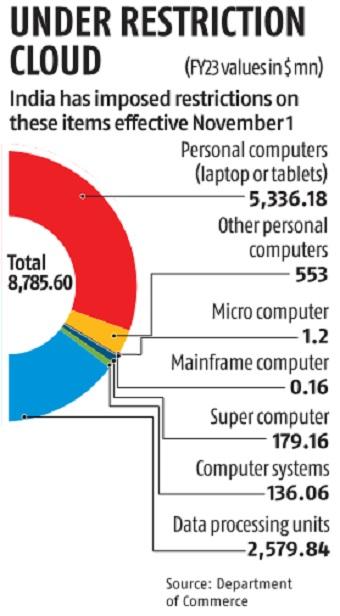
India had last month cited ‘security risks to citizens’ as the main reason for its decision to impose import restrictions on several electronic items, including laptops, tablets, personal computers, and servers, from November 1.
Curbing Chinese imports and pushing local manufacturing could also be among reasons.
United States Trade Representative Katherine Tai, too, had last month raised this issue with Commerce and Industry Minister Piyush Goyal during the G20 Trade and Investment Ministerial. She had said stakeholders needed an opportunity to review and provide inputs to make sure that the policy, if implemented, did not have an adverse impact on US exports to India.
While imports of IT hardware products from the US have a relatively small share compared to India’s imports from the rest of the world, a lion’s share of these imports comes from China. However, major American personal computer and server makers, such as Apple, Dell, HP, and Cisco, are concerned because they serve the Indian market via a large manufacturing base in China and Southeast Asian countries.
Also Read
Biden falls onstage at graduation ceremony; White House says he’s ‘fine’
Laptop import curbs lift EMS stocks but analysts warn of jumping the gun
Dixon Tech, Optiemus, HCL Info rally 8-9% on laptops, tablets import curbs
G20 Summit: Delhi police’s advisory; check restrictions, routes, and more
As India gears up to host G20 Summit in New Delhi, here’s what’s on agenda
Rising power demand in India exposes supply fault lines in states
7th NAM summit took place in 1983 without self-serving publicity : Cong
A first: Hyderabad-based pvt sector firm Grene Robotics unveils Indrajaal
Key govt functionaries visit G20 sites to take stock of preparedness
Interoperability of DPIs likely to be ‘long-term goal’ for G20 summit
Over the past few decades, tech companies have developed complex and interwoven global supply chains.
While the US remains the leader in the design and innovation for the information and communications technology (ICT) sector, manufacturing is largely outsourced to companies operating in China.
For perspective, consider Foxconn, the largest manufacturing partner of global IT hardware companies. Nearly 99 per of its workforce, which grew from 47,000 in 2004 to 1.1 million in 2014, was based in mainland China.
Even as the US administration has been assessing the critical ICT supply chains to reduce its reliance on China, it wants the transition to be smooth. India, on the other hand, has assured the industry that it will make the process of import licensing smooth for companies.
Industry representatives have urged the government to reconsider the new import policy. “Companies from Apple to Dell and HP and beyond are manufacturing in India and want to do more. But those things can’t happen overnight,” said Jason Oxman, president and chief executive of the Information Technology Industry (ITI), a global trade association for the technology sector.
“We need to partner with the Government of India to make sure the tech industry can continue to provide innovative products and services to Indian citizens while still advancing the manufacturing capabilities in India,” Oxman told Business Standard.
Last month, eight industry bodies, including ITI, the Consumer Technology Association and National Association of Manufacturers, wrote to Tai and US Secretary of Commerce Gina Raimondo, expressing concerns over India’s reliability as a trade and supply chain partner.
“This policy, announced with no prior notice or public consultation, could significantly disrupt trade, hamper efforts to more closely integrate India into global supply chains, and harm business and consumers in both countries. We urge you to raise this issue as a matter of urgency in your engagements with the Indian government, and take steps to ensure that any measures taken by India in this area are consistent with its international commitments,” the letter read.
A copy of this letter was also sent to US Secretary of State Anthony Blinken.
 aniltikotekar4sme.com