The sophistication that ECL is asking for is much more ahead and advanced compared to usual scoring models
)
Illustration: Ajay Mohanty
In January, the Reserve Bank of India (RBI) issued a discussion paper on the expected loss-based approach for loan loss provisioning. Once the framework is implemented, banks’ capital requirement will increase due rise in provisioning requirements.
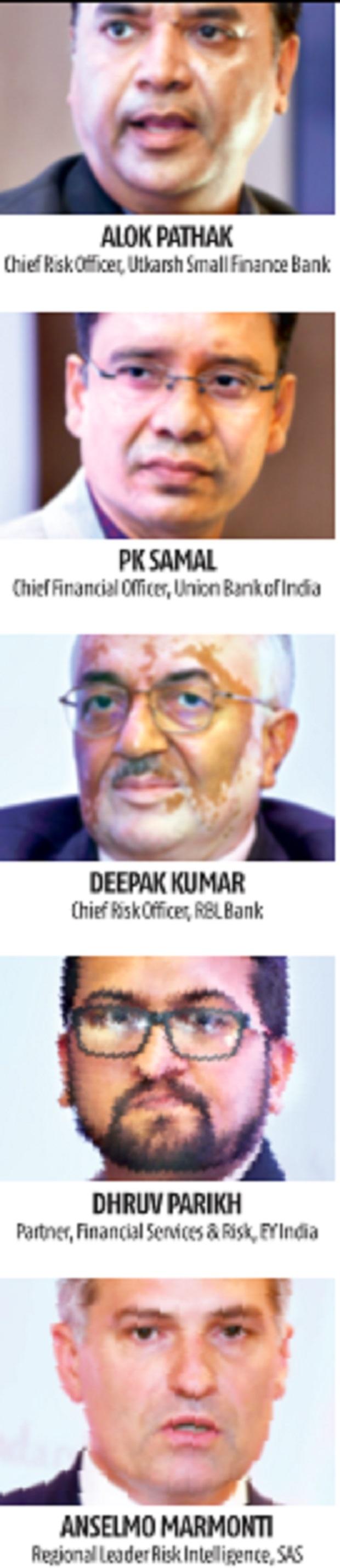
Alok Pathak, chief risk officer (CRO) at Utkarsh Small Finance Bank; PK Samal, chief financial officer (CFO) at Union Bank of India, Deepak Kumar, CRO at RBL Bank, Dhruv Parikh, partner, financial services & risk at EY India, and Anselmo Marmonti, regional leader risk intelligence at SAS discussed the challenges for Indian banks in a panel discussion on IFRS 9 – Implications for Indian banks moderated by Manojit Saha. Edited excerpts:
What are the challenges small finance banks may face while trying to implement the expected credit loss (ECL) model?
Pathak: The main challenge we have seen is the data. RBI allows banks to do their own homework, do their own analysis, create their own model, and then come to a conclusion.
In terms of overall provisioning, there is a difference. You can’t deny that the difference between the Indian GAAP (Generally Accepted Accounting Principles) and the ECL will be there. In the case of the Indian GAAP, people are talking more about the actual loss. And here we are talking more about the 30 DPDs (days past due). That is a major difference.
The regulator is very clear, they have given a lot of opportunities to banks, and when you are creating a model you should be clear about your assumptions.
A small bank, because suddenly, (with) that kind of information, now they have to collect and they have to work it out. So maybe they will take some lookalike data, or maybe we’ll take some proxy scenarios. We have to make a model based on that information.
Union Bank is one of the larger public sector banks in the country. From that point of view, what could be the key challenges that you will confront going ahead in implementing the ECL framework?
Samal: There are two aspects, one is the impact on capital, Common Equity Tier-1 capital, and what kind of additional provision banks will require.
The other thing is the quality of data that the bank was having and the sufficient past records, past behaviour of the loans.
The third most important point was whether the banks were having the appropriate technology. Putting across everything with a probabilistic model and technology has to play a greater role, so you have to have an appropriate model.
With respect to the stress book or the capital position, banks have improved a lot. The capital position has improved, profitability has improved. The stress book specifically the Special Mention Account (SMA)-2 assets are below 1 per cent. Most of the banks have already recognised everything and they have around 90 per cent provision coverage ratio.
In terms of absorbing the additional provisioning requirement, the banks are in a quite comfortable position
RBL Bank has been on a very high growth path. How do you see the bank’s transition to the IFRS 9, given that kind of growth?
Kumar: The provision increase in ECL needs to be covered through product pricing. Because that is the only way we can cover provisions. Otherwise, I will be eating into capital which will increase the bank’s vulnerability. In pricing, there are three basic components, cost of funds, cost of operations, and third is provision.
For a smaller bank, the cost of funds is usually higher. Smaller banks will have to offer higher rates which increases the cost of funds. With limited manpower and dependence on outsourced activities, cost of operations is also high.
The practical challenges that I am seeing are how to manage losses, provisions, and what will be the direction of banking business in the coming days with these types of increased provisions. To some extent, these issues are still prevailing in the system, but probably that is going to be aggravated in coming times.
Mr Parikh advises banks on several key aspects. How has your interaction been with the banks?
Parikh: It is important to recognise that Indian banks, generally, are not starting from zero. Secondly, we need to also keep in mind that IFRS 9 as guidelines has been implemented globally, so a lot of the banks who have international operations have experienced it in some form.
I think from an implementation perspective, there are four key elements that any bank will have to look at or are looking at. One is data, which is number one priority. The second element which I think people are concerned about is developing the models themselves.
From a strategy perspective, I think banks are relooking at their pricing strategy, looking at how they need to rebalance the portfolios if they need to, looking at what kind of collateral coverage they will need to get in. And then finally, how are they going to optimise their ECL, and eventually the capital? I think these are some perspectives that they need to bring in or think about as they make this transition. It is going to be an interesting journey, but some of these elements they need to focus on.
What is your perspective on the challenges ahead?
Marmonti: The sophistication that ECL is asking for is much more ahead and advanced compared to usual scoring models, meaning that now we are looking for, again, a long-term probability of default. So we need to do an evaluation of a lifetime loan which means if we are having the portfolio for 30 years, we need to consider that type of length or that type of maturity. So it’s an entirely different type of complexity that we need to consider.
 aniltikotekar4sme.com