SynopsisNarain was appointed vice-chairman in non-executive category on the NSE’s board from April 2013 and remained so till June 2017. Over the last 10 years, NSE’s revenues increased 18% to Rs 6,202 crore and its net profit grew 22% annually to Rs 3,573 crore. When Ramkrishna was CEO between 2013 and 2016, revenues increased 29%.
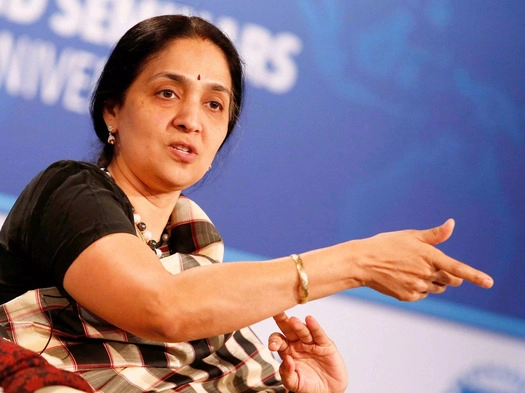
Chitra Ramkrishna, also known as queen of the bourses, rose to a leadership role on the National Stock Exchange through careful mentoring by her bosses, as is necessary in a male-dominated world of stocks and bonds.
A Bloomberg profile of Ramkrishna from 2015 commented that there were just three women running stock exchanges around the world.
‘Ramkrishna, an upper-caste Brahmin who calls Mahatma Gandhi her role model, wants to make stock markets accessible to India’s middle classes using the exchange-traded baskets of securities known as ETFs. “I’m sure even he would have bought my ETFs!” she said’, says the profile.
Bloomberg defines Ramkrishna as the woman who bested a 140-year-old exchange, as the National Stock Exchange, which she headed, became the world’s third- largest bourse by number of trades and the leader in India with an 82 per cent market share that dwarfed the 140-year-old Bombay Stock Exchange, or BSE.
A good start
S S Nadkarni of the state-run IDBI or Industrial Development Bank of India hand-picked Ramkrishna while she was working there to build a professionally-run stock exchange in contrast to the Bombay Stock Exchange.
Ramkrishna was working at IDBI after earning degrees in commerce and accountancy in Mumbai, where she was brought up after being born in Chennai. In 1992, she and four other technocrats were selected to join a team to build the first nationwide bourse. Ramkrishna was the only woman, picked because of her experience at IDBI in the 1980s working on a blueprint for a national regulatory agency that led to the creation of the Securities and Exchange Board of India or Sebi, the agency, irnonically, now probing her.
The NSE team was mandated to develop technology to move trading from open-outcry to electronic, untested in India at the time. They were going up against a Goliath, the Bombay Stock Exchange, that had been entrenched since its creation in 1875.
“People were really sceptical about us when we started,” Ramkrishna told Bloomberg. “It gave us enormous freedom, there were no expectations. We were able to question a lot of existing paradigms. We could even be irreverent about it.”
They worked out of a tiny, leased office in a part of central Mumbai known for its defunct textile mills. The average age of the team was 25 — only because its leader, R.H. Patil, was around 60 at the time and used to joke that he skewed the average upward, Ramkrishna recalled. They all worked intensely with a start-up mindset, and they had a blast, she said, “a party every evening.”
Investors, freshly bruised by India’s worst-ever stocks scam, were receptive to change. In 1992, a rogue trader, Harshad Mehta, had funneled money borrowed from banks into equities on the BSE, pushing up stock prices and earning the moniker “Big Bull.”
NSE’s new screen-based trading started in 1994. Using a satellite, it displayed stock prices that could be accessed simultaneously at brokerages nationwide.
“We kept crossing our fingers on many days, but the good news is that when we switched it on, it worked!” said Ramkrishna.
Handpicked again
The NSE introduced refundable membership for brokers, replacing BSE’s earlier system of auctioning broker permits that restricted the number of participants and trading volumes. Antiquated “badla” contracts, an indigenous system using credit for stock purchases, were substituted with more sophisticated futures and options. Nearly 60% of NSE’s broking membership in the early days came from cities other than Mumbai.
Ramkrishna spent many years working under Ravi Narain, who took over from Nadkarni. She regarded Narain as mentor and friend.
Sugata Ghosh, writing in The Times of India this week, describes Narain as wary, calculating and a consummate networker. “On a long rope from bureaucrats and the finance ministry, Ramkrishna and Narain ran the largest bourse, the NSE, with absolute control – crushing rivals, stifling dissent and influencing policies of the market regulator Sebi. A near-monopoly with overflowing coffers, NSE, a closely-held company, positioned itself as a national public institution that was virtually beyond reproach”, writes Ghosh.
Ramkrishna took over from Narain as MD and CEO of NSE in April 2013. She was the second-highest paid executive in the financial services industry in FY16, before she quit. Her salary that year was second only to Aditya Puri’s, then managing director of HDFC Bank, who took home Rs 9.7 crore, and almost three times that of BSE CEO Ashishkumar Chauhan, who earned Rs 3.3 crore.
Narain was appointed vice-chairman in non-executive category on the NSE’s board from April 2013 and remained so till June 2017. Over the last 10 years, NSE’s revenues increased 18% to Rs 6,202 crore and its net profit grew 22% annually to Rs 3,573 crore. When Ramkrishna was CEO between 2013 and 2016, revenues increased 29%.
Strong numbers, though, don’t take away the unravelling of the story of one of India’s most successful women in finance. One, who despite having a good head on her shoulders, tuned to a mysterious yogi for advice, sharing confidential bourse information with him, and implementing whatever he wanted in appointments, and other matters.
The unravelling
A Singapore-based whistle-blower alleged in 2015 that a Delhi-based member on the NSE was able to access privileged price information by linking to servers and getting access to least crowded servers. This later came to be known as the co-location scam where select traders were allegedly given preferential access to data and trading systems through the co-location facility at the exchange.
A technical advisory committee appointed by Sebi had found some evidence that the NSE was favouring a few traders over others. Questions then began to be asked about Ramkrishna’s corporate governance practices, such as appointing as senior consultant one Anand Subramanian, whose remuneration rose steadily even though he was not part of the executive management team.
Ramkrishna made this key appointment – Subramanian’s – on the yogi’s advice, it is now known, besides allocating a corner cabin to the new appointee and giving him travel rights of first-class air tickets, as well as salary raises. It is these aspects of her reign that are now under scrutiny.
The continuous correspondence that Ramkrishna maintained with the yogi on crucial NSE matters has stunned the world of finance. The yogi received details of NSE’s financials and business plan, and had the last word on the appraisal of employees.
(Originally published on Feb 17, 2022, 02:43 PM IST)
Share the joy of reading! Gift this story to your friends & peers with a personalized message. Gift Now
 aniltikotekar4sme.com