SynopsisEconomists and top company officials said this could lead to a permanent shift in the labour workforce market as the pandemic made companies realise the uncertainty and risk of heavy reliance on migrants.
Mumbai: Covid-19 seems to have led to a shift in the talent landscape of Indian manufacturers with several of them now replacing migrant workforce with local people.
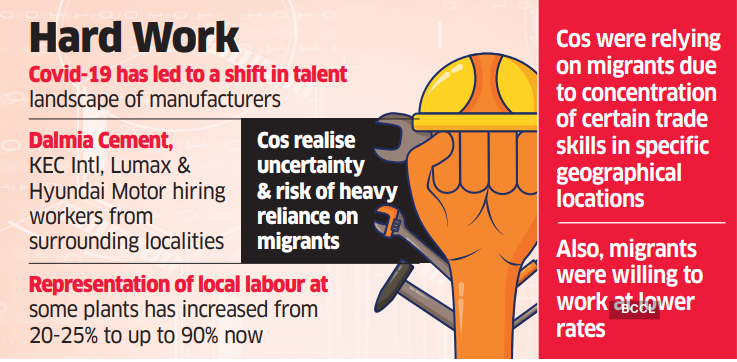
Dalmia Cement, KEC International, Lumax and Hyundai Motor have all seen a significant increase in intake of workers from surrounding localities in recent times after a major chunk of their migrant workers left for their homes after the imposition of the national lockdown to tackle the pandemic last year.
Economists and top company officials said this could lead to a permanent shift in the labour workforce market as the pandemic made companies realise the uncertainty and risk of heavy reliance on migrants.
Dalmia Cement has hired large batches of people in local areas in Maharashtra, Bengal, Orissa and other places and started skilling them. The representation of local labour in some of its plants has increased from 20-25% in pre-Covid times to 90-95% now.
“In our new Murli plant (in Maharashtra) we got an opportunity to replace outside people and hired batches of people in local areas and started skilling them,” said Ajit Menon, group human resources head at Dalmia Bharat Group. “In our Bengal plant, we have 90-95% local workers now versus 20-25% earlier, while in Orissa it is almost 100% local labour,” he said.
“Covid has accelerated the intake of local workforce… This has also given us the opportunity to give employment to people in the locations neighbouring our factories – many of whom are tribals and are from underprivileged communities,” Menon said.
KEC International, a part of RPG group, has stepped up local hiring across work sites and factories in Nagpur, Halol, Jaipur, Mysore and Jabalpur – with the local workers representation rising to up to 50% in its plants from 20% earlier.
“Our local talent engagement has gone up significantly,” said Somraj Roy, CHRO of KEC International. “From a business continuity perspective, leveraging of local talent has really helped the company. It ensures that the talent pipeline is continuous.”
Deepak Jain, managing director of auto components maker Lumax, said, “We have been aggressively hiring locals. They are mostly from villages within 50-100 km from our plants.” Lumax has factories in 33 locations across India.
A Mahindra spokesperson said: “There was a need based increase in local hiring of workers in the plants at the time of resuming operations. We are now seeing a return to stability with most of the people back to work.”
Hyundai Motor India senior VP, people strategy and business support, Stephen Sudhakar said contractor organisations are responsible for maintaining service levels and headcount. “Currently the mix of workers has been optimised to ensure convenience by sourcing from surrounding areas,” he said.
Companies have been relying on migrant labourers due to the concentration of certain trade skills in specific geographical locations as well as their willingness to work at lower rates.
Most of the supply of the country’s migrant workforce comes from rural hinterlands of Orissa, Bihar, Jharkhand, West Bengal, and Northeastern states. A lot of this labour comes at a cheaper cost than local workers due to the lack of jobs in these places.
However, a combination of factors, led by the impact of the pandemic, is prompting companies to hire more locals.
Many migrants are still not willing to come back as their employers are not able to give them the assurance that what happened nine months ago will not happen again, said Madan Sabnavis, chief economist at Care Ratings.
While many of the larger companies have resumed production at pre-pandemic levels, for thousands of manufacturers in small and medium enterprises segment, the future is still uncertain.
 aniltikotekar4sme.com