SynopsisWork from home may be the new normal for much of India Inc, but a bunch of companies, mostly startups, have brought 70-100% of their employees back to office, driven by declining Covid-19 cases and the need to interact face-to-face.
Kolkata | Bengaluru: Work from home may be the new normal for much of India Inc, but a bunch of companies, mostly startups, have brought 70-100% of their employees back to office, driven by declining Covid-19 cases and the need to interact face to face.
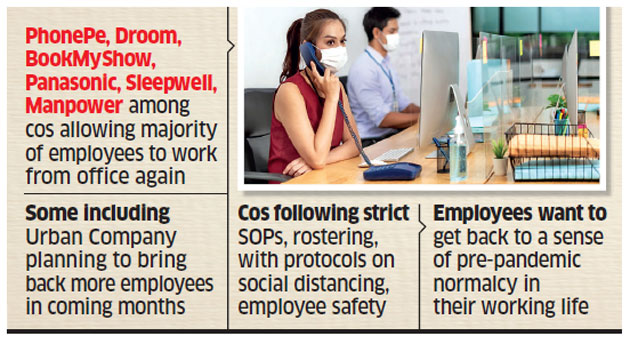
PhonePe, Droom, BookmyShow, Panasonic, Sleepwell, and Manpower are allowing a majority of their employees to work from office again, albeit with strict rostering and social distancing measures in place, while some others like Urban Company plan to bring back everyone by March.
Across sectors, companies are increasingly contemplating bringing more people back to office with the Covid-19 vaccine drive gathering steam and new infections dropping, industry insiders said.
“There is definitely a greater sense of confidence, but there is also a massive need within employees to get back to a sense of pre-pandemic normalcy in their working life,” said Anandorup Ghose, partner at Deloitte India.
Companies attributed their decision to bring most employees back to office to a combination of factors, including employees getting tired of prolonged work from home, letting people interact and ideate face-to-face, and increased confidence given declining Covid-19 cases across the country.
All of them said they are following strict standard operational protocols (SOPs) with ‘safety bubbles’, clear protocols on social distancing, employee safety, and actions in case of identification of a Covid-19 case.
PhonePe has had its workforce formally return to work effective December; with a rostering system that translates to about 30% of employees being in office on any given day.
“We are just making sure everyone has some facetime in the office,” said Manmeet Sandhu, chief people officer of the Bengaluru-based online payment app. “This option allowed small groups to engage in conversations, work on new ideas and connect back with the organisation. As more people began to come in, others saw the value and the benefit and this slowly became the norm,” she said.
Online used vehicle marketplace Droom – one of the first companies in the country to opt for WFH initially – said it started out with 50% employees in November, which has been upped to 100% this month.
About 30% of the firm’s employees had begun working there during the pandemic and had been working virtually throughout, and they needed to be integrated with the company culture, Droom CEO Sandeep Aggarwal said. Also, the campus is large enough to ensure adequate distancing, he said.
Entertainment ticket booking platform Bookmyshow HR head Shamita Ghosh said it has had 70% of its employees resume work at office, twice a week, on a rotational basis since mid-January.
“We were getting feedback from employees wanting to return to office, meet colleagues and collaborate once again in the office space. A return to some form of pre-covid normalcy of collaborating and working together in a common space was something that most employees missed tremendously,” said Ghosh.
Similarly, at ManpowerGroup India, about 70% of the staff is back with flexi-timings and rostering. “The need to be in a professional atmosphere coupled with the infrastructure conducive to enhanced productivity backed by the assurance of a safe working environment have been the cause of people resuming work,” said Sandeep Gulati, managing director of staffing solutions firm.
Vishal Ratanghayra, CEO of real estate developer Platinum Corp, said that while almost 100% of the workforce has returned, they are encouraging teams to step in on alternate day basis.
Deloitte’s Ghose said organisations that need to maintain a large ongoing customer facing facility like branches or hotels, or having manufacturing facilities, had their operating staff back at workplace by June while their corporate office staff were still working from home. “Now there is a greater realisation that this difference is not sustainable and therefore the corporate staff are also coming back,” he said.
Panasonic India started with 10% of the workforce in its corporate office, primarily senior management, coming in, which was gradually increased to 30%, then 50% and now 80%. “To protect and keep our people safe, we set up strict protocols,” said Adarsh Mishra, chief human resources officer of the appliances and electronics firm.
At Urban Company, around 40% of the total workforce has returned to office, and they plan to fully switch to work from office from March. However, employees will be required to come to office only 1-2 days a week, while anyone with comorbidities or specific conditions in the family can work from home.
“Given the decline in Covid numbers, we believe this is the right time to resume working from office,” said Sana Nayyar, vice president, HR, at the home services provider.
Others like Spencer’s Retail, which, being in the essential services business, had frontline teams comprising store operations and Distribution centres return to work in full strength by end of April 2020, have also been scaling up numbers in the regional and corporate support teams. Overall, they have had more than 90% employees back for a while.
“In the Store and Distribution centre all the employees follow defined shift rosters for the 7 day week with a weekly off, whereas in Corporate and Region office the workforce allowed is staggered throughout the 5 day week to adhere to the Group guidelines,” said MD Devendra Chawla.
Share the joy of reading! Gift this story to your friends & peers with a personalized message. Gift Now
 aniltikotekar4sme.com