In January 2020, when ET Prime came up with its portfolio of momentum stocks, valuations were stretched and investors were already getting increasingly apprehensive, but financial services and banking stocks continued to drive key equity indices to new highs.
We had started off with a basket of stocks from the NSE 500 that were on an uptrend. One month down the line, the portfolio had provided a 6% return, even though the Nifty was down 1.7%. Then, as dark clouds of the coronavirus outbreak started gathering, gloom crept up to the markets.
On February 28, the Sensex suffered its biggest single-day loss in absolute terms since 2015, while the Nifty50 hit the lowest level since October 2019. There were murmurs of an impeding recession. But all that was just the prelude, for the bloodbath was to continue well into March.
Market crashes have a contagion effect. And when they are triggered by a deadly virus which refuses to be tamed, it could snowball into a serious economic crisis.
During such times, what comes to the fore is mankind’s raw survival instinct. Consequently, investors are piling up on shares of pharma and fast-moving consumer goods (FMCG) companies, often considered a safe bet, to protect their portfolios against downside.
Our latest momentum portfolio is clearly in alignment with this trend.
Fears come true
The sailing was smooth for equities until the Covid-19 jolt hit the markets.
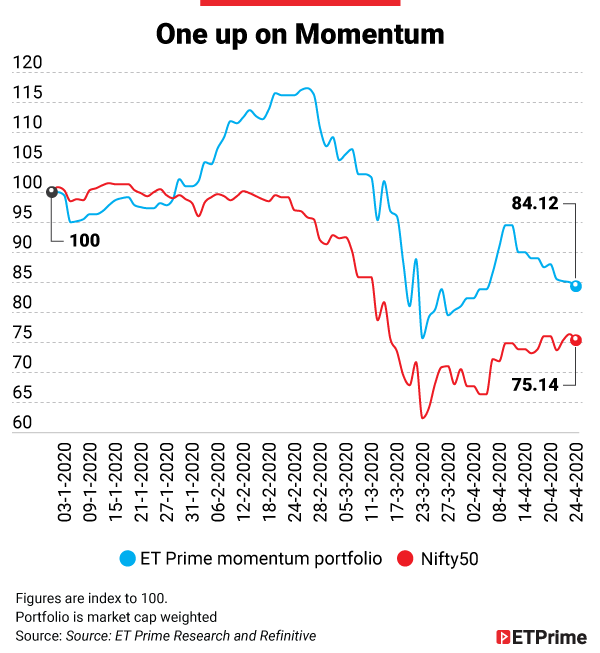
The entire month of January saw both the ET Prime portfolio and Nifty50 remaining flat. By February 25, the ET Prime portfolio was up by 16% and the Nifty50 remained flat. The growth was on account of ICICI Bank and Bajaj Finance, which went up by 8% and 23%, respectively. After the crash triggered by Covid-19, these stocks also went down the fastest.
The banking and finance sector has been the worst hit by the crash. Between February 27 and March 23, both ET Prime’s momentum stocks and the benchmark Nifty50 index lost 35% each. In the next one-month period from then up to April 24, the index recovered 20%, but momentum stocks gained only 10%.
However, if we look at the momentum portfolio based on the market weightage over the last four months, its performance has not been that bad (see chart below). Over the last four months, while the Nifty50 lost 25%, our momentum stocks were down by only 16%. Out of the 25 stocks in that portfolio, 10 were in the banking, financial services, and insurance (BFSI) segment.
In January, when we published our basket of momentum stocks, the Nifty50 index was quoting at a price-to-book value (P/B) of 3x and many investors were of the view that such levels were not sustainable. They were expecting a correction, especially after the news flow in the BFSI segment turned extremely negative following the IL&FS and Yes Bank fiascos. But nobody had expected an external shock.
Historically, market crashes follow valuation bubbles in certain sectors or stocks. When the novel coronavirus outbreak happened, the Indian market resembled a fat goose — high on P/E (price to earnings) ratios and powered by low-cost debt.
Interest rates were low in the developed world and companies were using that opportunity to buy back shares. Again, FAMG stocks (Facebook, Amazon, Microsoft, and Google), which account for 16% weightage on the S&P 500, were getting polarised in the US market. If Apple is included, this figure would go up further to 22%.
In India, a similar phenomenon was visible in the BSFI sector. Around 40% of the Nifty50 stocks are in this segment and, despite high valuations, some fund managers were aggressively buying them. So, when the virus hit the Indian markets, it punctured that fat goose — and its impact has been evident in momentum and growth portfolios.
The saviours
BFSI, which accounted for 80% of ET Prime’s January portfolio, is down by 40%, in line with the segment’s performance within the Nifty50 index. However, three stocks in the pharma sector and two in gas utilities, which were part of the portfolio, have held strong.
Abbott Laboratories had been on the radar of investors for a year or so owing to an improvement in the medical-devices and healthcare company’s working capital management and free cash flows. It was debt free and hence a good fundamental pick. By January, the stock had gained 50% in just six months. Similarly, Pfizer and AstraZeneca shares added 30% during the same period. With that kind of gains, they would have popped up on almost all momentum screeners.
Gujarat Gas was also among the hot favourites of momentum followers as well as value investors throughout calendar 2019. Almost 80% of the sales for Gujarat Gas are derived from Morbi district, India’s biggest ceramic cluster. Margins were improving, and the stock had for long been on the momentum radar.

Two footwear companies were also present in the January portfolio. Shares of Bata and Relaxo — both fundamentally strong companies — had been on an uptrend for a long time. They did figure in all momentum and growth filters.
Had it not been for the 15 non-BFSI stocks, the momentum portfolio would have fallen flat in the aftermath of the virus outbreak.
New momentum leaders
The recent recovery in the Nifty50 index has been mostly on account of FMCG and pharma stocks. Shares of banks, non-banking finance companies (NBFCs), asset management companies, and insurance firms have plummeted, with investors quickly exiting these sectors.
According to Edelweiss, panic buying of medicine in this prolonged lockdown should ideally help the pharma sector. “In Q4 FY20, pharma will likely remain the favourite, with mid-teens earnings growth on the back of a favourable base. Adjusted for one-offs in the base, viz., impairments and write-offs, earnings growth is still likely to be a buoyant high single-digit. Domestic sales would expand 10%–11% YoY led by pricing growth across the board,” it said in a report.
More important, pharma and consumption are defensive sectors which have displayed resilience during tough times such as the dotcom bust of 2000 and the financial crisis of 2008. Eventually, they will see extremely high valuations before a fall or a slowdown in stock prices. Most consumption stocks, including Nestlé, HUL, and Procter & Gamble, have bounced back to their pre-crash levels.
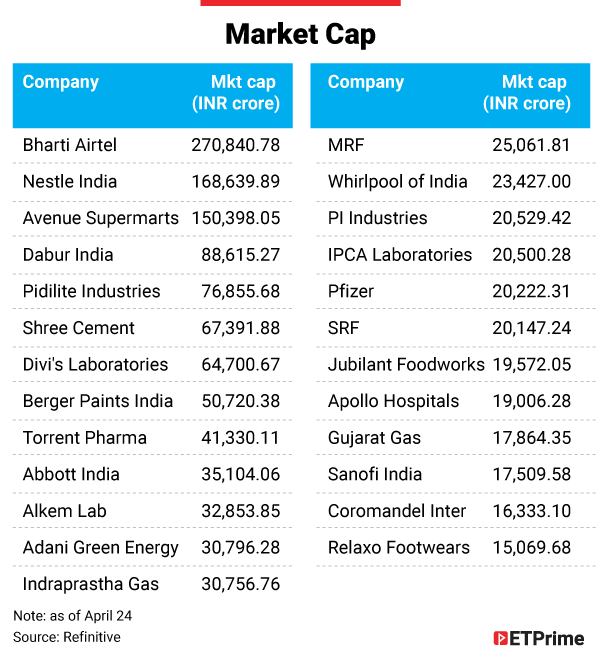
From the first portfolio, six stocks (from energy and consumption sectors), have made it into our April list. It will be interesting to see if they would continue to figure in our next portfolio update since the composition of a basket of stocks chosen on the basis of momentum tends to change a lot. But if a stock is in a long-term uptrend that goes on for years, it would eventually become a good long-term investment.
The bottom line
Our idea is to stay with stocks that have performed well in the past on the assumption that the trend will continue. But the most important question in the current scenario is: Will a momentum portfolio manage to do exceedingly well?
The answer is no. And that’s why we need stringent risk-management measures.
Since our focus is on momentum, the portfolio performance is likely to be volatile. Such a portfolio reflects the overall mood and momentum stocks generally outperform the broader market when the trend is up.
Though a minor setback can slow them down considerably, our focus here is to mitigate the damage. That is why we look at stocks with a low down-beta. The idea is that in the event of a market fall, such stocks are likely to be less affected in terms of the magnitude of pain.
Addendum: the methodology
When we decided to test a screener model to find stocks based on momentum, the idea was quite simple.
Momentum is a behavioural factor that moves in tandem with broader investor sentiment. Hence, from the top 500 companies we picked stocks that have been gaining over the last one-year, six-month, and three-month periods (one-year return > six-month return > three-month return). The prices should be above their 200-day moving averages as well. Further, to keep volatility under check, we decided to look at stocks with high sharpe ratios or down-side beta.
We have used the same parameters to update this portfolio. There are no finance companies in the new portfolio. Remember, we are not building a value portfolio and, therefore, the screener did not pull up any BFSI stock this time even though the sector is attractive at a P/B of around 2x.
Building a momentum portfolio can be a complex exercise involving several parameters. However, we prefer to keep things simple.
 aniltikotekar4sme.com