There are two kinds of deals that happen during a crisis. First, the distressed ones. There’s going to be a lot of that as the current crisis unfolds further and some companies, good ones included, unable to extend their runways, fold up and look for exits. Second, the strategic ones, which are planned for growth and crafted for scale. The Reliance-Facebook deal falls squarely in the second category. The story for this started much earlier than the headlines, which have just started appearing.
The numbers story
The investment from Facebook values the Jio Platform at INR4.62 lakh crore. ET Prime took a snapshot of the top Indian listed companies with market capitalisation between INR2 lakh crore and INR5 lakh crore. Guess how many companies turned up? Ten.
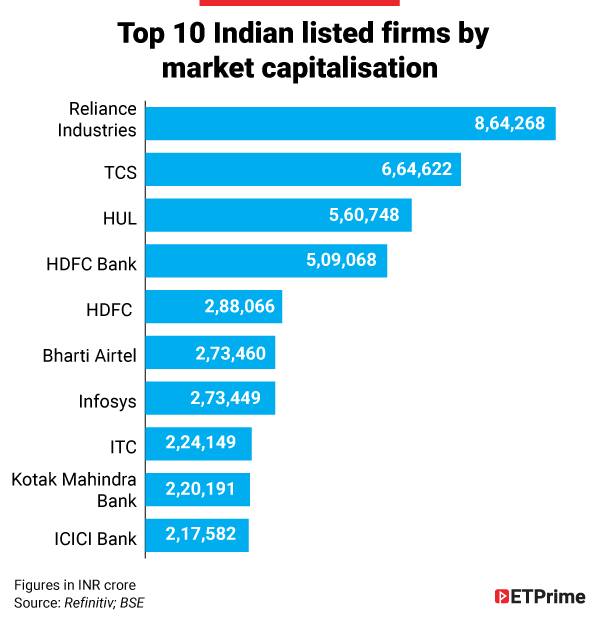
This deal puts Jio Platforms at the fifth position on the list, just below HDFC Bank and above HDFC Ltd. Note that Bharti Airtel, Jio’s main competitor, in its traditional telecom business, is lower in the pecking order.

The other companies on the list have a much longer history. As listed companies, they have stringent governance requirements and their market capitalisation has been built over years of trust. They have consecutive years of profitability (net profit) and most of them also have free cash flows sustained over a period of time.
The sectors they operate in range from banking to telecom to FMCG to technology services and, of course, to Reliance, Jio’s parent company. None of them operates in the emerging new space that Jio Platforms is operating in, which is part telecom, part commerce, and part content, part payments.
No one knows exactly what the real power of this platform could be, apart from the fact that it is helmed by India’s largest company by market capitalisation, Reliance. Then, why did Facebook pay this hefty amount for this deal?
There are three questions ET Prime is asking:
Question #1: Is it really a surprise?
This story started back in 2013, when Infotel Broadband Services was rebranded as Jio Platforms. After the settlement period was over for the business split between the two Ambani brothers, Mukesh Ambani took a big bet on 4G and data and, thereby, on telecom.
Jio was launched in 2016, drastically changing the telecom narrative. By 2018, the digital ambition of the company was growing, with quick acquisitions. Saavn’s merger with Jio Music in 2018 and the Haptik acquisition in 2019 were steps in that direction.
Then came the announcement in October 2018 stating that Jio Platforms would become a wholly owned subsidiary of the parent firm housing all the digital businesses. Not only would this hold all the digital platforms, it would also drive new technology development. It was formed with investment of INR108,000 crore from RIL.
Reliance Jio’s liabilities worth INR108000 crore was planned to be transferred back to RIL. The idea was that Reliance Jio Infocomm would thus become debt free.
The idea was clear even then. In fact, the press release at that time stated the intentions very clearly:
“This new company will be a truly transformational and disruptive digital-services platform. It will bring together India’s No. 1 connectivity platform, leading digital app ecosystem, and the world’s best tech capabilities to create a truly digital society for each Indian. Jio has been heralding the digital-services revolution in India and will continue to do so in the years to come. Given the reach and scale of our digital ecosystem, we have received strong interest from potential strategic partners. We will induct the right partners in our Platforms company, creating and unlocking meaningful value for RIL shareholders.”
Note the words in bold.
The other key requirement during this time, of course, was the debt clean-up across its business units. The parent company’s sale of 20% stake in its oil-chemical business to Saudi Aramco for USD15 billion is now delayed beyond its March deadline. So, this comes in just at the right time.
Question #2: So, what’s Jio Platforms really?
Jio Platforms sounds grand and mysterious. What does it consist of? The verticals of Reliance as listed in the last annual report were as follows:
The comparable vertical listed in the annual report was digital services. That was around July 2019. The wholly owned subsidiary Jio Platforms was announced in the October 2019 press release. Simply put, it combines the digital apps and the connectivity solutions.
The press release shared in October said the digital platforms included:
- MyJio: omni and self-care
- JioTV: live TV with 630-plus channels, including 135-plus HD ones
- JioCinema: video entertainment app
- JioNews: news and magazine app covering 900-plus magazines and 300-plus newspaper editions across formats
- JioSaavn: music app with 45 million tracks under licences in 16 languages
It had also talked about emerging platforms in healthcare, education, agriculture, commerce, government-to-citizen services, gaming, manufacturing, etc. The company’s investment in data from machine learning to augmented/mixed reality, artificial intelligence, and blockchain, would be backing the platforms.
In the current press release for the Facebook deal, Jio Platforms is said to include “Jio’s leading digital apps, digital ecosystems, and India’s No. 1 high-speed connectivity platform under one umbrella. Reliance Jio Infocomm, which provides a connectivity platform to over 388 million subscribers, will continue to be a wholly owned subsidiary of Jio Platforms.”
So, where’s the overlap across the Facebook digital properties and the Jio Platform properties, and what is the opportunity after the deal?
Question #3: What’s the bet for? What’s up WhatsApp?
India already contributes in very high numbers to key Facebook properties. In many cases, Indian users account for a tenth of the global users. After the deal, the obvious overlap, and hence the immediate impact, will be felt in the e-commerce area. Facebook, through various means, including with its investment in Meesho, had been evaluating the SME space for e-commerce in India. The overlap will give this a boost.
Similarly, it will give a big fillip to mobile payments. Beyond the obvious areas, there could be planned synergies in virtual reality, gaming, and education. The power of content, commerce, and community driven by the mobile network can be unleashed for any of these services at scale, making the impact of the deal widespread across sectors from e-commerce to telecom to gaming to mobile payments and potentially even healthcare and education.
Is that too much of a market overlap to be a considered a risk by the Competition Commission of India (CCI) in its analysis of the deal? Given the companies involved, that does not seem likely.
How high is the valuation?
Jio Platforms is neither pure telecom, nor pure content, nor pure entertainment. In such a case, to arrive at a valuation, a detailed sum-of-the-parts valuation works best, valuing each part separately. For example, how many movies were added in content, how many licences closed, etc., and then adding up the value generated from each.
The difference between the current deal valuation and the total of the sum-of-the-parts valuation would be the premium or discount on the deal.
In the absence of such detailed data, we have looked at the EV/Ebitda multiples for other comparable sectors in software, media, and entertainment.
Average EV/Ebitda multiples for some of the comparable sectors are given below. They range from 8x to 21x. The current valuation shows the EV/Ebitda for this deal to be about 21x, which is at the highest range of comparable valuations. According to various analyst reports, this assumes that Jio’s Ebitda would double from its current levels.
What drives this premium? The best way to understand that is to look at it from an economic moat point of view. Economic moats make great companies. In this case, they can also give a sense of why a premium could be charged in this deal.
According to financial-services firm Morningstar, there are five kinds of economic moats. Let’s analyse this deal from the economic moat point of view:
- Network effect: Growth in value of a service as more people use it, as is evident in modern-day marketplaces such as Google and Amazon.
- Cost advantage: Allows a firm to sell at the same price as competitors but still generate higher profits and be able to undercut competition. Intel and UPS had earlier prided themselves on low-cost manufacturing and distribution.
- Intangible assets: These include brands, patents, licences, and corporate culture, allowing companies to charge more and block competition.
- Switching costs: When time equals money and vice versa, consumers hate having to switch to other solutions. Think banks.
- Efficient scale: Evident where incumbents generate economic profits, but new entrants would cause returns to fall, as in natural geographic monopolies, nice markets, and rational oligopolies. Defence companies and airports qualify.
This deal can definitely unlock a huge network effect with the combined power of WhatsApp and Jio subscribers across plays in commerce and payments and even in potentially longer-term ones.
The cost advantage could add to that. Imagine being able to charge INR10 for a movie, given the growth in the subscriber base. It could definitely undercut competition in the already bleeding telecom market and compete in the OTT space more directly as well.
Intangible assets are in this case the licensing deals that are already in place for content. Company culture for both the companies could be vastly different and it remains to be seen how some of the collaborations will play out in real time.
The switching costs could significantly increase if payments, commerce, and others converge.
Will this combined entity garner enough market share to force the new entrants to lose theirs? That is neither proven nor estimated yet.
But even from an economic moat point of view, with three of the five factors showing a large impact, this deal is significant and hence the value charged.
Will there be concerns like creation of super apps and impact on net neutrality? When two of the richest men in the world join hands, those questions are bound to be asked.
Last, but not the least, both the companies have been active investors in the ecosystem. Will this also create a new Softbank equivalent for startup investment? That’s a bigger question we are waiting to analyse.
(Research support by Rochelle Britto)
(Graphics by Sadhana Saxena, Abdul Shafiq and Mohammad Arshad)
via The story of Jio Platforms: a decade in the making, and for once, data and oil do mix – ET Prime
 aniltikotekar4sme.com