It’s cataclysmic, and a double whammy for those at the helm of the Indian economy — Nirmala Sitharaman and Shaktikanta Das. Consider the daunting odds.
Only a couple of months ago, India was grappling with a demand-side problem. That not only persists but threatens to scale humongous proportions in a virus-hit economy.
But a locked-down country will also end up with a supply-side problem. Indeed, supply disruptions are almost inevitable as a shuttered economy writes the epitaph of millions of SMEs, and even some bigger companies, in the days and months ahead.
So, this time, it’ll be both a supply- and demand-side problem — it couldn’t possibly get any worse. But then, every crisis also presents an opportunity. A large and swiftly executed stimulus, along with decisive steps to contain the pandemic, may just pull India out of the deep hole.
John Maynard Keynes may have probably approved of this strategy, possibly supported by modern monetary theorists. A stimulus can revive demand and remove supply bottlenecks in the economy to an extent.
Deficit financing is frowned upon by economists in normal times, but this is a rarest-of-the-rare situation. The government must roll out a large stimulus — with the Reserve Bank of India (RBI) possibly monetising a part of the fiscal deficit — to extend a lifeline to businesses, preserving jobs and wages, and easing the supply- and demand-side shocks. It may not be inflationary or lead to a run on the rupee, at least in the short term, given the demand slump and low commodity prices, particularly oil.
Stimulus is a compulsion
Faced with this predicament, a massive stimulus has become a compulsion. If a deviation from fiscal discipline is a vice during normal times, absence of a credible package invites international scrutiny during a crisis. Every day of delay to put in place a meaningful stimulus is a lost opportunity for India. The country runs the risk of being seen as indecisive in responding to a crisis.
USD6 billion a day will be India’s output loss on a conservative basis for the lockdown spanning March 24 to May 3. It is not clear whether this will be the final phase of the lockdown. Maharashtra, the state with the highest economic output of USD37 billion or 14% of the total, is suffering an output loss of INR7,700 crore or more than a billion dollars every day. What makes matters worse is that a recovery won’t happen at the same pace. Recouping lost employment and wages might take months or even years.
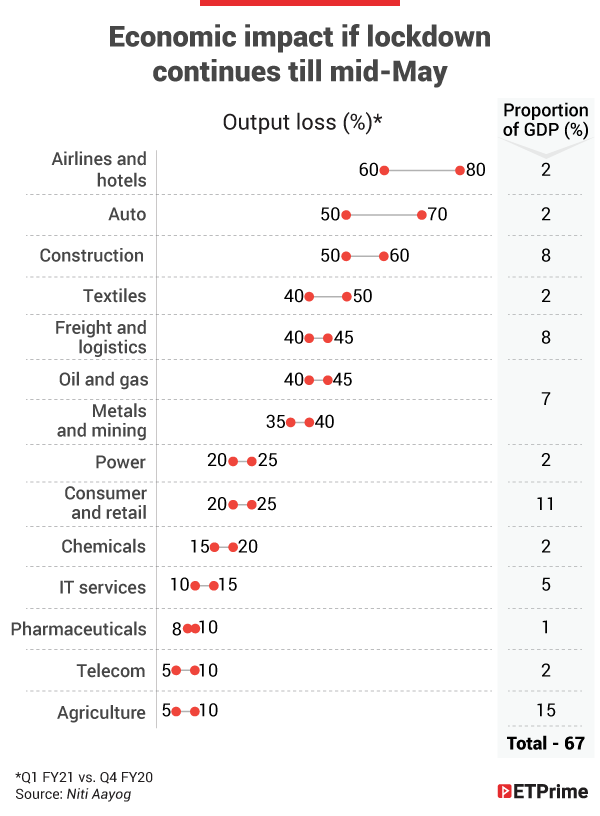
Some experts, including former RBI governors, have expressed reservations on an outright big-bang stimulus from an overall macro stability perspective. It would be pertinent to examine those concerns.
Support jobs, wages
India’s poor per capita income is a hindrance, as a big stimulus package increases sovereign indebtedness and makes people worse off, goes one argument. This proposition, though justified during normal times, doesn’t hold good in a crisis when output and job losses are huge. In fact, 40 days of lockdown have set the nation back by around INR16 lakh crore in terms of real output loss and a decline of USD368 in per capita GDP in nominal terms. This is the direct impact of a lockdown due to a downward spiral of falling income and employment.
Thus, without a stimulus, per capita income would deteriorate further and there would be a huge chasm between the actual and desired rates of growth. The relief of INR2,500 per beneficiary provided under the Pradhan Mantri Garib Kalyan Yojana would be quite inadequate to compensate for the lost income due to lockdown. Migrant labourers will face further problems. Aggregate demand will fall further unless a bigger package is announced.
The high household leverage further makes it incumbent on the government to prevent loss of wages and employment. Over the last five years, household debt has grown at a CAGR of 17% while wage growth has seen a muted 5% rise. Moreover, household debt stands at almost 20% of GDP, compared to 15% five years ago. If wages fall further, this scenario will aggravate and pose a serious retail loan-repayment crisis, apart from a severe aggregate demand shock.
Moreover, there are approximately seven crore small businesses, probably having a cumulative loss of around INR4 lakh crore. Banks are credit shy for known reasons. Hence, only generous grants by the government will save the day for these businesses and their employees. Even if half the losses are covered, a fiscal assistance of around INR1.5 lakh crore to INR2 lakh crore would still be needed. For perspective, the US has outrightly announced a USD350 billion package for its small and medium businesses.
Second, a stimulus is inflationary, say critics. However, food and manufacturing inflation may not see a spike. The lockdown has only led to non-availability of labour and hassle in plying of trucks, but food stocks haven’t been adversely hit. Moreover, certain weather forecasts indicate that rainfall would be 100% of the long period average (LPA), which should ease food prices in the future. Above all, when aggregate demand is extremely weak, there is little chance of a demand–pull inflation playing out. Deficit financing is inflationary only during normal demand conditions.

Higher fiscal deficits could lead to exchange-rate volatility, goes the third argument. However, empirical data doesn’t corroborate this view very strongly. Singapore, which has unleashed a massive stimulus equivalent to more than 10% of its GDP, has witnessed only a 5% fall in its currency versus the dollar since January, while the rupee lost 6.75% despite its stimulus being a minuscule 0.8% of GDP. The Chinese renminbi fared even better, with a depreciation of a mere 1.15%, while the Japanese yen appreciated 7.7% despite a mother of all stimulus packages of more than 20%.
If deficits are accompanied by sovereign rating downgrades, currency might turn volatile but the need for stimulus during such extraordinary times is widely acknowledged as an absolute necessity. The recent FII outflows from India’s stock exchanges can be attributed to the perceived safety of the dollar over other classes. A big dose of stimulus is unlikely to make it further adverse. On the contrary, it might increase investor confidence in India’s growth story and attract more capital flow.
Finally, critics advocate a cap on stimulus. A Japanese-style stimulus in the range of 10-20% of GDP would be a tall order for India at this juncture. However, putting a tight range wouldn’t be fair either, as the size of the package needed to keep income and demand intact for an emerging dynamic would be clear only with the passage of time.
May revive manufacturing
A well-oiled stimulus aimed at the supply and demand sides can prompt manufacturing activity to shift base to India, though it may not happen overnight. South Korean carmaker Hyundai and steel maker Posco may be interested in shifting base to Andhra Pradesh if they commit investments, according to some media reports.
In this light, there is definitely a case for extending the 15% tax rate for new manufacturing units until the pandemic is brought under control, so that India can become an effective alternative to China. Japan’s offer of USD2 billion to bring home its companies willing to shun China is a fine example of its aggressive stimulus, which recently topped 20% of its GDP.
It’s more important to revive aggregate demand. Companies, irrespective of their size, need a liquidity boost at this juncture so that jobs and wages are protected, and demand compression is kept low. Refund of income tax and GST dues can also make a huge difference.
An interesting feature has been that the US has been decoupling its imports from China from the beginning of calendar year 2019. The loss to China due to this was USD90 billion, with low-cost destinations and Europe gaining USD31 billion and USD23 billion respectively, according to a report by consultancy firm AT Kearney. Tax sops coupled with stimulus packages to ward off demand contraction is a great opportunity for India to garner a good share of China’s loss. The post-pandemic world order will see China losing more market share. If India desists from a fiscal boost citing fiscal discipline, it risks losing this once-in-a-lifetime opportunity to set the stage for increasing manufacturing’s share in GDP to 25%.
The RBI unleashed a bazooka on March 27 and followed it up with another set of measures last week, notable among them being targeted long-term repo operation 2.0 (TLTRO 2), refinance for Sidbi and Nabard, and the lowering liquidity-coverage requirement (LCR) for banks.
However, all these are contingent on the availability of risk capital. As argued in some of ET Prime’s earlier pieces, risk capital has completely collapsed. The TLTRO 2, which mandates that 50% of funds availed from repo at 4.4% should be in NBFC papers, though apparently akin to a stimulus, may not find enough takers, since banks are risk averse to investing below investment grade. Due to this condition, the ensuing auctions might find few takers and the purpose itself might be defeated.
Reduction in reverse-repo rate to 3.75% is aimed at incentivising credit-shy banks to lend. Bank credit growth for FY20 was at a record low of 6.6%. This explains why fiscal policy has a much more important role to play during such crises compared to monetary boosters.
Policy recommendations
1. Revive the concept of tax-free bonds, may be tax-free Covid-19 bonds, as this helps to channelise more household savings. As most asset classes now face value erosion, the government must utilise this opportunity to garner household savings, which can be used for the stimulus while reducing fiscal impact.
2. Direct monetisation of deficit by RBI purchase of bonds must be immediately explored. The recent decision to increase the ways and means advances (WMA) limit of states by 60% is indeed a welcome move.
3. India can post high growth rates globally after the pandemic. The country should use this to its advantage and the government must revive the idea of sovereign bonds, which helps to relieve fiscal impact.
4. As stated earlier, the government must consider grants to small businesses, which would cost about INR4 lakh crore. Moreover, bailing out private entities wouldn’t amount to a moral hazard at this juncture and all help needs to be extended.
5. Infrastructure development must continue. The decision to increase spending by the highway’s ministry needs to be followed by others as well. Good infrastructure is the most vital aspect to convince foreign manufacturers to set up base here.
6. Finally, a TARP-like scheme, akin to that of the US, needs to be devised so that whatever is invested is recouped with returns when the economic cycle reverses.
The stimulus will entail a combined fiscal deficit (Centre and states) of almost 13%-14% of GDP with downside risks if growth decelerates further. Adherence to fiscal austerity in the name of macro-economic stability would be myopic.
 aniltikotekar4sme.com