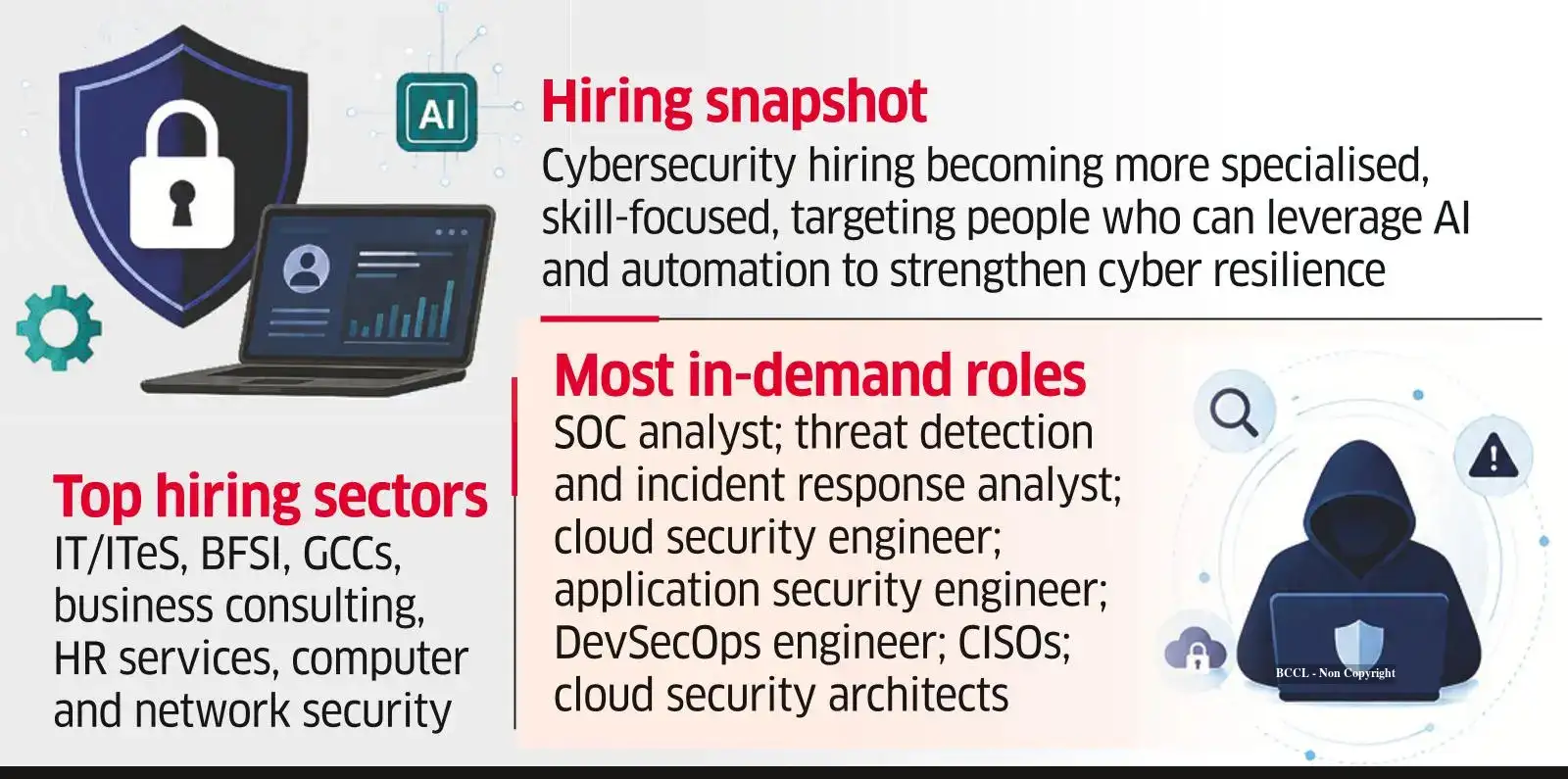
In response to the increasing complexity of cyber threats, companies are ramping up their recruitment efforts in cybersecurity. There is a heightened focus on acquiring specialized skills in cloud security and artificial intelligence, reflecting the urgent need for professionals in these areas. Over the past year, the demand for cybersecurity experts has surged, with businesses increasingly turning to automation and AI to streamline their security operations.

Bengaluru: A string of high-profile cyber attacks has prompted companies to step up hiring across cloud security, artificial intelligence (AI) security and threat intelligence as they seek to bolster their defences against evolving threats.Businesses are prioritising specialised talent while increasingly relying on automation and AI to handle routine security operations, said industry executives.
Also Read: AI-linked hiring in India outpaces job losses by over 51,000, says Nomura
Companies actively hiring cybersecurity talent include Accenture, EY, TCS, PwC India, IDFC FIRST Bank, Deloitte, NTT DATA, JPMorganChase, Walmart Global Tech India and Wipro, according to data compiled for ET by specialist staffing firm Xpheno.
Cybersecurity hiring has increased 15-20% on average over the past year, said Neelabh Shukla, chief business officer at talent solutions provider Careernet.
“AI is accelerating the cyber threat landscape. Attacks that once took days, weeks, or months can now be executed in a fraction of the time using frontier AI models. As a result, the focus of enterprises on cyber is increasing, but the availability of skilled talent is not keeping pace with demand,” said Aloke Kumar Dani, partner, Deloitte India.
Deloitte has around 3,000 cyber professionals serving the India market and another 8,000 supporting global clients, yet demand continues to outpace supply, said Dani. To bridge this gap, the firm has expanded talent sourcing beyond metros, among other initiatives.
Also Read: Where will the most job losses occur in years to come? Here’s what Nandan Nilekani thinks
Hiring focus, however, is shifting from quantity to quality.
“Cybersecurity today is a business resilience imperative,” said Santha Subramoni, cybersecurity lead, Advanced Technology Centers Global Network, Accenture.
As organisations accelerate cloud, data and AI-led transformation, they are increasingly looking for professionals who can combine cybersecurity expertise with AI, cloud and business acumen. Accenture’s global research shows that demand for AI-related cybersecurity skills has grown 2.5 times since 2020, reflecting the convergence of cybersecurity, AI and business transformation.
“Organisations must focus on hiring, upskilling and reskilling talent while leveraging AI and automation to strengthen cybersecurity operations,” added Subramoni.
Umashankar Lakshmipathy, co-head of cloud, infrastructure and security services (CIS), cybersecurity and COBALT at Infosys, said, “Our focus is on building a future-ready cybersecurity workforce that combines deep cyber expertise with skills in AI and automation.”
Infosys is hiring lateral talent with proven skills in AI, automation, analytics and platform engineering. At the same time, it is focused on reskilling and enabling existing talent and preparing new campus recruits through structured training programmes.
Recruitment firm Michael Page has seen an 18% YoY increase in cybersecurity mandates, driven by the rising frequency and sophistication of AI-enabled attacks.
“Salaries have gone up. Cybersecurity professionals can command salaries starting at Rs 25-30 lakh, going up to Rs 1.2-1.3 crore or more,” said Pranshu Upadhyay, regional director, Michael Page India. “Candidates with niche skills in areas such as cloud security, cyber architecture and AI security can command 25-35% hikes.”
“We expect cybersecurity hiring to remain strong. Because demand is high, candidates are often sitting on multiple offers, and the payout ratio is higher for these skill sets,” he added.
Experts say demand is increasingly shifting towards professionals who can work alongside AI to strengthen cyber resilience.
“The trajectory is for talent demand in cybersecurity to become hyper-niche with specialists orchestrating AI for output,” said Kamal Karanth, co-founder, Xpheno.
NEXT STORY
SECTIONS
ANILast Updated: Aug 08, 2026, 04:37:00 PM IST
Artificial intelligence is creating more jobs than it is eliminating in India. This technology has resulted in a net positive employment impact for the nation. However, AI is disrupting traditional roles and reducing demand for entry-level workers. Companies are showing weaker demand for junior employees while senior roles remain stronger.
New Delhi: Artificial intelligence (AI) is creating more jobs than it is eliminating in India, with AI-related hiring reaching 83,100 compared with 31,921 documented layoffs and attrition, according to a Nomura report.The findings indicate a net positive employment impact of AI in India so far, even as the technology disrupts traditional roles and reduces demand for entry-level workers.
In its Asia Economic Monthly report, Nomura said India was experiencing the largest absolute impact from AI among the Asian economies covered by its analysis, both in terms of documented layoffs and hiring.
Read More: Where will the most job losses occur in years to come? Here’s what Nandan Nilekani thinks
The report said India’s large population and its position as a global back-office hub have made the country a key market for assessing AI’s impact on employment.

Live Events
“We find that India is experiencing the largest absolute impact from AI across both documented layoffs/hiring freezes and AI hiring,” Nomura said, adding that “so far, the net impact is also positive for India.”
Nomura’s data showed that India accounted for 83,100 of the roughly 1.31 lakh AI-related jobs created across the Asian economies in its database. In comparison, it identified 31,921 AI-related layoffs and attrition in India, the highest among the countries surveyed.
While overall hiring has exceeded job losses, the gains have not been evenly distributed across workers. Nomura noted AI was creating a two-tiered labour market, with companies showing weaker demand for entry-level employees while demand for experienced and senior workers remained relatively stronger.
Read More: Vizag to emerge as India’s top digital infra hub, to create 52,000 jobs: Report
Citing an ICRIER survey of 651 firms in India’s IT sector, the report said 55 per cent of companies reported a decline in entry-level hiring, compared with 25 per cent reporting a decline in mid-level hiring and 14 per cent in senior-level recruitment.
The shift comes as companies increasingly automate routine work typically handled by junior employees. Nomura identified banking back-office operations, customer service and junior technical roles such as quality assurance testing and coding among the jobs being displaced by AI.
The impact is also showing up through slower recruitment rather than outright layoffs. Nomura cited staffing firm Xpheno’s estimate that net hiring by Indian IT companies fell to 140,000 in FY26 from 600,000 in FY22 as companies reduced campus recruitment instead of terminating existing employees.
At the same time, most new AI-related jobs remain concentrated in technology. Nomura said more than 90 per cent of AI-related job creation in its Asian sample came from the technology sector, while hiring in India was mainly for AI data annotation and linguistics work.
Nomura said the early evidence runs counter to fears that AI adoption would result primarily in large-scale job destruction, but cautioned that the technology was still at an early stage and its full labour-market impact could take years to emerge.
“We are positively surprised by our aggregate result showing that AI has been a net positive for jobs,” the report said, while noting that there were “many disruptions beneath the surface.”
Stories you might be interested in

