If you’ve sold any property or equity shares or other specified assets, you might qualify for a full tax exemption on your capital gains, provided you meet certain conditions outlined in Section 54, Section 54F, Section 54EC and other relevant provisions.
According to the Section 82 of the Income-tax Act, 2025 (Section 54), if a taxpayer makes long-term capital gains from selling a residential property, those gains can be exempted as long as they are reinvested into buying another residential house property in India.
The Section is relevant for individuals or Hindu Undivided Families (HUF) who earn long-term capital gains from the sale of a residential house property (i.e., a building or the land associated with it, taxed under the head Income from house property). To qualify for the exemption, the taxpayer must reinvest the capital gains in a new residential house property located in India, adhering to the following timelines:
- Purchase of a new house property within 1 year before or 2 years after the date of transfer or
- Construction of a new house property within 3 years from the date of transfer.
Chartered Accountant Suresh Surana says that it is pertinent to note that the tax exemption is limited to the cost of the new asset where the capital gains exceed such cost, with the balance remaining taxable. However, when the capital gains are equal to or less than the cost of the new asset, the entire gains shall be exempt.
Additionally, the benefit under Section 82 is subject to a monetary limit, meaning that the highest amount of capital gains that will be eligible for exemption is capped at Rs 10 crore. Any capital gains exceeding this limit would remain taxable in accordance with the applicable provisions.
Section 82 of the ITA 2025 highlights certain important points that are relevant from a tax planning and compliance standpoint. Surana shares some of the key points are outlined below –
- Option to invest in two residential houses: Where the capital gains do not exceed Rs. 2 crore, the taxpayer may, at their option, invest in two residential houses in India instead of one. However, this option can be exercised only once in a lifetime.
- Lock-in period and withdrawal of exemption: If the new property is transferred within 3 years, the earlier exemption is effectively withdrawn through adjustment in the cost of acquisition, leading to higher taxable capital gains.
- Capital Gains Account Scheme (CGAS): If the capital gains are not fully utilised before the due date of filing the return of income u/s 263(1) of the Income Tax 2025 (corresponding to section 139(1) of Income Tax Act, 1961), the unutilised amount must be deposited in a notified CGAS with a specified bank or institution.
The deposit in CGAS is deemed to be utilised for the purpose of claiming exemption, subject to actual utilisation within the prescribed period. Any unutilised amount after the expiry of 3 years becomes taxable in the year in which the period lapses.
Also read: Bengaluru landowner sells 17 apartments, earns Rs 11.8 crore LTCG, pays no tax; I-T dept sends notices; he contests and wins in ITAT Bangalore
Difference between Section 54 and Section 54F
Chartered Accountant Abhishek Soni, co-founder, Tax2Win explains the difference between Section 54 and Section 54F:
- Section 54 applies when a taxpayer sells a residential house property and reinvests the capital gains in another residential house property.
- Section 54F applies when a taxpayer sells any long-term capital asset other than a residential house property (such as land, gold, shares, etc.) and invests the net sale consideration in a residential house property.
Soni says that if a taxpayer is claiming exemption under Section 54 or Section 54F of the Income Tax Act, the claim must be reported in the Capital Gains Schedule (Schedule CG) of the Income Tax Return.
- ITR-2: If the taxpayer does not have business or professional income.
- ITR-3: If the taxpayer has business/professional income.
How to report Section 54, 54F in ITR?
Surana says that tax exemptions under Section 54/54F of the Income-tax Act, 1961(ITA 1961) [corresponding to Section 82/86 of the Income-tax Act, 2025 (ITA 2025)] must be reported in ITR-2 (or ITR-3 if the taxpayer has business income).
The exemption is disclosed under Schedule CG (Capital Gains) and the detailed exemption information is required in Schedule CG – Part D Information about deduction claimed against Capital Gains.
Taxpayers are required to first report the sale consideration, cost of acquisition/improvement, and the resultant capital gains in Schedule CG.
Also read: How to pay zero or lower income tax on your residential property sale using Sections 54 and 54F
Thereafter, the relevant exemption Section should be selected; Section 54 in case of “Reinvestment in a residential house against LTCG arising from sale of residential property”, and Section 54F in case of “Reinvestment in a residential house against LTCG arising from transfer of other capital assets”.
A screenshot showing the ITR utility where you need to put the information if claimed Section 54 or Section 54F tax exemption:
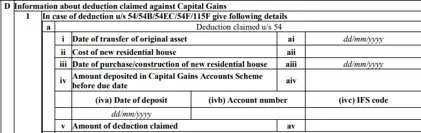
Source: CA Suresh Surana
The following details need to be filled while claiming the exemption under Section 54/54F:
- Date of transfer of original asset
- Cost of new residential property
- Date of purchase/construction of new property
- Amount deposited in Capital Gains Account Scheme (CGAS), if applicable alongwith Date of Deposit, Account Number and IFSC Code
- Deduction amount claimed under Section 54/54F

