CBDT plans to expand foreign asset disclosure measures, including lower value accounts and pre-filling alerts on its e-portal
CBDT enhances foreign asset disclosure to curb tax evasion, promoting compliance through Nudge 2.0 campaign
Taking positives out of the Nudge (non-intrusive usage of data to guide and enable) 2.0 campaign, the Central Board of Direct Taxes (CBDT) intends to expand the target base to include lower value account besides pre-filling alerts on e-portal among other measures.
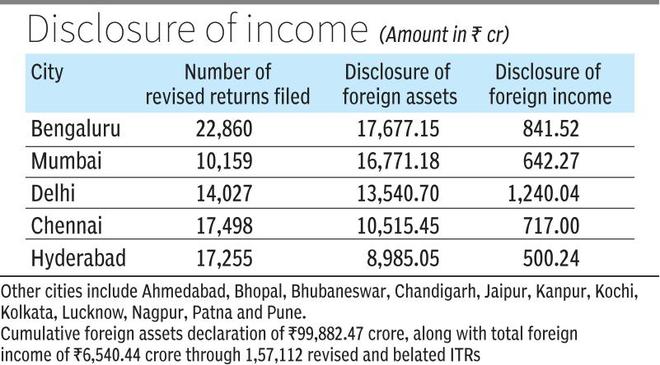
Meanwhile, Bengaluru tops the chart of overall taxpayers from 18 big cities that revised or filed belated income tax returns (ITRs) declaring foreign assets (FAs) and foreign source of income (FSIs) for financial year (FY) 2025-26.
An internal report of CBDT, accessed by businessline, showed that because of the campaign cumulative foreign assets declaration was around ₹1 lakh crore along with total foreign income of over ₹6,500 crore through over 1.57 lakh revised and belated income tax returns.
The Income Tax Department got over ₹800 crore through tax. Under the NUDGE 2.0, SMSs and mails sent in November-December last year to identity high-risk cases where foreign assets appear to exist but not reported in the ITRs filed for AY 2025-26. They were advised to review and, where necessary, revise their ITRs by December 31, 2025, avoid potential penal consequences.
Now, based on the outcomes of first two campaigns, CBDT is preparing the future course of action. Sources said the board intends to expand the target base to include lower-value common reporting standard (CRS)/Foreign Account Tax Compliance Act (FATCA) reported accounts, recognising that non-reporting in such cases reflects behavioural non-compliance rather than merely tax quantum risks.
The CRS, developed by the Organisation for Economic Co-operation and Development (OECD), enables countries to automatically exchange financial account information to curb offshore tax evasion. On the other hand, India has an agreement with the United States under FATCA information-sharing arrangements.
The CBDT also proposes strategic directions for a continuous nudging model allowing institutionalised periodic data-backed campaigns instead of a single window initiative, and standardisation of reporting schedules to reduce ambiguity and improve accuracy of information. It desires to introduce predictive risk analysis, pre-filling alerts on e-portal, automatic filling of connected fields across various schedules in the ITR, expanded global coordination and enhanced employer and professional engagement, as per the report.
Sources also said most of the declarations are largely from professionals while big businessmen, politicians and others continue to hoard black money. Among the directly nudged population, Bengaluru, Hyderabad, Chennai, Delhi and Mumbai collectively accounted for the largest volumes of revised returns and asset disclosures, reflecting the concentration of internationally mobile professionals and high-net-worth taxpayers in these jurisdictions.
It may be noted that over the last two years, cumulatively more than 1.11 crore revised and updated returns have been filed resulting in collection of ₹8,800 crore as taxes through Saksham Nudge campaigns. Also, the success of the Saksham Nudge programme paved the way for the foreign assets of smaller taxpayers disclosure scheme announced in the 2026 Budget by Finance Minister Nirmala Sitharaman.
Published on May 10, 2026

