Rising POSH complaints indicate improved awareness, yet experts warn of significant underreporting and ongoing systemic issues in corporate culture
Experts warn of underreporting and ongoing systemic issues in corporate culture
A year-on-year rise in complaints under the POSH (Prevention of Sexual Harassment) regime across India’s top listed companies suggests an improved reporting awareness but also points to existence persistent systemic issues in the corporate world.
businessline analysis of data sourced from primeinfobase.com shows that POSH cases in Nifty500 companies were up 13 per cent year-on-year in FY25 at 2,583 complaints compared to 2,276 complaints in FY24. This was at 1,779 complaints in FY23. Further, across the three fiscal years (FY23, FY24 and FY25) the percentage of complaints upheld out of the total complaints has been in the range of 66-69 per cent.
TCS (125), Wipro (125), ICICI Bank (117), Indigo (79), and HDFC Bank (75) are companies with the maximum number of absolute POSH complaints in FY25. Sectorally, financial services, information technology (IT) and consumer companies lead in share of complaints.
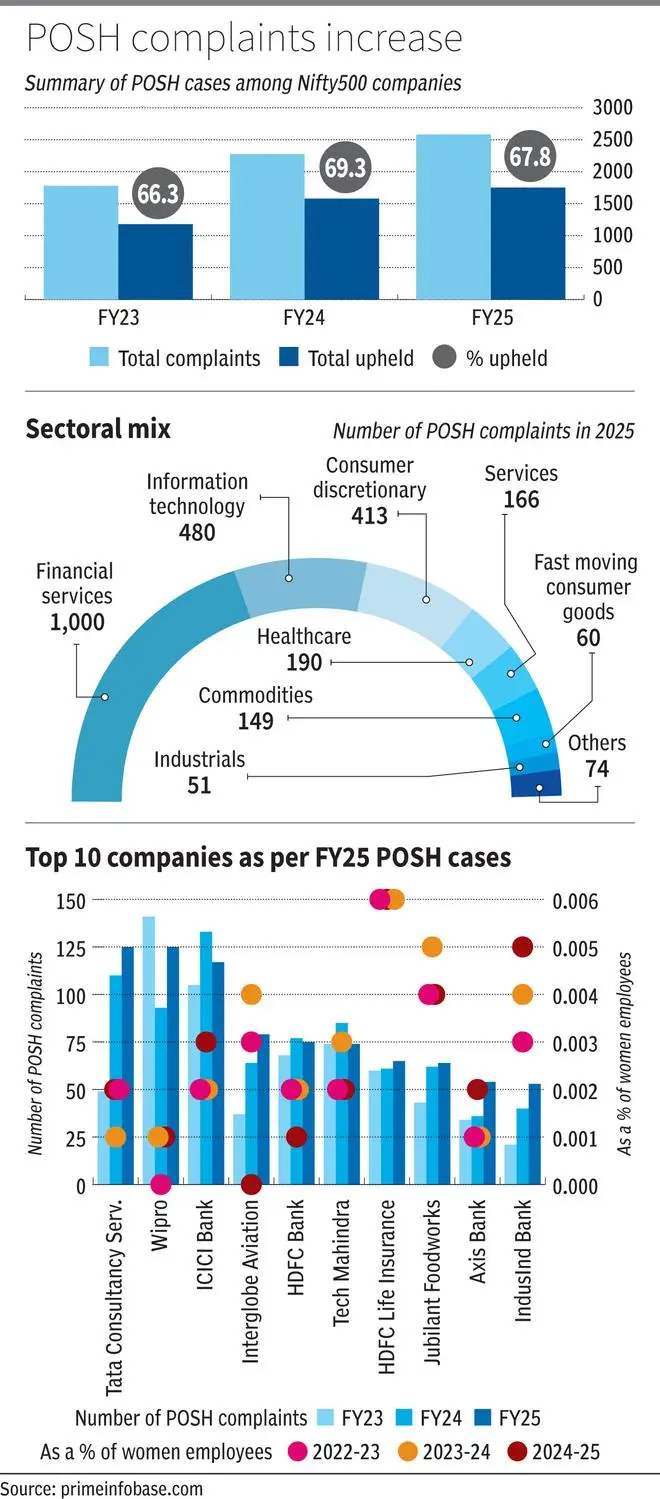
However, 212 of the Nifty500 companies, all of whom have significantly high workforce levels, reported zero POSH complaints in FY25, and 147 companies reported less than five POSH complaints in the fiscal.
Workplace culture
HR and legal experts told businessline that while the increase in complaints point to stronger implementation of POSH policies and greater employee sensitisation, the relatively low number of reported cases across India’s top 500 companies suggests significant underreporting due to stigma and workplace culture issues.
Preetha Soman, Partner — JSA Advocates & Solicitors, says there has been a significant improvement in reporting under POSH, especially in larger companies, but it is not uniformly robust across companies. “Many employees still weigh the emotional, professional and social cost of reporting, before coming forward. That hesitation is particularly visible in cases involving senior respondents, influential business leaders, rainmakers, or close-knit team environments where the complainant may fear isolation or subtle retaliation,” she said.
Vasanthi Srinivasan, Professor — Organizational Behaviour & Human Resources Management says that despite rising numbers being indicative of more robust reporting mechanisms than in the past, 2,500+ complaints across 500 companies is “a bad story”.
“For 2,500 complaints that have been disclosed, I would expect that another 10,000 complaints were not filed. Fifty-eight companies with greater than 5,000 employees have zero cases,” Srinivasan said.
Structural barrier
As per Srinivasan, the first structural barrier is that POSH is treated as a “checkbox” making the setting up of the Internal Committee, training of members, policy formulation, hiring of external expert all a “perfunctory” exercise. “Many companies believe that zero or low complaints means that the organisation is doing well,” she said.
JSA’s Soman urges employers to use the POSH data far more intelligently.
“Particularly in large organisations, POSH complaints should not be looked at only as isolated cases to be closed. They should be analysed for trends, for example, repeated concerns in certain teams, complaints linked to specific managers, patterns during travel or offsites, functions with low reporting and high attrition etc,” she adds.
As per Aditya Narayan Mishra, MD and CEO, CIEL HR Services Limited, POSH is a good first step to make Indian workplaces better for women but victims still fear retaliation and are many a time also confused if their experience even counts as a harassment depending on its normalisation across certain company cultures.
Published on April 21, 2026

