A gold loan is only as safe as the gold pledged for it. While gold was rising, the gold loan companies lent more and more, and their stocks rose with it. Gold is now falling, and the stock market, which always looks ahead, has changed its stance.
To understand why the gold loan stocks are not doing well, one has to understand how a gold loan works, how much was lent when gold was at its highest, how that is becoming an issue now, and, more importantly, whether this is happening for the first time or whether it has happened in the past also.
A gold loan company is considered safe because the jewellery lying in its vault is worth more than the money it has lent against it. As long as gold keeps rising, that comfort only grows, and for the last few years gold has all seen a rise. The companies grew with it, and so did their share prices. When gold falls, the equation works the other way. The jewellery is worth less, while the loan stays where it was.
There is one more thing to consider. In the year that saw gold prices rising, the lending by these companies grew far faster than the jewellery coming into their vaults. Why so? Because much of the new lending was against jewellery they already held, because its value had gone up. Now the value has come down, but the loans have not.
To be clear, this does not mean these companies are in trouble. They have seen gold fall before, in 2013, and they came through it. Even today, the jewellery they hold is worth more than what they have lent. And that is a comfort factor. The market, though, is looking ahead at how much of this comfort will remain if gold prices stay down – and at which loans would feel the impact first.
So, investors who are waiting for the quarterly results to tell them this will get the news after the stock price has already moved. To make sense of what the stocks are doing, they should look at how a gold loan works, how much was lent when gold was at its highest, and how much room is left. And all of this information is there in what the companies and the RBI have already put out.
How a Gold Loan Works
For the borrower, a gold loan is the simplest loan there is. He hands over the jewellery, takes the money, and gets the jewellery back when he repays. The jewellery is the security, and the lender asks for little else.
For the lender, the whole business rests on never lending the full value of the gold. The RBIhas laid down how far a gold loan company can go on a loan that is not for a business or a farm, and the limit depends on the size of the loan.
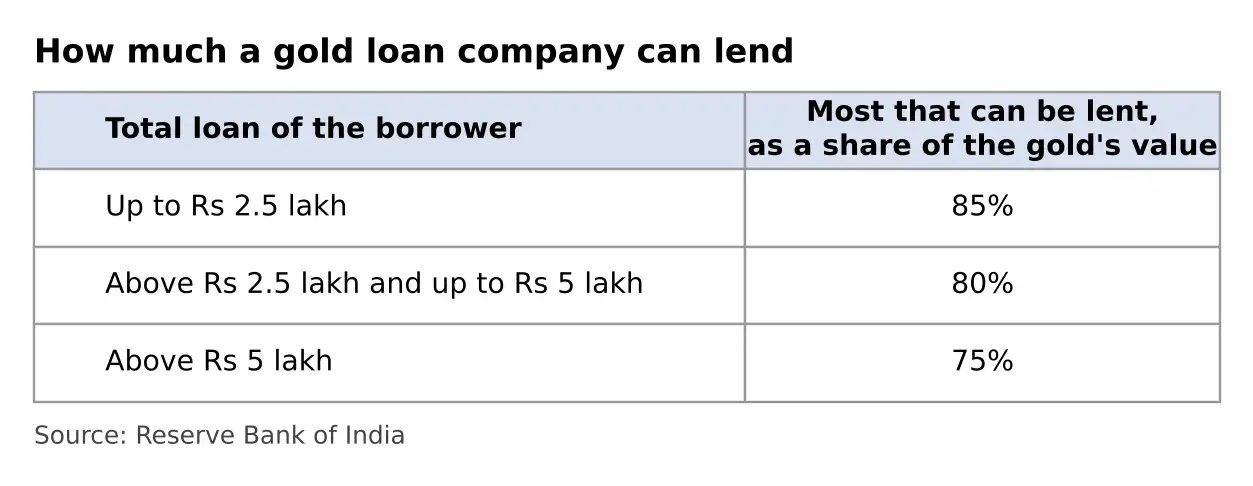
Where the borrower is to pay everything at the end, the limit is worked out on the full amount that will be due then, interest included. These limits have to be kept all through the life of the loan, and not only on the day it is given. So when gold falls, a loan that was well within the limit on the first day can go over it without the borrower or the lender having done anything.
The part that is not lent is the lender’s margin. In a year when gold is rising, nobody pays much attention to it. Its use becomes apparent only when the price of gold falls.
Then there is the matter of when the money comes back, and here a gold loan is unlike a home loan or a car loan. In most cases there is no monthly instalment. The borrower takes the money and often comes back only at the end, to pay the principal and the interest together. All through that period the company adds the interest to its income, though the cash is yet to come.
Now, here’s the important point: Charging interest and collecting it are two different things, and in this business months can pass between the two. And if the borrower does not come back at all, the lender can auction the jewellery. It is the last resort, and it takes time. And, most importantly, what the company gets depends on the price of gold on that day.
This is where a fall in gold starts to matter. The margin kept at the start has to take care of two things at the same time, the interest that is adding up every month and any fall in the price of gold. Interest on these loans is not low, so even with gold standing still, a good part of the margin gets used up over a year. If gold falls as well, the jewellery can end up being worth less than what the borrower owes.
That does not mean he will walk away. Families do not give up their jewellery easily, and that attachment has always been the strength of this business. But it does explain why the price of gold matters to these companies in a way it does not to other lenders.
Same Gold, Bigger Loans
When the price of gold rises, the worth of the jewellery already lying in a gold loan company’s vaults goes up. A customer who had borrowed against it some months back can now borrow more against the same ornaments, without offering more gold as collateral. This is called a top-up loan.
For the customer, it is extra money without a fresh pledge. For the company, it is growth that comes easily, because the customer is already known, the jewellery is already tested and stored, and only the loan amount changes. When gold rises as fast as it did last year, top-ups can become a very large part of the business.
And Muthoot Finance’s annual report for 2025-26 shows how large. In that year, Muthoot gave top-up loans of about Rs. 59,000 crore. Its gold loan book, after all the fresh lending and all the repayments, grew by about Rs. 51,000 crore. The top-ups were bigger than the growth in the book.
The gold in the company’s vaults backs up the story. Between September 2025 and September 2026, Muthoot’s gold loans went up by more than 40%. The quantity of gold it held against them, counted in tonnes, was slightly lower at the end of that period than at the beginning. A much bigger loan book was resting on about the same gold.
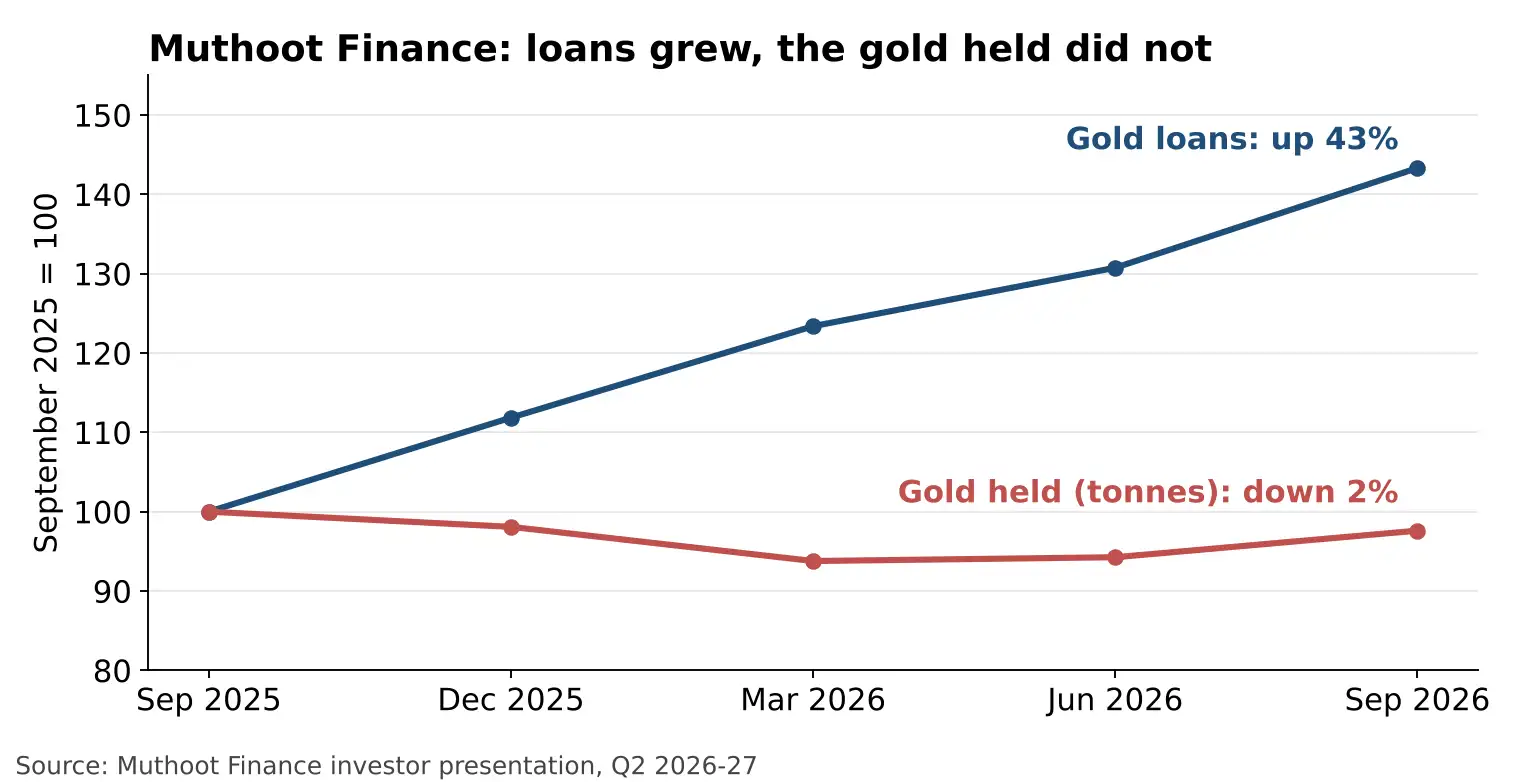
Muthoot did not change the way it lends. It did not start giving more money against the same value of gold. Going by its annual report, it gave a little less than before. The loans grew because gold itself became costlier. The same bangle was worth more, so the same customer could borrow more against it. The problem comes when gold becomes cheaper. The bangle is then worth less, but the loan taken against it stays the same.
At Manappuram Finance, the growth was faster. Its gold loans nearly doubled in the 12 months to September 2026, while its gold holding rose by about 20%. Manappuram’s presentations also show it lending a larger share of the gold’s value than it did a year back, which was not the case at Muthoot.
This was not limited to these two companies. The RBI, in its Financial Stability Report of June 2026, noted that the recent rise in gold loans across lenders was driven mainly by existing borrowers, who were using higher gold prices to take larger loans and roll over their old ones. Its data showed that only a small part of the gold loans given during the year went to people borrowing for the first time.
The growth of the last year was real, but much of it came from the price of gold and not from new customers or new jewellery. When the price falls, there is no such easy route back. The loan comes down only when the customer repays.
How Much Cushion is Left?
Muthoot Finance gives its own answer to this every quarter. In its presentation to investors, it puts the market value of all the gold it holds next to all the gold loans it has given, and shows how much higher the first is than the second. It calls this the “margin of safety”.
In December 2025 that margin was 44%. By September 2026 it was 35%. That means, against gold worth Rs. 100, the company had lent only about Rs. 56 in December and that figure rose to about Rs. 65 by September.
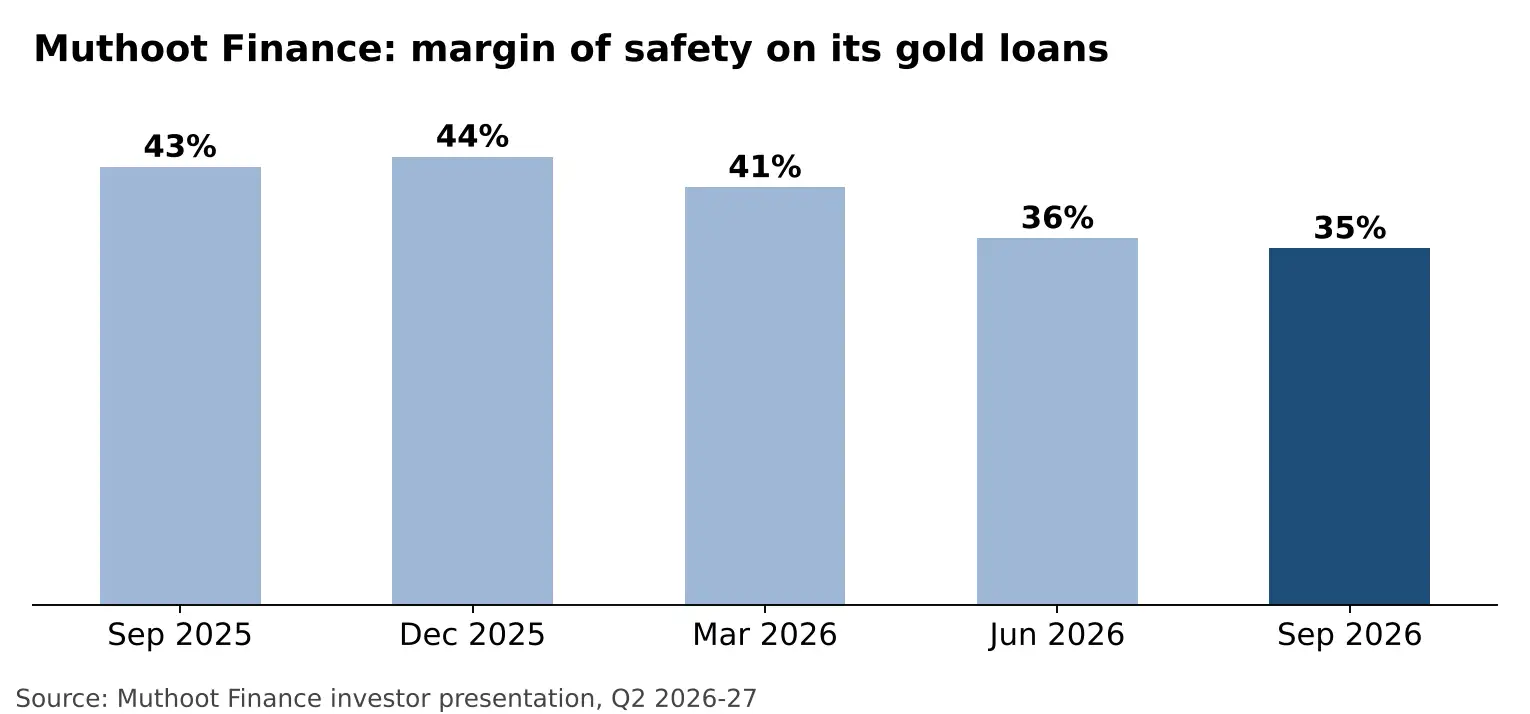
Now, 35% is not a small margin. The gold price would have to fall by about a third from its September level before what is held in Muthoot’s vaults, taken together, is worth less than the loans. Gold has come down since then, but not by anything like that.
At the same time, the figure has to be understood carefully. The margin came down during months when gold was still going up. The price of gold used in the company’s own table was higher in September 2026 than in December 2025, and yet the margin shrank, because the loans grew faster than the value of the gold. That is, the cushion had already become thinner before the price of gold turned.
The company also says, in a note under the same table, that the figure leaves out the interest that has added up on the loans. For a loan that is to be repaid at the end, the RBI’s limit counts that interest. If it is counted here as well, the margin would be somewhat lower than what the table shows.
And, also remember that this is an average over lakhs of loans. A customer who borrowed when gold was much lower, and did not take a top-up after that, has plenty of room even today. One who borrowed or topped up near the peak has much less. The table does not say how the loan book is divided between the two, and that is what would matter most now.
Since September, gold has come down while the loans have stayed. The margin today would be lower than 35%. By how much, the company will say only when it reports next.
Which Loans are Hit First?
A fall in the gold price does not hit all loans together. It first impacts the loans where the borrower is already late.
Lenders sort their loans by how late the payment is. At Muthoot Finance, a loan on which payment is overdue by more than 30 days goes into one bucket, and a loan overdue by more than 90 days goes into another, which is the bucket of bad loans. Both have grown this year. Loans in the first bucket were about Rs. 1,000 crore in March 2026. By September they were more than Rs. 23,000 crore, about an eighth of all its loans. Loans in the second bucket nearly doubled in the same six months.
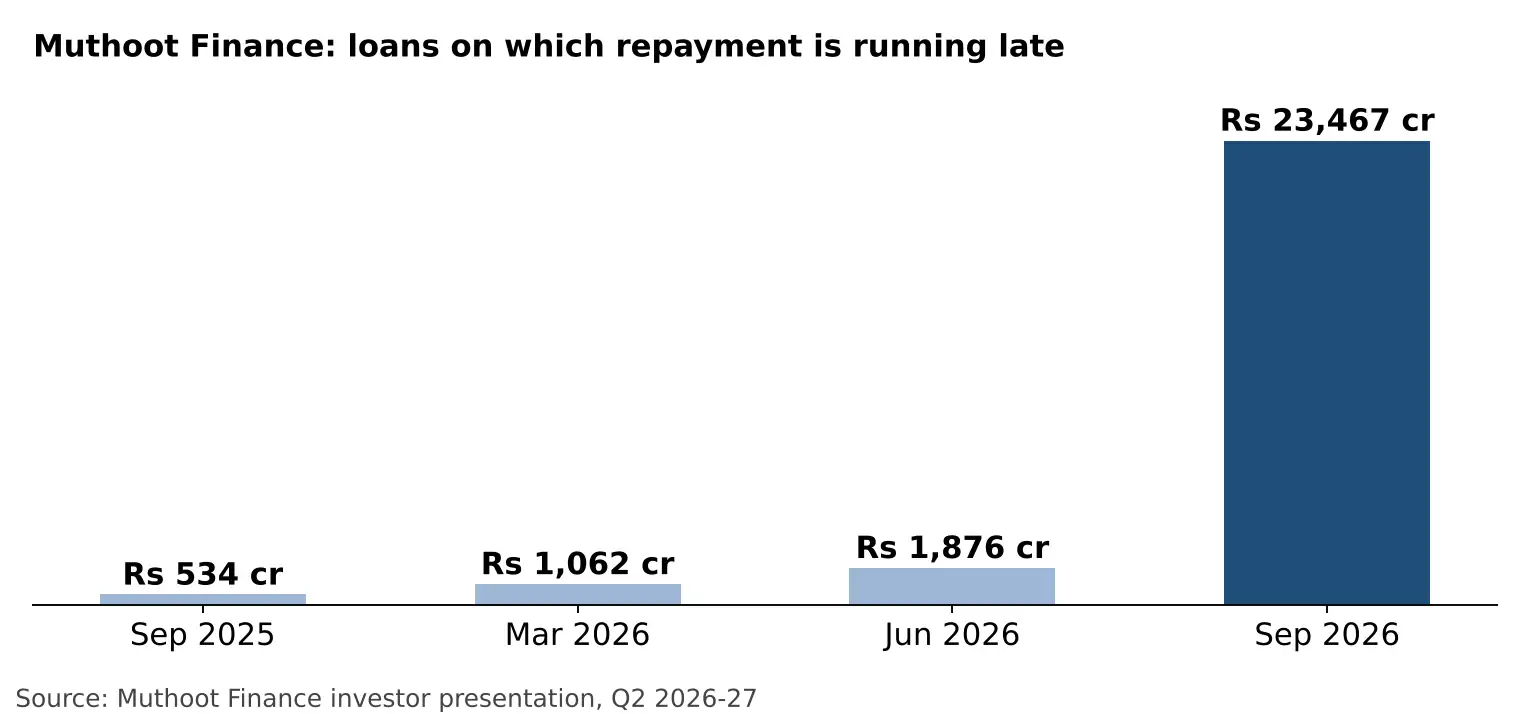
The management had an explanation for this on its results call. It said a customer often has two or three loans, and when one of them runs late, all of them get counted as late, which accounts for a large part of the increase. It said a gold loan turning late or bad is not the same as a loss, because the jewellery is still with the company. It also said it prefers to give the customer more time to repay instead of going for an auction, and that in its experience almost all its customers do repay. By the management’s own account, auctions have been very few so far this year.
All of that can be true. At the same time, giving more time works best when gold is steady or rising, because the jewellery goes on covering the dues while the customer arranges the money. When gold is falling, every month of waiting adds interest on one side and can take away value on the other. That is how the price of gold reaches this part of the loan book.
Then there is the interest that has been charged but not yet collected. Since most borrowers pay at the end, some of it is always there in the books of a gold loan company. Going by what the management has said on its calls, the amount has gone up in the last two quarters. It was unusually low in March, so the rise looks sharper than it is. It is still one of the figures that will tell us how the late loans are behaving.
Manappuram Finance’s management has said on its results call that its late loans have gone up a little, that they are still in single digits as a share of its loans, and that the delay is largely a matter of customer behaviour after the rules changed in April.
What matters from here is whether the loans in the first bucket get repaid, get renewed, or move into the second.
The April Rule Change
A gold loan is usually given for a year. At the end of the year, the borrower has to do one of two things. He can pay the principal and the interest and take his jewellery back. Or, if he does not have the money, he can ask the company to renew the loan for another year.
When the gold price is rising, renewing is easy. The jewellery is worth more than it was a year earlier, so there is room for the old loan and often for some extra money as a top-up. Muthoot Finance’s management told analysts on its results call that customers made use of rollovers and top-ups before the rules changed.
The rules changed on April 1, 2026. That was the last date the RBI had given lenders to move to its new directions on lending against gold. Under the new rules, a gold loan company can renew a loan or give a top-up only on three conditions. The borrower should not be behind on the loan. If the whole amount was to be paid at the end, he has to first pay the interest that has added up over the year. And the loan has to be within the permitted share of the gold’s value, taken at the price of gold on that day.
Each of these is harder to meet when gold has fallen. The interest for a full year has to be paid in cash before the loan can be renewed. And if the jewellery is now worth less than it was when the loan was given, the old loan may itself be above the limit. In that case, the borrower has to repay a part of it as well.
So, a borrower who wants to renew his loan now has to bring money to the branch. If he can, nothing changes for the company. If he cannot, the loan turns late, and if it stays that way, it turns bad.
This matters for the coming months because of the loans given last year. Under the RBI’s directions, a loan given before a lender moved to the new rules continues under the old ones. A one-year loan taken or topped up in early 2026, when gold was high, falls due in early 2027. That is when the new conditions will apply to it for the first time.
None of this makes the rule a bad one. It appears to be aimed at stopping a loan from being renewed year after year while the interest on it goes unpaid, and in the long run that protects the lender too. It is only that it has come into force in the same year in which gold has turned.
The Fall of 2013
Gold prices fell in 2013 as well, and the gold loan companies had grown very fast in the years before that. Muthoot Finance’s annual reports of that period show what a fall in gold does to this business, and also that the business comes through it.
In 2013-14, Muthoot’s gold loan book shrank by about a sixth, from Rs. 26,000 crore to under Rs. 22,000 crore. Its profit fell by more than a fifth that year, and fell again the next year.
Gold was not the only reason. The RBI had at that time capped lending by gold loan companies at 60% of the gold’s value, while banks had no such cap, and the company’s annual report says this had hurt its lending. The cap was later raised to 75%.
The auctions of those years are also on record. In 2013-14, the company auctioned the jewellery of more than seven lakh loan accounts, and what it realised was about 92% of what those borrowers owed. In the next two years it recovered a smaller share. Over the three years, the gap between what was owed and what the auctions brought in added up to roughly Rs. 1,500 crore. In 2025-26, by comparison, the company auctioned fewer than 24,000 accounts.
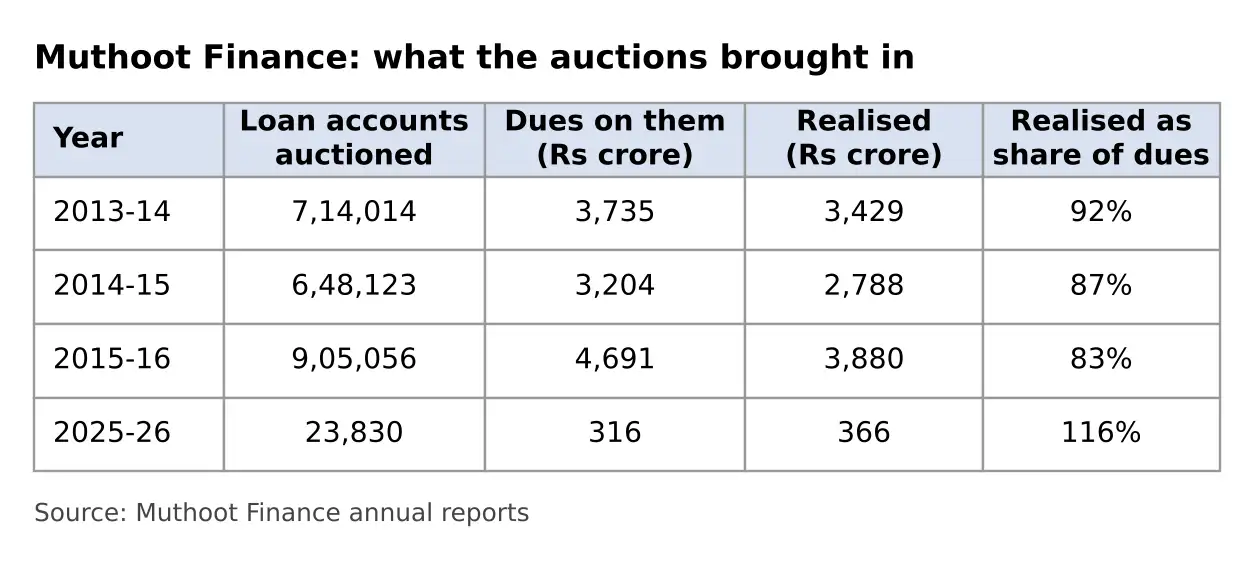
The margin that shows on paper while a loan is running and the money that comes back when the jewellery is finally auctioned need not be the same. By the time a loan necessitates an auction, interest has been adding up on it for a long time, and the price of gold on that day decides the rest.
Muthoot remained profitable in each of those years, and its loan book today is about seven times what it was in March 2013.
So, is today like 2013? In some ways it is easier, because the company is far bigger and has been through this once before. In one way it is harder. In 2013 the fall in gold came at a time when lending was capped at 60% of the gold’s value. This time it has come after a year in which loans grew much faster than the gold held against them.
What to Watch
The first thing to watch is the price of gold itself. If gold holds around the current levels, a good part of the worry goes away, because the loans given near the peak get repaid or renewed over the coming year and the margin stops shrinking. If it keeps falling, or stays down for long, those loans become due one after another at a price lower than the one they were given at.
Within the companies, the late loans come first. A late loan that gets repaid, or renewed under the new rules, is no cause for worry. One that goes to auction is a different matter. If auctions pick up, the figure to look for is how much they bring in against what was owed, as it was in 2013.
Then there is the margin of safety that Muthoot Finance publishes every quarter, and the share of the gold’s value that Manappuram Finance is lending. Both will show, with some delay, what the fall in gold has done. The interest that has been charged but not yet collected is worth a look alongside.
The RBI has put the matter in a balanced way. In its Financial Stability Report of June 2026, it said the risk of gold loans going bad was contained and that the margins gave a comfortable cushion. In the same paragraph it said that lending against gold had grown rapidly at a time when gold prices were moving sharply, and that a long fall in gold could weaken the cover, put borrowers under stress, and lead to more late payments.
Nobody knows where gold will be six months from now. What is known is how much was lent against it when it was high. For a gold loan company, a fall in gold is something to be lived through, as it was the last time. How comfortably it comes through will depend on how the lending was done when gold was rising.

