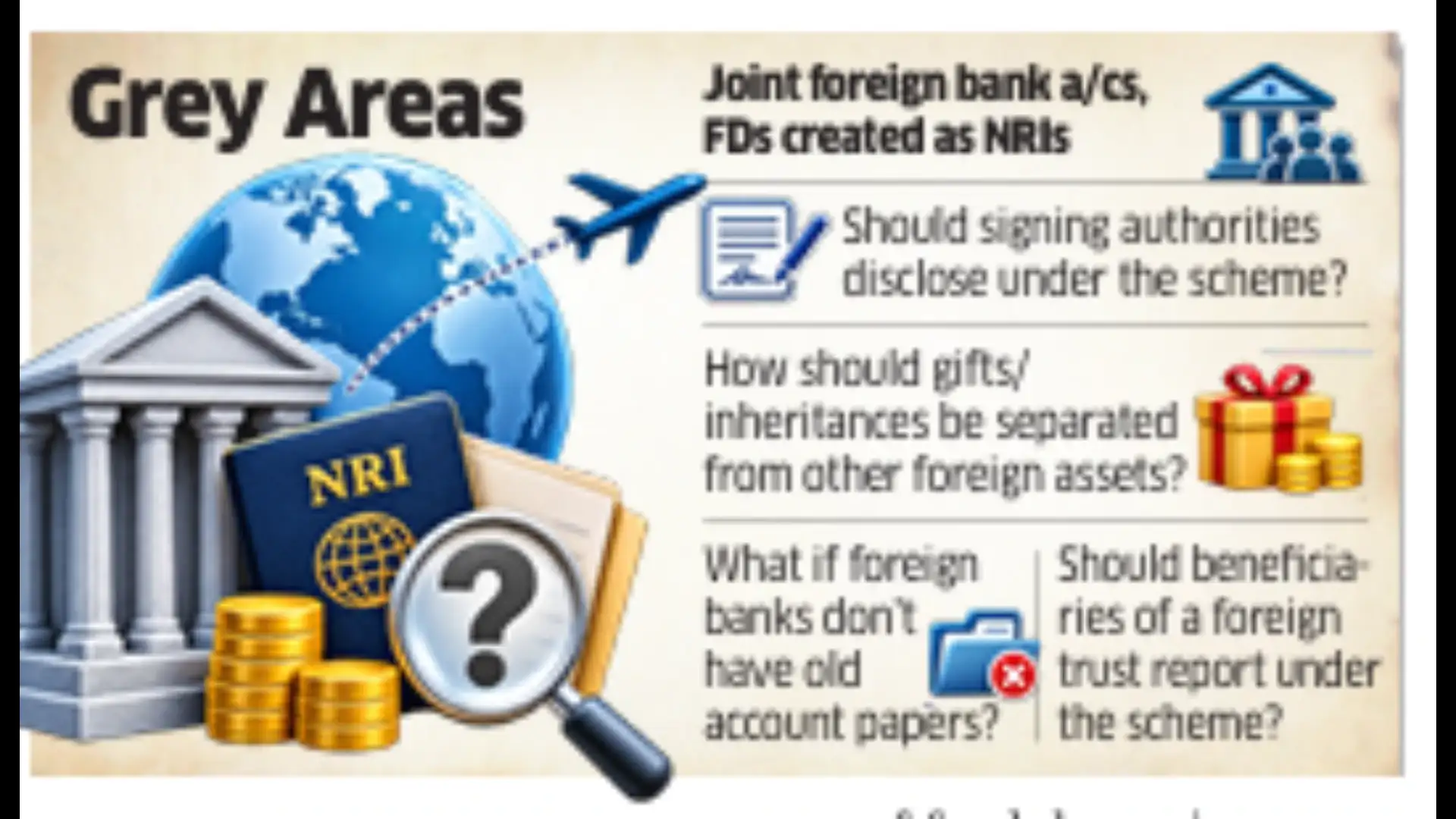
Many are knocking on the doors of tax authorities to cut through the confusion over a list of ambiguities in the miniamnesty scheme for undisclosed foreign assets and income.Will a taxpayer who is merely a signing authority for a foreign bank account but doesn’t own the funds get caught in the tax net after declaring as a signatory? How to segregate gifts and inheritances from other foreign assets which were acquired? Or, what if a foreign bank no longer has the statements of accounts which were opened years ago?
Questions like these and more are cropping up as the December 31 deadline nears for the Foreign Assets of Small Taxpayers-Disclosure Scheme, 2026 (FAST-DS), a one-time compliance initiative.
The voluntary disclosure window, which opened on August 16, allows a person to regularise undeclared overseas stocks, properties, ESOPs, and earnings up to Rs 1 crore without declaring sources of funds by paying a combined tax and penalty of 60%. Foreign assets up to “5 cr acquired with reported earnings can be legitimised with a Rs 1 lakh fine.
Despite the tax office responding to FAQs, taxpayers and professionals want the Central Board of Direct Taxes (CBDT) to clarify several unaddressed issues.
For instance, how to avoid tax and penalties on the quantum of bank deposits accumulated from the overseas earnings of a declarant when he was an NRI? Since NRIs’ foreign earnings aren’t taxed in India, deposits created from that income should not be taxed and penalised.
Those who missed out on reporting, either due to ignorance or wrong advice, are anxious for answers. A declaration, once accepted, cannot be changed; the amount paid will not be refunded, and false information will invalidate the declaration. After December 31, persons who don’t declare under FAST-DS may face a higher financial burden if faced with proceedings under Black Money Act.
After Dec 31, non-declarants may face a higher financial burden if faced with proceedings under Black Money Act.
While a trust beneficiary or for-eign account signatory has to report these facts under the ‘Foreign Assets’ (FA) Schedule in the I-T Return (ITR), it’s felt the same should not be extended to the scheme.
It’s suggested that the Board (or CBDT) confirm that an account over which the taxpayer holds only signing authority, with no financial interest, is not an un-disclosed foreign asset for the purpose of the scheme, said a member of The Chamber of Tax Consultants, which is among the bodies to reach out to CBDT.
Similarly, a beneficiary of a foreign trust has to report the information in the ITR. But some fear that disclosure under FAST-DS could bring them un-der the taxman’s lens even if the beneficiary owns no trust asset or hasn’t received funds from the trust.
“In cases where undisclosed for-eign income is credited to a for-eign bank account, it’s unclear whether the income or bank bal-ance (asset) must be disclosed. An FAQ under the 2015 Scheme suggested that the asset has to be disclosed. FAST-DS doesn’t pro-vide similar clarity. This is im-portant as valuation of income and asset may differ. Another is sue concerns foreign income on which Indian taxes have been paid but wasn’t disclosed in Schedule FA,” said Harshal Bhu-ta, co-founder and country co-head, international tax and FE-MA, at Ascentium India.
Also, in cases where tax payer holds a foreign account jointly with a spouse and has contributed a part of the funds, there’s no mechanism for apportionment between joint holders.
An area of concern, says char-tered accountant Ashish Karundia, relates to employees who inadvertently failed to re-port ESOPs in Schedule FA and subsequently didn’t offer divi-dend income to tax, despite hav-ing paid tax on shares as salary perquisites. “Such employees could face disproportionate and multiple layers of tax and com-pliance costs: withholding tax on dividends in overseas jurisdiction, a 60% levy in India for non-disclosure of dividend and a further 1 lakh for disclosure of underlying shares, irrespective of their value, said Karundia.
Under the scheme, the fair market value of every asset is determined as on March 31, 2026, a clause that dampened enthusiasm for the scheme, thanks to the rupee’s slide against the dollar.
“Most are put off by the 1 crore limit, which today is a minuscule number. In the 2015 scheme, there was no limit. Many who are ready to pay and declare could not participate as the respective amounts breached 1 crore as per March 2026 value. Such a scheme should have higher limits of 100-200 crore to draw wider interest,” said Rajesh Shah, partner at Jayantilal Thakkar, a Mumbai-based CA firm.
Disclosure under FAST-DS could bring beneficiaries under taxman’s lens even if they own no trust asset