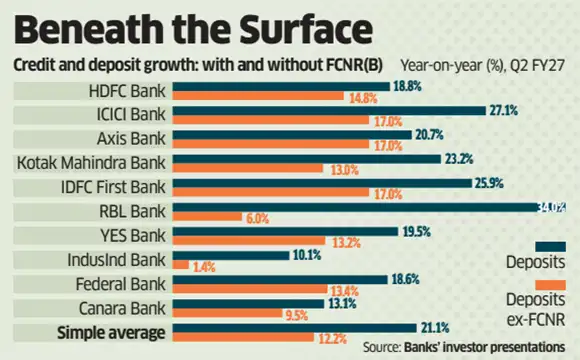
An analysis of 10 banks shows that reported deposit growth averaged 21.1% year-on-year during July-September. However, excluding the special foreign currency inflows, domestic deposit growth was estimated at just 12.2%-a massive gap of nearly nine percentage points.
MUMBAI: The sharp rebound in bank deposit growth during the September quarter appears to mask continued difficulties in domestic deposit mobilisation, as the growth was temporarily inflated by the Reserve Bank of India’s special Foreign Currency Non-Resident (Bank) swap window.An analysis of 10 banks shows that reported deposit growth averaged 21.1% year-on-year during July-September. However, excluding the special foreign currency inflows, domestic deposit growth was estimated at just 12.2%-a massive gap of nearly nine percentage points.
A similar trend was seen in lending. Reported credit growth averaged 24.2%, but excluding loans linked to the central bank’s special window, it was an estimated 18.9%, a difference of more than five percentage points.
The divergence suggests that underlying deposit mobilisation remains weaker than headline numbers indicate, particularly as growth in low-cost current and savings account deposits continues to lag overall deposit growth.
At the banking-system level, RBI data showed that deposit growth of 17.8% at September-end continued to trail credit growth of 19.4%, despite extraordinary foreign-currency inflows. Deposit growth subsequently moderated to 16.7% by October 15, while credit growth remained higher at 18.2%. Credit-deposit ratio stood at 81.6%.
Among individual lenders, RBL Bank reported deposit growth of 34% during the quarter, which moderated to just 6% when FCNR (B) deposits were excluded. Kotak Mahindra Bank‘s deposit growth fell to 13% from 23.2%, while ICICI Bank‘s declined to 17% from 27.1%. HDFC Bank reported 18.8% deposit growth, including a four-percentage-point contribution from the special window.
The impact was also visible on the lending side. ICICI Bank‘s reported advances growth of 30% moderated to 24.1% after excluding FCNR(B)-backed lending, while Axis Bank’s growth of about 23% fell to nearly 19% on its adjusted measure.
The special window, which closed on August 31, helped banks collectively mobilise nearly $133 billion in FCNR (B) deposits. Banks are now looking to deploy the surplus liquidity into fresh lending over the next two quarters while simultaneously reducing their reliance on expensive wholesale deposits and borrowings.
“We are carrying some amount of excess liquidity currently, and I would expect that to be kind of deployed over the next two quarters,” Anindya Banerjee, chief financial officer at ICICI Bank, said during the lender’s September-quarter earnings call.
Kotak Mahindra Bank similarly expects its FCNR (B)liquidity to support incremental lending over the coming quarters, in addition to growth funded by regular deposits.
“The FCNR (B) deployment will be in addition to the core deployment from the core deposit,” said Devang Gheewalla, group chief financial officer at Kotak Mahindra Bank. He indicated that the bank would deploy the remaining liquidity into customer assets over the next few quarters.
RBL Bank is also looking to expand its wholesale and secured retail businesses using the additional liquidity. The bank has already used part of the funds to retire expensive borrowings and bulk deposits, while temporarily deploying the balance into short-term investments and corporate loans.The inflows have temporarily eased competition for domestic deposits.
.

