The words “higher bond yield” have been in the news for some time. In the last 10 days, however, the terminology has changed to “bond rout”. Does this matter to you and me? Yes, because the bond yield impacts everything as it is nothing but a reflection of the cost of money.
So, what is a bond rout? It is, quite simply, a rush to sell government bonds. A government bond is nothing but a loan to a government, and in normal times, it is the safest investment there is. In a rout, too many holders sell these loans at the same time. This causes prices to fall sharply, and governments have to offer much higher interest rates to borrow fresh money.
That is what is happening now in the US, UK, France, and Japan. There are three reasons for this, and they have all come together.
Costly oil has brought back the fear of rising prices. The US central bank has started raising interest rates again, and others are leaning the same way. And governments are borrowing more than lenders are comfortable with.
How big is this issue? On September 30, the interest rate the US pays to borrow for 10 years – called the 10-year yield – closed at 5.29%. That is the highest level since 2002. A month ago, it was about 4.8%. It eased a little, to 5.24%, on October 1.
The US is not alone. The UK’s cost of borrowing for 30 years crossed 6% on October 1. It is the first time this has happened since 1998. France’s 10-year rate touched its highest level in nearly a quarter of a century. Japan, which lived with near-zero rates for a generation, is now paying about 3.1% for 10 years.
Routs have happened in the past. The difference this time is that the selling is heavier in the rich countries. The developing world, India included, is holding up better so far. To understand why, it helps to start with the one thing that touches all of us: The cost of money.
Why This Matters
Money has a price, like anything else. The price is the interest rate. And in any country, the most important interest rate is the one the government pays, because the government is the safest borrower there is. It can tax, and in most countries it controls the currency it borrows in. Nobody else gets to borrow more cheaply.
To understand this better, think of a building. The government’s rate is the ground floor. Every other borrower sits on a floor above it. A bank lending to a large company asks for the government rate plus something extra for the risk. A small business pays more than the large company. A family pays according to its own standing.
So, when the ground floor rate is raised, every floor above goes up with it. This is what a bond rout means for you and me. The cost of money rises for everybody, and it rises without any central bank announcing anything.
Let’s first look at how this impacts companies. The extra interest that European companies of good standing pay over their governments has risen to almost 0.9 percentage points, the highest since April. A company which pays more to borrow will think twice before putting up a new factory.
Now, take the example of a family. Let’s say it has a home loan of Rs. 50 lakh for 20 years. At 7.25%, the monthly EMI is about Rs. 39,500. At 8.25%, it is about Rs. 42,600. So a one percentage point increase costs this family about Rs. 3,100 more every month, or roughly Rs. 7.4 lakh over the life of the loan.
Then look at the governments themselves. The US Treasury’s own schedule shows it selling about $343 billion of notes and bonds in a single month, and that includes replacing old debt which falls due. Every extra percentage point on one month’s sale adds about $3.4 billion a year to its interest bill. So the borrower also pays for the rout.
Now, look at this from another angle. Costlier money is bad for borrowers, but it is better for some savers. New fixed deposits and new bonds pay more. But those who already hold older bonds, directly or through debt mutual funds, pension funds, and insurance policies, see the value of what they hold fall. Why? That needs a two-minute look at how a bond works.
The Bond Mechanics
A bond is a loan that can be bought and sold. When a government needs money, it issues a paper which basically says this: Lend me Rs. 100, I will pay you a fixed sum every year, and I will return the Rs. 100 at the end. The fixed yearly sum is the interest. The return the buyer earns is called the yield.
Remember this, however. The price of a bond and its yield move in opposite directions. Suppose you hold a 10-year bond that pays Rs. 5 a year on Rs. 100. Tomorrow the government issues new bonds that pay Rs. 6. Will anyone pay you Rs. 100 for your old bond when a new one pays more? No. To sell it, you will have to cut the price to roughly Rs. 93, the level at which the buyer also ends up earning 6%. You have lost about Rs. 7 on something you were told was safe.
So, when a headline says yields are rising, the way to read it is like this: Bond prices are falling. And when yields rise quickly in many countries together, everybody who owns bonds, which means banks, insurers, pension funds and mutual funds, is looking at losses all at the same moment. That is a rout.
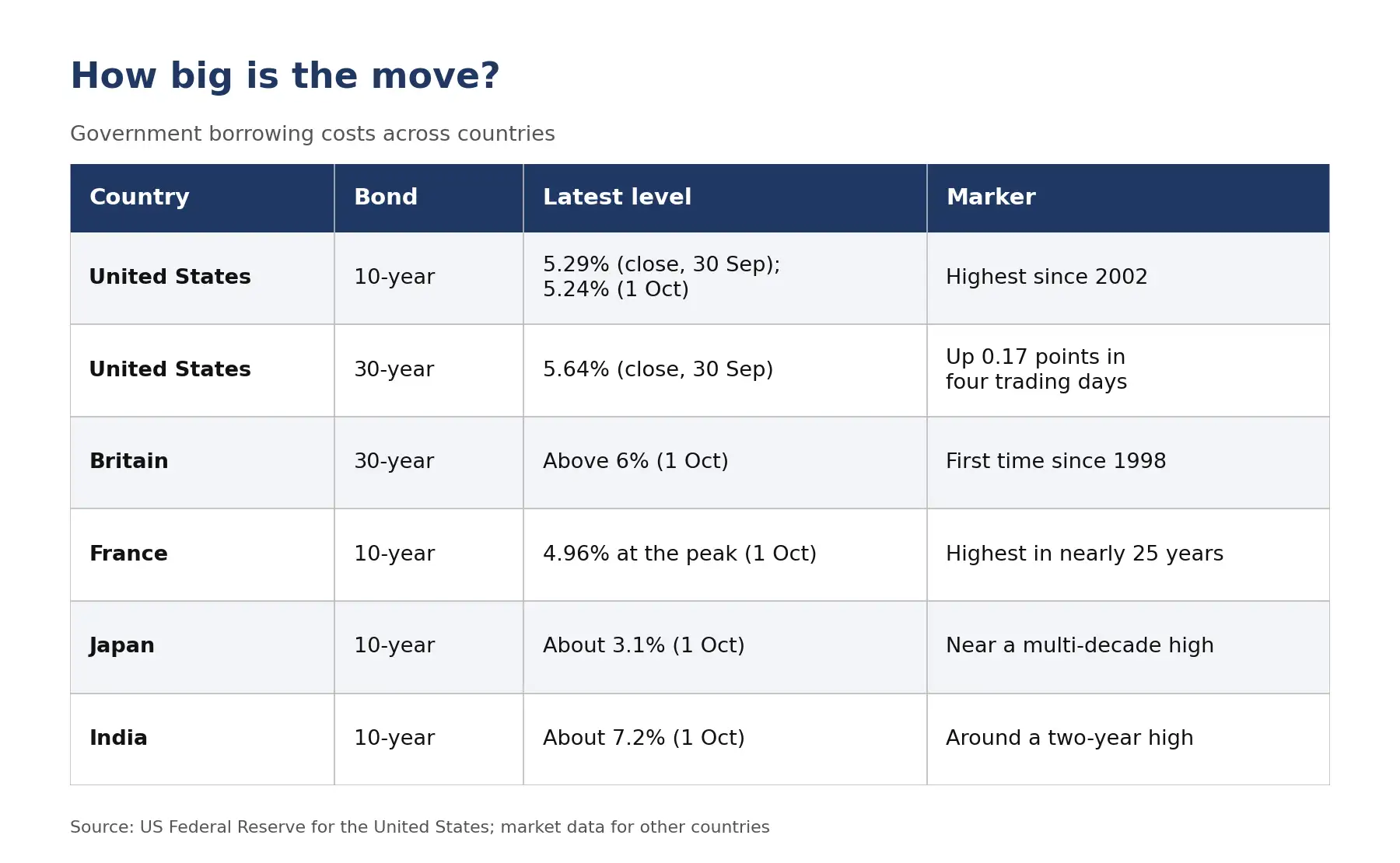
How Big is the Move?
The levels are high. But it is not the level in any one country that stands out. It is that they are all high together. Bond markets normally move for their respective local reasons: A budget here, an election there. For all of them to sell off at once, there has to be something common underneath. That brings us back to the three reasons.
Reason 1: Oil
The US-Iran war has disturbed the world’s energy supply for months. The US Energy Information Administration says oil averaged $91 a barrel in August, $7 more than in July, and that the world’s oil stocks have fallen by an estimated 400 million barrels this year. September was worse. The spot price of Brent crude, which is the price of a barrel for delivery now, stood at $113.96 on September 29.
Now, why does oil matter to a bond? Costly oil pushes up the price of fuel, of transport, and in time of almost everything. When prices rise, the fixed yearly payment on a bond buys less. So the buyer asks for a higher yield to make up for it. In the euro area, inflation rose to 3.2% in August from 2.9% in July. In the US, the central bank’s preferred measure of inflation was running at 3.7% in July.
If oil were the whole story, this would be an inflation scare. Painful, but something we have seen before. It is not, however, the whole story.
Reason 2: Central Banks
For much of the last two years, bond investors assumed the next move in interest rates would be down. That assumption has changed.
On September 16, the US Fed raised its policy rate by a quarter of a percentage point, to a range of 3.75% to 4%. The vote was 12 to 0, and its statement said inflation remains elevated. In the UK, the Bank of England held its rate at 3.75%, but three of its nine rate-setters voted to raise it to 4%. It has also paused its auctions of government bonds while it reviews a different way of selling them.
It is not that every central bank has raised rates. But the direction has turned, and that is what matters for a bond. A 10-year bond is, in a way, a view on where short-term rates will be over the next ten years. If those are seen going up, not down, the 10-year yield has to go up too.
Reason 3: Too Much Borrowing
This is one number which tells us why this is more than just an oil scare.
The US also issues bonds whose payments rise with inflation. How large? The US government bond market is now about $32 trillion in size, and worries about deficits and the volume of new bonds continue to weigh on it. The gross debt figure of the US is close to $40 trillion.
The US Treasury has not increased the size of its bond sales. In August it said it expects to keep auction sizes unchanged for at least the next several quarters. Its own table shows sales of $343 billion of notes and bonds in September, with similar amounts in the months on either side. So, the worry is not about a sudden jump in supply. It is about a steady, large supply, and about who will keep buying it.
And this is where the borrowing feeds on itself. Higher yields raise the government’s interest bill. A bigger interest bill widens the deficit. A wider deficit means more bonds to sell. And more bonds can push yields higher still.
Selling & More Selling
Markets rarely fall in an orderly way. Traders have described the US bond market as caught in a “vicious loop”. Hedge funds and other large investors are reported to have been forced to sell long-term bonds, either to protect the rest of their holdings from rising rates or because their losses crossed a limit.
How does that work? Many funds buy bonds with borrowed money and set a stop-loss, a price at which they must sell to limit the damage. When prices fall to that level, they sell. That selling pushes prices down further, which brings the next fund to its own stop-loss. Nobody in this chain has changed his view of the US economy. They are selling because they have to.
Each country has its own problem. The US has its deficit. France has its public finances. Japan has a central bank that is slowly ending decades of cheap money. But these markets are tied to each other by the people who own them.
Japan shows it best. For years a Japanese saver earned almost nothing on a bond at home. When a Japanese 10-year bond pays about 3%, money has less reason to flow abroad. And a buyer who stays home is, for the US and Europe, a buyer lost. As one market strategist put it, as yields move up, they pull each other up.
What About Shares?
A more expensive “safe” rate raises the bar for every risky asset. Shares linked to one strong theme can look past that for a while. Can they do it for long? History gives a reason to be careful. US stocks did sell off over rising yields in 2023.
In the past, rising US yields and a strong dollar were the usual trigger for a sell-off in developing countries. This time it has not gone that way, at least so far.
An index of government bonds issued by emerging markets in their own currencies is flat for the year, while a similar index for rich-country bonds is down 4.5%. Since the end of 2025,US 10-year yield has risen by more than that of Indonesia, South Africa, Mexico, India, or Malaysia. In Brazil and Colombia, yields have actually fallen. Of the 10 countries in the comparison, only Poland has seen a bigger rise than the US.
Why? Investors give three reasons. Many developing countries kept their government finances in tighter order. Their central banks raised rates early when prices started rising after the pandemic, and earned trust for it. And in several of them, local savers and institutions now buy enough government bonds that the country depends less on foreign money. South Africa’s central bank governor put it in one comparison. The country has missed its inflation target for six months. America has missed its own for 67.
Now, why does this matter for our question? If oil alone were the cause, the oil-importing developing countries should have been hurt the most. They are not. So the pattern points to borrowing and inflation records, and not to oil alone.
At the same time, it would be wrong to call anyone safe. Countries that have to keep renewing large amounts of short-term debt, such as Argentina and Egypt, are exposed. A fall in US shares could reduce the appetite for every risky asset, emerging markets included. And there is a level to watch. The yield on a widely followed index of emerging-market dollar bonds is at 7.2%, and analysts say investors have tended to sell when it reaches 8%.
And India?
India sits in the group that has held up. Its 10-year government bond yield has risen less than the US since the end of 2025. But it has risen, to about 7.2% on October 1, around a two-year high.
India imports most of its oil, so the oil part of the story reaches it directly. The minutes of the RBI’s August meeting put retail inflation at 4.4% in June, back above the 4% target after 16 months below it, and carry the RBI’s own projection of an average of 5% for this financial year.
The RBI’s policy rate, the repo rate, was kept at 5.25% in August. That leaves the 10-year yield almost 2 percentage points above it. In plain words, the bond market has already raised the cost of money in India to some extent, without the RBI doing anything. It is the ground-floor effect we saw earlier.
The timing is worth noting. The RBI’s rate-setting committee is meeting from October 5 to 7. It meets with the US central bank having just raised rates, with oil well above where it was at the last meeting, and with the rupee to look after.
On the other side, a special RBI scheme over the summer brought in nearly $133 billion of non-resident deposits, and that gives it room. Is that room enough if US yields stay where they are? That is the question to keep in mind this week.
What Can Stop It?
There are four ways out, and it helps to keep them apart. One, oil cools, and with it the fear of rising prices. Two, central banks step in as buyers. Three, governments cut their borrowing, or shift it towards shorter-term debt to take the pressure off long bonds. Four, yields simply rise to a level at which pension funds and insurers find them too good to refuse, and buying comes back by itself.
The first depends on a war. The second has to do with central banks that are trying to bring inflation down. The third asks governments to do something that is never easy. That leaves the fourth, which does work, but only after more pain. Which of these will come first? No one quite knows.
So, what should you watch? Five things would do. The price of oil for delivery now, not later. The results of government bond auctions, which show whether buyers are turning up. The statements of central banks, and any hint of buying bonds. The gap between what companies and governments pay to borrow. And the yield on inflation-linked bonds, because that shows most plainly what lenders are charging governments for their debts.
Oil may have lit this fire. But the wood was piling up for years, in the form of government borrowing at a time when money was cheap. No one can say how long the selling will last. What we can say is that the cost of money starts with the government’s bond, and that is the number to understand first.

