Read more at: https://taxguru.in/income-tax/ao-dispose-reopening-objections-reassessment-itat-mumbai.html?utm_source=follow.it
Copyright © Taxguru.in
Objections Cannot Be Buried in the Final Order – Reassessment Quashed for Skipping the GKN Mandate
Background
The assessee-company was engaged in importing electronic goods such as batteries and torches and selling them in the wholesale market. For Assessment Year 2015-16, it filed its original return declaring a total income of ₹29,29,433.
A search was conducted by the Investigation Wing in the case of Shri Renukamata Multi State Co-operative Urban Credit Society Ltd. The Department allegedly found that several accounts maintained with the society belonged to persons of limited financial means, although substantial cash deposits and high-value transactions had been routed through those accounts.
Based on the information received from the Investigation Wing, the Assessing Officer formed a belief that the assessee had undertaken unexplained transactions of ₹3,20,97,440 with Ashish Panchal, proprietor of Nine Impex, and ₹8,33,00,000 with Zara Trading Private Limited through the said credit society. The total alleged unexplained transactions amounted to ₹11,53,97,440.
Since these transactions were allegedly not reflected in the return of income, the assessment was reopened under section 147 by issuing notice under section 148.
Assessee Denies Transactions and Files Objections
In response to the notice under section 148, the assessee filed its return on 28 July 2021. The recorded reasons were also supplied to it.
The assessee thereafter filed its objections on 28 December 2021. It specifically contended that it had not undertaken any transaction with Shri Renukamata Multi State Co-operative Urban Credit Society Ltd. It also challenged the reopening as being based merely on information received from the Investigation Wing without any independent inquiry or application of mind by the Assessing Officer.
Despite the objections being available on record, the Assessing Officer did not pass a separate speaking order disposing of them. Instead, he proceeded with the reassessment, issued a final show-cause notice and eventually treated the entire sum of ₹11,53,97,440 as bogus transactions and added it to the assessee’s income.
The CIT(A) upheld the assessment. The assessee approached the Mumbai Tribunal and raised additional grounds challenging the validity of the reassessment itself.
Revenue’s Defence
The Revenue argued that the reopening was based on credible information received through the Insight and verification mechanism. According to it, the Assessing Officer had applied his mind to the information, recorded reasons and obtained the necessary approval under section 151.
It was further contended that adequate opportunities had been granted to the assessee through notices under section 142(1). The assessee’s objections and submissions had been considered during the assessment proceedings, and therefore, there was no procedural violation.
The Revenue also attempted to characterise the objections as general in nature, contending that the assessee had principally sought additional time and a personal hearing.
Question Before the Tribunal
The fundamental question before the Tribunal was whether the Assessing Officer could complete the reassessment without first disposing of the assessee’s objections by passing a separate speaking order.
The Tribunal admitted the additional grounds because they raised a pure question of law going to the root of the reassessment proceedings and were based on material already available on record.
Considering Objections Is Not the Same as Disposing of Them
The Tribunal examined the chronology of events and found that the assessee had filed its objections on 28 December 2021. However, no separate speaking order disposing of those objections had been passed before the reassessment was completed.
Even during the appellate proceedings, the Revenue was unable to produce any such speaking order.
The Tribunal rejected the Revenue’s contention that the objections had been considered during the reassessment proceedings. It held that mere consideration of the objections in the course of assessment or in the final reassessment order could not substitute the mandatory requirement of disposing of them through a separate speaking order.
GKN Driveshafts Procedure Is Mandatory
The Tribunal relied upon the Supreme Court’s landmark decision in GKN Driveshafts (India) Ltd. v. ITO [2003] 259 ITR 19 (SC).
The procedure laid down by the Supreme Court requires that, after receiving the reasons recorded for reopening, the assessee may file objections to the issuance of notice. Once such objections are filed, the Assessing Officer is duty-bound to dispose of them by passing a speaking order before proceeding further with the reassessment.
The object of this procedure is to enable the assessee to understand why its objections have been rejected and, if necessary, challenge that rejection before the appropriate forum before the reassessment is concluded.
No Second Innings to the Assessing Officer
The Tribunal further relied upon the Bombay High Court’s decision in KSS Petron Pvt. Ltd. v. ACIT, which held that failure to follow the procedure prescribed in GKN Driveshafts goes to the jurisdiction of the reassessment proceedings.
Significantly, the Bombay High Court had also held that such a defect cannot be cured by remanding the matter to the Assessing Officer and giving him another opportunity to dispose of the objections. The Tribunal also referred to the Madras High Court’s decision in Jayanthi Natarajan v. ACIT, which recognised the mandatory nature of this procedure.
Accordingly, the reassessment order passed under section 147 read with section 144B was quashed. Since the reassessment itself was invalid, the grounds concerning the merits of the ₹11.53 crore addition became academic and were left open.
Authors’ Comments
This decision reiterates that filing objections against reopening is not an empty ritual. Once objections are filed, the Assessing Officer must dispose of them through a separate and reasoned speaking order before completing the reassessment.
The Department cannot contend that the objections were indirectly considered while making the final addition. Such an approach defeats the very purpose of the procedure prescribed by the Supreme Court. The assessee must receive the decision on its objections at an intermediate stage, when it still has an effective opportunity to challenge the continuation of the reassessment.
The ruling is also important because the Tribunal did not remand the matter for correcting the defect. Following the jurisdictional Bombay High Court decision in KSS Petron, it treated the failure as going to the root of jurisdiction and quashed the reassessment itself.
However, the principle must be applied with reference to the statutory regime governing the relevant year and the date of initiation of reassessment. The present case arose under the earlier reassessment framework and the procedure laid down in GKN Driveshafts.
The practical lesson is clear: whenever reasons for reopening are supplied, objections should be filed specifically and promptly. If the Assessing Officer proceeds without passing a separate speaking order, the reassessment becomes vulnerable on jurisdictional grounds—irrespective of the magnitude of the proposed addition.
Cases Discussed
- GKN Driveshafts (India) Ltd. v. ITO & Ors. [2003] 259 ITR 19 (SC) — relied upon for the mandatory requirement that objections to reopening be disposed of by a speaking order before proceeding with reassessment.
- KSS Petron Pvt. Ltd. v. ACIT, ITA No. 224 of 2014, order dated 03.10.2016 (Bombay High Court) — relied upon for the principle that failure to follow the GKN Driveshafts procedure goes to jurisdiction and cannot be cured by restoring the matter to the Assessing Officer.
- Jayanthi Natarajan v. ACIT [2018] 100 taxmann.com 511 (Madras) — referred to regarding the mandatory procedure for disposal of objections to reopening.
FULL TEXT OF THE ORDER OF ITAT MUMBAI
1. The instant appeal of the assessee filed against the order of NFAC, Delhi [for brevity “Ld. CIT(A)”], order passed under Section 250 of the Income Tax Act, 1961 (for brevity ‘the Act’), for Assessment Year 2015-16, date of order 25.08.2025. The impugned order emanated from the order of the National Faceless Assessment Center, Delhi (for brevity ‘Ld. AO’), order passed under Section 147 r.w.s. 144B of the Act, date of order 30.03.2022.
2. The assessee filed the original return by declaring total income Rs. 29,29,433/-. The case was reopened u/s. 147 and accordingly a notice was issued u/s. 148 of the Act on 31.03.2021 based on the information received from the Investigation Wing of the Department that the assessee had taken accommodation entry made by way of unexplained transaction amount to Rs. 3,20,97,440/- with Mr. Ashish Panchal, proprietor of M/s Nine Impex, and Rs. 8,33,00,000/- with M/s. Zara Trading Private Limited through Shri Renukamata Multi State Cooperative Urban Credit Society Limited, which comes total amount to Rs. 11,53,97,440/- during the impugned assessment year. As the total transaction of Rs. 11,53,97,440/- was not reflected in the ITR, the Ld. AO had initiated proceedings u/s. 147 of the Act. In response to the notice u/s 148, the assessee filed the return on 28.07.2021. The assessee engaged in business of importing electronic goods like batteries, torch, etc. and selling on local market on wholesale trading basis. In response to the notice, the assessee filed the written submission and informed that the assessee had no transaction with the Renukamata Multi State Cooperative Urban Credit Society Limited. But finally, the Ld. AO treated the entire transaction as a bogus transactions and the addition was confirmed total amount to Rs. 11,53,97,440/- with the total income of the assessee. The aggrieved assessee filed an appeal before the Ld. CIT(A), but the Ld. CIT(A) had rejected the appeal of the assessee. Being aggrieved, the assessee filed an appeal before us.
3. The Ld. AR challenged the jurisdiction of Ld. AO related issuance of notice u/s. 148 and completion of assessment u/s. 147 without disposing the objection filed by the assessee during the proceedings through the Additional Ground. The Additional Ground taken by the assessee is duly reproduced as below:
“I. Reopening is bad in law:
1. The reopening of the assessment vide notice u/s 148 of the Act dated 31/03/2021 is bad in law as the same is based on borrowed satisfaction the impugned notice is issued merely on information received that the Assessee has undertaken an unexplained transaction with M/s Renukamata Multi State Cooperative Urban Credit Society Ltd during the year, without appreciating the fact that there was no such transaction undertaken by the assessee with the said credit society and therefore the reopening is bad in law.
2. The learned CIT (A) failed to appreciate that the details of the alleged transactions with M/s Renukamata Multi State Co-operative Urban Credit Society Limited had not been provided to the assessee and therefore the assessment has been completed based on assumptions and presumptive basis.
3. The Ld. CIT(A) failed to appreciate that notices were issued u/s. 142(1) of the Act and reassessment order was passed without disposing off the objections raised by the assessee, therefore the same was in violation of the procedure as laid down by the Hon’ble Supreme Court in the case of GKN Drive Shaft reported in 259 ITR 19 and hence the entire proceedings are void-ab-initio.
The assessee craves leave to add, alter modify or delete one or more ground before or at the time of hearing of Appeal.”
4. The Ld. AR filed paper books comprising pages 1 to 587, which have been placed on record. The Ld. AR submitted a detail of the reassessment proceedings initiated by Ld. AO. Ld. AR submitted the list of dates & events which are as follows:-
| Sl. No. | Particulars | Date | APB Page |
|---|---|---|---|
| 1. | Reasons recorded | 31.03.2021 | 45 |
| 2. | Notice u/s. 148 | 08.07.2021 | 36 |
| 3. | Return of RY filed u/s. 148 | 28.07.2021 | 35 |
| 4. | Notice u/s. 143(2) issued | 07.12.2021 | 39-40 |
| 5. | Notice u/s. 142(1) | 09.12.2021 and 22.12.2021 | 49-50 |
| 6 | Objection filed by the assessee | 28.12.2021 | 51-54 |
| 7 | Notice u/s 142(1) | 24.01.2022 | 55-56 |
| 8 | Showcause Notice | 21.03.2022 | 90-98 |
5. The Ld. AR invited our attention in recorded reasons duly noted by the Ld. AO. The said recorded reason was supplied to the assessee, which is enclosed in APB page 45 to 46. The relevant part of the observations of the ld. AO is reproduced as below:
“A search operation was carried out at the offices (head and branch) of M/s. Renukamata including head office at Ahmednagar and branch offices at Mumbai, Ahmedabad, Chennai, Hyderabad, Ulhasnagar by the Investigation Wing, Mumbai on 26.05.2017. During the field enquiries at the premises of account holders in Mumbai, it was found that most of such account holders are persons of low means and their financial profiling do not correspond to the high volume of cash deposits in their accounts with the society.
It is further noticed that the assessee has involved in the transactions made with credit society during the F.Y.2014-15 as unexplained credit of Rs.3,20,97,440/- and other transactions totaling to Rs.8,33,00,000/-, In total the assessee has unexplained transactions of Rs. 11,53,97,440/- during the F.Y.2014-15, which was not reflected in its return of income for A.Y.2015-16.
In this case a return of income was filed for the year under consideration but no scrutiny assessment u/s. 143(3) of the Act was made. Accordingly, in this case, the only requirement to initiate proceeding u/s. 147 is reason to believe which has been recorded above.
It is pertinent to mention here that in this case the assessee has filed return of income for the year under consideration but no assessment as stipulated u/s. 2(40) of the Act was made and the return of income was only processed u/s. 143(1) of the Act. In view of the above, the provisions of clause (b) of Explanation 2 to section 147 are applicable to facts of this caseand the assessment year under consideration is deemed to be a case where income chargeable to tax has escaped assessment.
Thus, on the basis of material available on record, I have reason to believe that there is failure on the part of the Assessee to disclose fully and truly all the material facts necessary for its assessment for the year under consideration. Therefore, I have reason to believe that the income chargeable to tax amounting Rs. 11,53,97,440/- has escaped assessment coming within the meaning of section 147 of the Income Tax Act, 1961.”
6. The Ld. AR contended that, upon receipt of the reasons recorded for reopening the assessment, the assessee duly filed objections thereto. However, without disposing of the said objections, the Ld. AO proceeded to frame the impugned reassessment order. Accordingly, the Ld. AR submitted that the reassessment order passed under section 147 of the Act is bad in law.
The Ld. AR further placed on record the response sheet evidencing the assessee’s compliance with the notice issued under section 142(1) of the Act. The said response sheet dated 28.12.2021 contains the objections raised by the assessee, inter alia, stating that the assessee had not entered into any transaction with the concerned co-operative society. The relevant submission is reproduced as under:
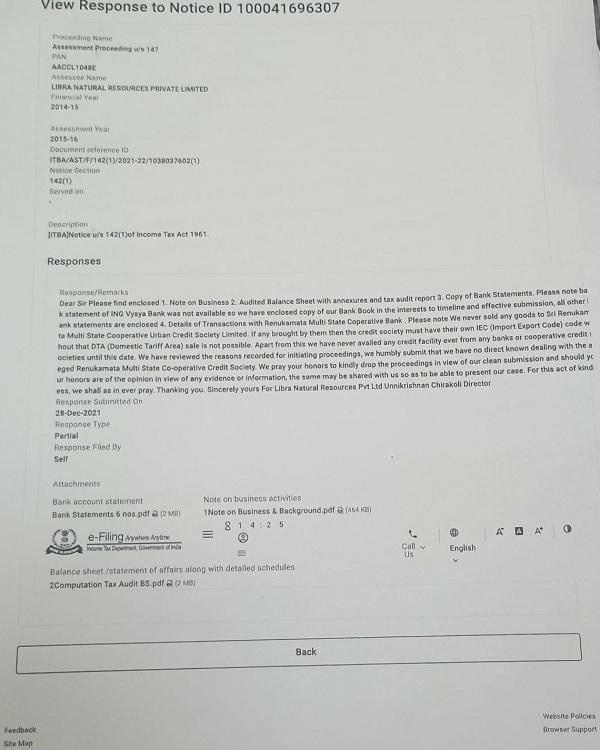
7. The Ld. DR argued and relied on the order of revenue authorities. The Ld. DR filed a written submission comprising pages 1 to 52 on dated 03.09.2026, which has been placed on record. The relevant part of the DR’s submission is reproduced as below:
“AO’s Comments on Additional Grounds
Ground No. 1: Reopening under Section 148 is bad in law
The contention of the assessee is not acceptable. The notice under section 148 dated 31.03.2021 was issued after recording reasons to believe based on credible information received through the Insight/verification mechanism regarding financial transactions linked to the assessee. The Assessing Officer applied independent mind to the information before recording reasons and obtaining the requisite statutory approval under section 151. The validity of reopening has already been upheld during the assessment proceedings. The reassessment proceedings were initiated in accordance with the provisions of the Income-tax Act, and therefore the reopening is valid in law.
Ground No. 2: Details of alleged transactions were not provided
The assessee’s contention is denied. During the reassessment proceedings, notices under sections 148 and 142(1) were duly issued, providing sufficient opportunity to the assessee to explain the transactions. The assessee was informed of the basis of reopening and was given adequate opportunity to furnish evidence. The assessment was completed after considering the material available on record and the submissions made by the assessee. Hence, the assessment cannot be said to have been completed merely on assumptions or presumptions.
Ground No. 3: Objections were not disposed of before passing the reassessment order
As per ITBA System, it is seen that notice u/s.142(1) of the Act on dated 08.07.2021 & 22.12.2021 and 24.01.2022 were issued to the assessee with the specific questioner has been issued to the assessee. It is pertinent to mention that there are no any specific objection has been raised except general objection i.e. request for personal hearing and sufficient time to provide the Submission.
It is submitted that adequate opportunities were provided to the assessee during the reassessment proceedings. The objections raised by the assessee were duly considered during the course of assessment. The reassessment order was passed only after considering the facts, material available on record, and the assessee’s submissions. Therefore, there is no violation of the prescribed procedure, and the reassessment order is legally sustainable.
In view of the above, the additional grounds raised by the assessee are devoid of merit and deserve to be rejected. The order passed under section 147 read with section 143(3) is in accordance with the provisions of the Income-tax Act and may kindly be upheld.”
8. We have heard the rival submissions and perused the material available on record. The additional grounds raised by the assessee go to the root of the validity of the reassessment proceedings and arise from the facts already available on record. Accordingly, the additional grounds are admitted for adjudication. The undisputed chronology of events shows that the assessee, after obtaining the reasons recorded for reopening, filed its objections on 28.12.2021. Thereafter, the Ld. AO proceeded with the reassessment and issued the final show-cause notice dated 21.03.2022. However, no separate speaking order disposing of the objections was passed before completion of the reassessment proceedings. The revenue, despite relying upon the factual report, has also not brought on record any separate speaking order disposing of such objections.
9. The contention of the Ld. DR that the objections were considered during the reassessment proceedings does not cure the above defect. The procedure laid down by the Hon’ble Supreme Court in GKN Driveshafts (India) Ltd. v. ITO & Ors. reported in [2003] 259 ITR 19 (SC) requires the Assessing Officer, upon receipt of objections to the notice for reopening, to dispose of the same by passing a speaking order before proceeding with the reassessment. Consideration of the objections in the course of reassessment cannot substitute the requirement of their disposal in the manner prescribed.
10. We further find that the Hon’ble Bombay High Court in KSS Petron Pvt. Ltd. v. ACIT, ITA No. 224 of 2014, order dated 03.10.2016, as relied upon in the present proceedings, has held that failure to follow the procedure prescribed in GKN Driveshafts (India) Ltd. (supra) goes to the jurisdiction of the reassessment proceedings and such defect cannot be cured by restoring the matter to the Assessing Officer. The same principle has also been referred to in Jayanthi Natarajan v. ACIT reported in [2018] 100 taxmann.com 511 (Madras).
11. In the present case, the assessee’s objections dated 28.12.2021 were admittedly on record, whereas no separate speaking order disposing of those objections has been produced before us. Mere reference to or consideration of the objections in the subsequent proceedings cannot be equated with compliance with the mandatory procedure laid down in GKN Driveshafts (India) Ltd. (supra).
12. Accordingly, respectfully following the aforesaid judicial precedents, Additional Ground Nos. 1 to 3 are allowed and the reassessment order passed under section 147 read with section 144B of the Act is quashed. Consequently, the original grounds raised on merits have become academic and are, therefore, left open and not adjudicated.
13. In the result, the appeal of the assessee bearing ITA No. 6695/Mum/2025 is allowed.
Order pronounced in the open court on 18th day of September 2026.

