‘Inflation is too high…’: Fed hikes interest rates by 25 bps as Warsh resists Trump’s cut demand
The US Federal Reserve raised interest rates on Wednesday for the first time since 2023, moving to contain inflation that has stayed well above its long-term target. The Federal Open Market Committee announced the decision after a two-day meeting, lifting the benchmark interest rate by 25 basis points to a range of 3.75%-4.00%.The move marks a shift for the US central bank, which had kept rates unchanged since January as it waited to assess the impact of higher energy prices, tariffs and broader price pressures on the economy.
Inflation forces Fed action
The Fed’s decision comes after consumer inflation stayed at 3.4% in August, unchanged from the previous month but still much higher than the central bank’s 2% target. Inflation pressures have been supported by higher energy prices following renewed tensions in the Middle East, the impact of tariff policies and strong demand linked to the artificial intelligence boom.
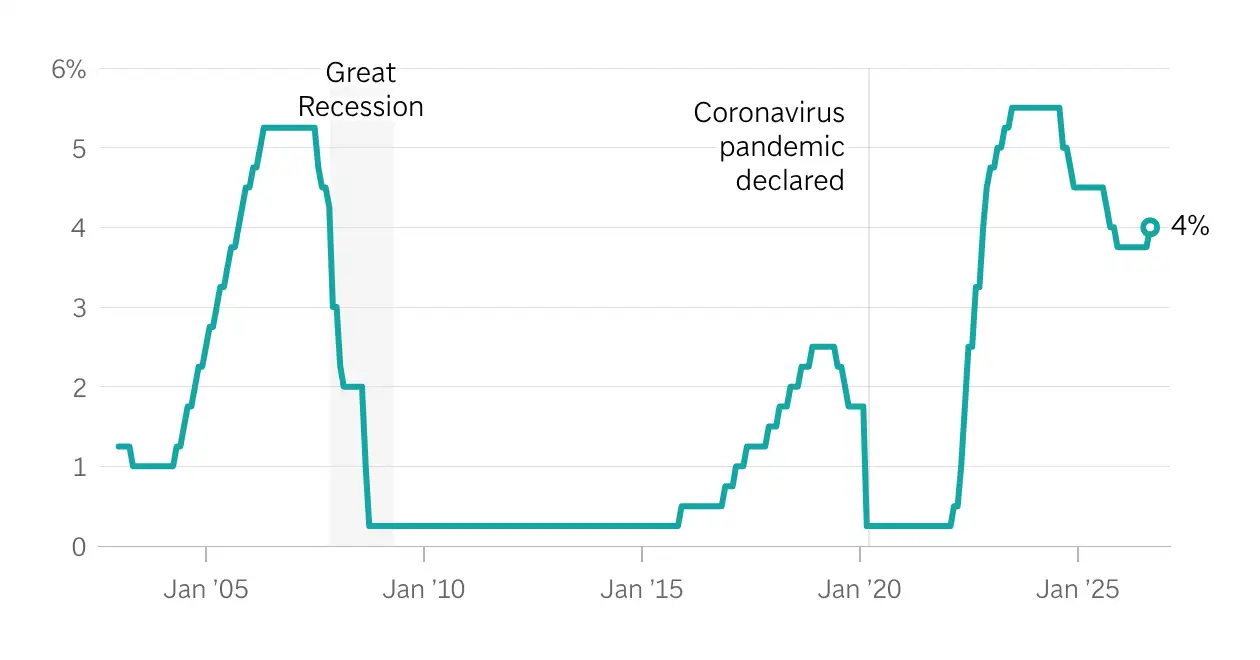
The central bank had earlier chosen to wait before changing rates, but the latest inflation data strengthened the case for action. At the Fed’s July meeting, a quarter of voting members had dissented from the decision to hold rates steady and had called for an immediate hike.
Warsh faces first big credibility test
The rate hike is also a major test for Fed Chair Kevin Warsh, who took over the central bank earlier this year. Warsh had avoided giving clear guidance on the likely path of rates, but he had signalled that the Fed would act if inflation failed to slow meaningfully.
The decision could put him at odds with US President Donald Trump, who had picked Warsh with the expectation that he would support lower interest rates to boost economic activity.
Trump has repeatedly pushed the Fed to cut rates, arguing that lower borrowing costs would help growth. But inflation has left the central bank with less room to ease policy.
Also Read: US Fed chair Kevin Warsh explains why the Federal Reserve raised interest rates
What the rate hike means
Analysts say that a hike could strengthen the Fed Chair’s inflation-fighting credibility, and the Fed may need to signal a limited further hiking cycle to avoid excessive tightening of financial conditions.
Disclosure: This article has been written by Podishetti Akash, who is not a SEBI-registered Research Analyst or an Investment Adviser. Podishetti Akash and her ‘relative(s)’ (as defined under Section 2(77) of the Companies Act, 2013) do not hold any financial interest in the companies mentioned in this article as of the date of publication. The views/recommendations mentioned in this article, wherever applicable, are those of the respective SEBI-registered Research Analyst/brokerage and have been reproduced/reported with due attribution. They should not be construed as the views or recommendations of The Economic Times Digital or the journalist. Readers are advised to consider the original research report and make their investment decisions based on their own assessment. Brokerage disclourses here.
View 8 Comments on this Story
(What’s moving Sensex and Nifty Track latest market news, stock tips, Budget 2025, Share Market on Budget 2025 and expert advice, on ETMarkets. Also, ETMarkets.com is now on Telegram. For fastest news alerts on financial markets, investment strategies and stocks alerts, subscribe to our Telegram feeds .)
Subscribe to ET Prime and read the Economic Times ePaper Online.and Sensex Today.
Top Trending Stocks: SBI Share Price, Axis Bank Share Price, HDFC Bank Share Price, Infosys Share Price, Wipro Share Price, NTPC Share Price
…moreless
NEXT STORY
SECTIONS
ETMarkets.comLast Updated: Sep 17, 2026, 01:13:00 AM IST
The Federal Reserve increased interest rates by 0.25 percent. This action was driven by a strengthening US economy and rising inflation. Domestic spending remains resilient and job gains are keeping pace. Inflation has stubbornly stayed above the Federal Reserve’s target for years. The central bank’s focus remains on achieving price stability.

Listen to this article in summarized format
×
Subscribe to

Unlock AI Briefing and Premium ContentSubscribe Now
Already a member? Sign In
The strengthening of US economy and geopolitics pushing inflation higher were key reasons for the Federal Reserve to raise interest rates, its chair Kevin Warsh said on Wednesday. Reiterating his commitment not to give forward guidance on the rate path, he pointed to trends in the economic data to deliver the Fed’s stated objective of price stability.The American economy appears to be strengthening. New hirings, private sector earnings and business capital investment have improved in recent months. Credit flows have been robust, he said at a press conference, adding, “I would be hard pressed to describe broad financial conditions as restrictive. So we removed the dose of accommodation, so that financial and credit conditions would be more consistent with our ultimate objectives.”
The Federal Reserve raised the interest rate range by 0.25% to 3.75%-4%. “Economic activity is expanding at a solid pace. While uncertainty remains elevated owing, in part, to geopolitical developments, domestic spending has been resilient. Productivity growth is strong, and capital investment is robust. Job gains have kept pace with the workforce, and the unemployment rate has changed little,” the Fed said in a statement.
Also Read: A 25 bps hike: US Federal Reserve raises interest rates for first time since 2023
Warsh however said that despite the geopolitcal landscape, one would appreciate the resilience of the US economy. And while the job market also remains resilient, inflation has stubbornly remained above the Fed 2% target for years.

Live Events
“So our predominant focus is on the price stability side of our mandate. Plain fact is that inflation is too high, and has been for too long. This summer’s inflation readings do not tell me that underlying trends have meaningfully improved,” he said.
Follow US market live updates here
On the rise in bond yields, Warsh said that they are not a function of a loss in confidence in the central bank.
Instead, the rise in real-world borrowing costs is due to economic strength, surging capital expenditures that have increased the competition for capital, and geopolitical factors, Warsh said in a press conference following the Fed’s latest meeting.
(Disclaimer: This article is based on inputs from agencies. These do not represent the views of The Economic Times)
(What’s moving Sensex and Nifty Track latest market news, stock tips, Budget 2025, Share Market on Budget 2025 and expert advice, on ETMarkets. Also, ETMarkets.com is now on Telegram. For fastest news alerts on financial markets, investment strategies and stocks alerts, subscribe to our Telegram feeds .)
Subscribe to ET Prime and read the Economic Times ePaper Online.and Sensex Today.
Top Trending Stocks: SBI Share Price, Axis Bank Share Price, HDFC Bank Share Price, Infosys Share Price, Wipro Share Price, NTPC Share Price
…moreless
Stories you might be interested in

