Just a year ago, much of the talk in the banking sector was about a shortage of deposits; how money flowing into other financial instruments had become a problem for banks. They had to compete for depositors, offer higher interest rates, and raise money through relatively expensive bulk deposits and certificates of deposit.
Today, the situation has reversed. By August 31, 2026, a sudden deluge of money ($127.23 billion to be exact) had flowed into the banking system through the Foreign Currency Non-Resident (Bank), or FCNR(B), deposits under the RBI’s special swap facility. As much of this money was swapped with the RBI, surplus rupee liquidity in the banking system rose to a record Rs. 9.7 lakh crore on September 3.
On the street, these developments have produced an apparently straightforward conclusion: Banks will have to pay interest on the new deposits before they can deploy all the money, resulting in lower net interest margins, or NIMs. The NIM is, simply put, the difference between the interest a bank earns and the interest it pays. And it is a key parameter for assessing its performance.
Now, the question to ask: Is this a valid conclusion? It is probably a reasonable one. But it is not a conclusion that can be applied uniformly to every bank.
For a bank that needs funding, the excess money could prove to be a boon. But it could hurt one that already has enough money. It could also tempt some banks to offer loans that they should not offer.
The outcome will finally depend on how much money each bank raised, what the money costs, how quickly it can be deployed, and what returns the bank earns after accounting for credit risk. In short, the outcome will differ from bank to bank.
Can Unused Money Hurt a Bank?
Yes, it can. For a simple reason. A bank has to start paying interest from the day it accepts a deposit. Does it find a lender willing to pay a higher interest on the same day? Not necessarily. And remember, we are not speaking of some small amount that can quickly find borrowers.
So, till the money is lent, it may be parked with the RBI, invested in short-term government securities or kept in some other liquid instrument. These are assets that generally earn less than a properly negotiated retail, small-business, or corporate loan.
Let’s explain this clearly: If a bank pays 6% on a new deposit but earns only 5% by parking the money in a liquid asset, it is actually losing money. It will not make money until it finds a borrower paying a higher interest rate. Or it uses the money to replace a more expensive source of funding.
This is the reason behind the pessimistic narrative on how these additional deposits would compress, at least initially, the NIM of banks.
A decline in NIM, however, need not mean that the bank’s total interest income will fall. A bank can earn a smaller margin on a much larger loan book and still produce more net interest income in absolute rupees. Margin percentage and total profit must therefore be examined separately.
Banks That May Benefit, Or Not
Consider a bank where the loan book was already growing rapidly and it was, in fact, relying on costly market funding. For such a bank, the influx of new deposits would solve an existing problem.
Such a bank does not necessarily need to create a completely new loan book. It could use the incoming deposits to replace certificates of deposit, bulk deposits, or other expensive borrowings that were already financing its existing loans. The benefit comes through a reduction in funding cost.
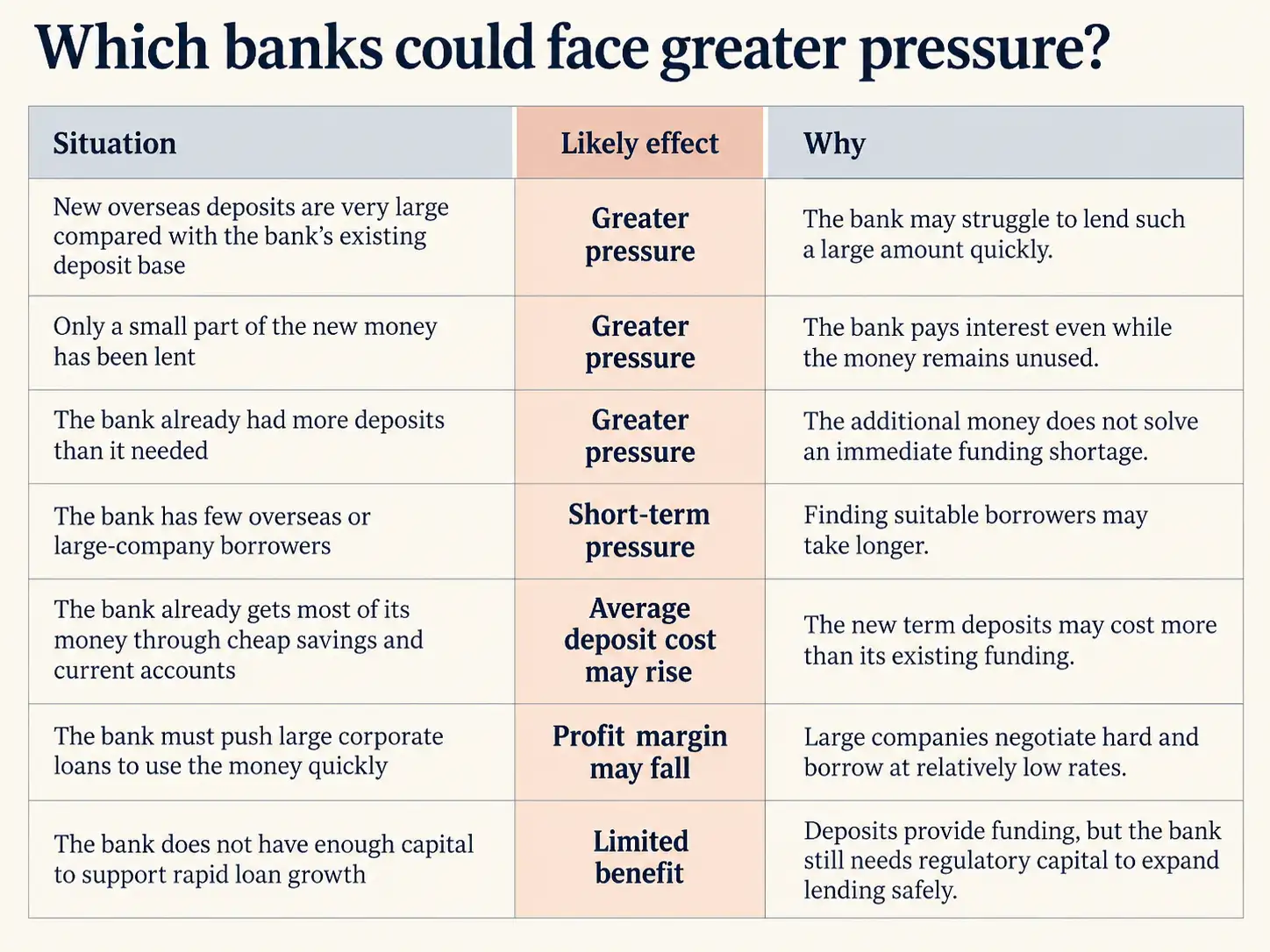
However, for a bank that already had more deposits than it required, the additional funding may become a problem. Unless it has a strong pipeline of borrowers, the new money may remain in low-yielding assets and drag down the overall NIM.
Simply put, the key question is not how much money a bank collected. It is whether the bank needed the money and already knew where to use it.
Wholesale Banks: Consider a bank with a large corporate and international business. It will be in a position to deploy substantial sums relatively quickly. One large trade-finance, infrastructure, or corporate transaction can absorb as much money as thousands of small retail loans.
Such a bank may be better equipped to handle a sudden multibillion-dollar inflow. It has existing relationships with large borrowers, an international lending operation, and people who understand foreign-currency loans.
However, even for such banks, pricing could prove to be an issue. Large companies can, and do, compare offers from several domestic and international banks to negotiate lower borrowing rates. Overseas corporate loans thus tend to provide relatively thin margins.
A wholesale-focused bank may therefore lend the money quickly but still report some NIM dilution. Its advantage is speed; its disadvantage is the relatively low return earned on each rupee or dollar deployed.
Now, here is another risk. If several banks that have raised foreign-currency deposits simultaneously approach the same group of corporate borrowers, competition could push loan rates down further. Banks may then successfully deploy the money but earn less than they originally expected.
Retail-focused Banks: There is little doubt that personal loans, credit cards, vehicle finance, and certain small-business loans give substantially higher yields than loans to large companies. But such lending is not easy. The bank has to find thousands of customers, assess their repayment ability, complete the documentation, and monitor each loan.
A bank with an established branch network, strong digital distribution, and a steady flow of creditworthy customers may be able to absorb the additional money over time. But a bank without that machinery could be left carrying excess liquidity for longer.
A retail bank is therefore not automatically better placed than a wholesale bank. It may earn more on each loan, but it also requires more time and operating capacity to create those loans safely.
Cheap-deposit Banks: At first glance, a bank with a strong deposit franchise should be best positioned. But the opposite can sometimes be true.
A bank that already receives a large share of its funding through low-cost current and savings accounts may find that the new term deposits are more expensive than its existing average deposit cost. Unless it can earn an adequate return on the additional money, the new deposits could raise rather than reduce its funding cost.
Danger to Watch For
There are several possible pitfalls. The greatest danger arises when the huge funds in hand begin to impact lending decisions. A bank under pressure to deploy the excess money may reduce loan rates too aggressively, or enter unfamiliar markets, or approve weaker borrowers.
That may provide temporary relief from the margin problem. It can, however, create a larger asset-quality problem when the loans begin defaulting.
This does not mean that a weaker deposit franchise has suddenly become a strength. It means that the value of the new money must be measured against the funding it replaces, not against zero.
For one bank, the deposit could replace funding costing 7%. For another, it may sit alongside savings deposits costing considerably less. The same new deposit can therefore improve the first bank’s funding economics while diluting the second bank’s funding mix.
Don’t Focus on Amount Collected
Most media reporting on this issue has focused on the amount collected – collectively and by individual banks. But such a focus can prove misleading. A large bank can absorb $10 billion more easily than a much smaller bank can absorb $3 billion.
Here are two real-life examples to illustrate this point. One large lender has disclosed mobilising nearly $18 billion, or about 9% of its existing deposit base. It has already extended about $9 billion of loans through its overseas operations. So, roughly half of the mobilisation has been directly deployed.
A smaller private-sector bank raised approximately $3.4 billion. Although the absolute sum was much lower, it represented about 26% of the lender’s existing deposit base. It has disclosed deploying about $1.1 billion into loans, or about one-third of the amount raised.
The larger lender collected much more money but faced a smaller deployment challenge. The inflow represented a smaller portion of its balance sheet, and a greater percentage had already been converted into loans.
The smaller lender has a potentially larger growth opportunity, but also a much larger execution risk. It must find a proportionately greater volume of suitable borrowers without cutting lending rates excessively or compromising its credit standards.
This comparison does not tell us which lender will eventually earn the better return. That requires information about the deposit cost, loan yield, maturity, operating expenses, foreign-exchange costs, and future defaults. But it does show why the total amount raised cannot be used as a measure of success.
Real, But Not Unlimited Regulatory Advantage
Eligible FCNR(B) deposits have been exempted from the Cash Reserve Ratio and Statutory Liquidity Ratio requirements. In simple terms, banks are not required to set aside part of these deposits as cash with the RBI or as compulsory government-security holdings
That makes more of the money available for lending. It improves the economics of the deposit, but it does not guarantee a profitable loan opportunity.
The RBI’s foreign-exchange swap also reduces the risk arising from movements between the dollar and the rupee on the deposit principal. However, the RBI has clarified that the facility covers the principal amount and not the interest component.
Banks must therefore still consider the interest cost, residual foreign-exchange exposure, operational expense, and return on whatever asset they create. The regulatory concessions make the funding easier to use; they do not make it free.
In a Nutshell
The better-positioned bank is one that already had strong loan demand, expensive funding that can be replaced, sufficient capital, and an established lending operation. It can employ the deposits without sharply lowering loan prices or moving into unfamiliar and riskier segments.
The more vulnerable bank is one that raised an unusually large amount relative to its balance sheet but has not yet identified enough profitable lending opportunities. The pressure will be greater if it already had surplus deposits or must compete aggressively for corporate borrowers.
Wholesale banks may deploy faster but at thinner spreads. Retail banks may earn higher yields but require more time. Banks dependent on expensive market funding could benefit immediately, while banks already funded by cheap deposits may find the new money less valuable.
The next few quarterly results should reveal the differences. The most important numbers will be the proportion of new deposits converted into loans, the reduction in expensive borrowings, the yield earned on new assets, the movement in deposit costs, the change in NIM, and any early deterioration in credit quality.
The deposit mobilisation has made the balance sheets of banks bigger. How the money is used will determine whether it also makes them better.

