Can ChatGPT actually help me make money, or is it better at giving advice than turning advice into sales? I decided to test that question with a challenge: I gave ChatGPT seven days and asked it to help me make Rs 4,000.
By the end of the experiment, I made Rs 579 out of my Rs 4,000 target, which is nearly 14.5% of what I had set out to make.
I had already tried other ChatGPT experiments before, but this time I wanted to test whether an AI-generated plan could work in the real world.
The rules were simple. I wouldn’t borrow money or make a major investment. On working days, I could spare only one hour a day. Saturday and Sunday were my weekly offs, giving me around six to seven hours each.
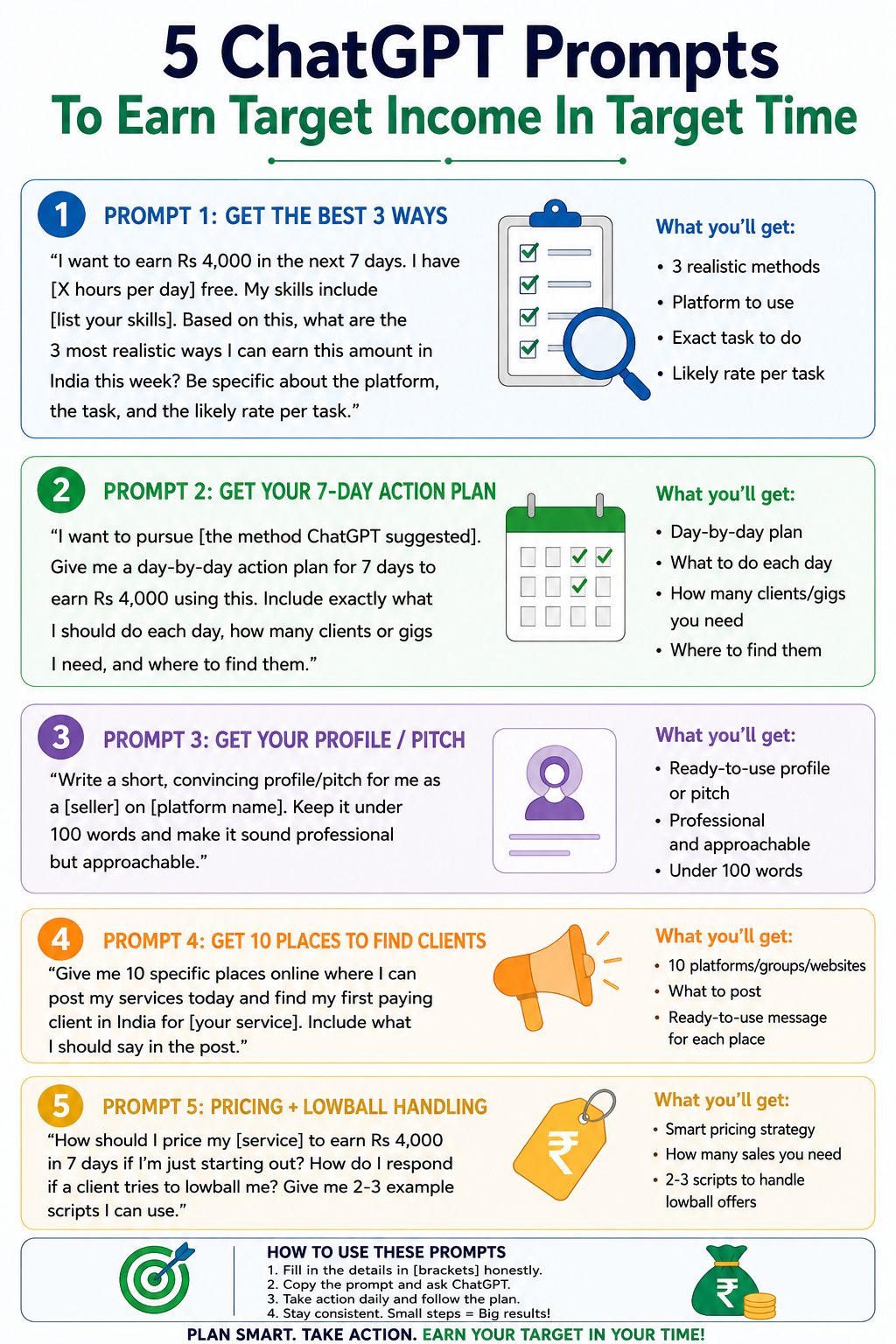
Here’s the prompt I gave to ChatGPT: “I want to earn Rs 4,000 in the next 7 days. I have 1 hour per day on working days and 6-7 hours on my week offs on Saturday and Sunday free. My skills include graphic designing, cooking, AI tools management (basic), video editing. Based on this, what are the 3 most realistic ways I can earn this amount in India this week? Be specific about the platform, the task, and the likely rate per task.”
STORIES YOU MAY LIKE
I wasn’t looking for a list of 20 side-hustle ideas. I wanted a plan that matched my skills, available time and the seven-day deadline.
ALSO READ
ChatGPT split the challenge into two parts – digital products during the week and food sales at the weekend.
I decided to follow the plan and see whether I could actually turn its suggestions into cash.
ChatGPT gave me two ways to chase Rs 4,000
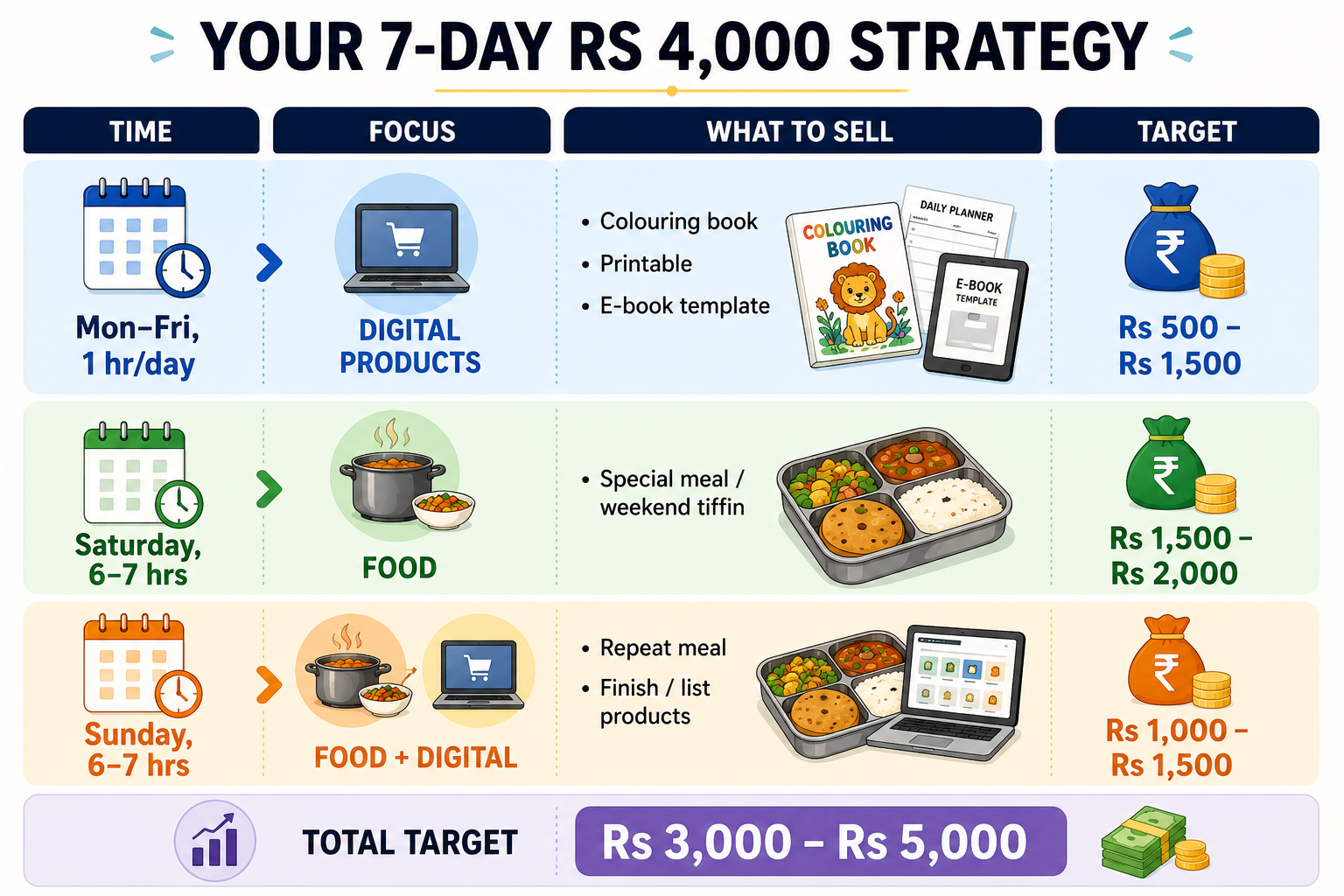
ChatGPT’s first response was a seven-day strategy:
“Your 7-day Rs 4,000 strategy”
Mon–Fri, 1 hr/day: Digital products — Colouring book / printable / e-book template — Rs 500-Rs 1,500
Saturday, 6–7 hrs: Food — Special meal / weekend tiffin — Rs 1,500-Rs 2,000
Sunday, 6–7 hrs: Food + digital — Repeat meal + finish/list products — Rs 1,000-Rs 1,500
Total: Rs 3,000-Rs 5,000
But it also gave me an important warning: “Earning Rs 4,000 in actual cash within a week would be difficult through digital products alone.”
It therefore treated food as the immediate cash-generation route and digital products as something that could become an income-generating asset over time.
I decided to test both.
It told me not to start a regular tiffin service
ChatGPT specifically advised me against starting a regular tiffin service. A daily tiffin business would mean regular cooking, packaging, delivery and recurring commitments – difficult to manage alongside a full-time job.
Instead, it suggested a limited Saturday/Sunday special meal with one fixed menu. The idea was to take pre-orders first and cook only what had already been ordered.
For finding customers, ChatGPT suggested apartment and neighbourhood WhatsApp groups, friends, colleagues, nearby PGs, students and working professionals.
The initial target was around 15-20 meals.
There was, however, a problem I had underestimated: I was starting with no customer base for the food business.
For digital products, ChatGPT wanted me to start small
ChatGPT initially suggested several possibilities but narrowed the first week’s focus to one product: a colouring book.
It advised me to make it specific rather than generic – for example, a themed children’s colouring book instead of simply calling it a “50-page colouring book”.
ALSO READ
It suggested pricing a colouring book around Rs 199, small activity packs at Rs 149-Rs 199 and templates around Rs 299-Rs 399.
The objective wasn’t to maximise the price immediately. “Your goal isn’t to sell one Rs 999 product. It’s to get your first 5-10 buyers and reviews.”
That sounded reasonable. But the real test was whether I could find those buyers within seven days.
The seven-day plan ChatGPT suggested
I asked ChatGPT to turn the ideas into a seven-day roadmap.
The weekday schedule was:
Monday: Research one product and its niche
Tuesday: Start creating the product
Wednesday: Continue creating it
Thursday: Finish the product, cover and promotional material
Friday: List the product and start selling
The weekend was supposed to focus on the food experiment, while I continued some digital-product work.
At the time, I thought that would be manageable.
It turned out to be one of the most important parts of the experiment.
I created two digital products
The biggest surprise was how much time product creation consumed.
Instead of creating one product, I ended up making two – one colouring book and one children’s activity book.
Time spent on digital products: One hour/day
Money spent: Rs 30/per booklet printing cost
Products created: 2
Products sold: 4
On the surface, creating two products looked like progress. But my actual target wasn’t to create products. It was to make Rs 4,000.
I had started measuring progress by the number of products I had created rather than the amount of money customers were willing to pay.
I also asked ChatGPT about pricing
I asked: “How should I price my digital product/tiffin service to earn Rs 4,000 in 7 days if I’m just starting out? How do I respond if a client tries to lowball me? Give me 2-3 example scripts I can use.”
ChatGPT suggested keeping the digital products at accessible introductory prices and also gave me scripts for responding to customers.
The food experiment ran into a different problem
The weekend experiment exposed another weakness.
I tried reaching potential customers, including people I already knew, but getting them to commit to a new food service wasn’t easy.
I initially thought the problem was credibility. I was new to the business, so I assumed people simply didn’t trust me enough to buy food from me.
But when I looked at the experiment more closely, that explanation seemed too simple.
There could have been other reasons: the offer, target customer, pricing, convenience, urgency or simply approaching people who did not have an immediate need for the product.
The bigger issue was that I was trying to sell something without an established customer base.
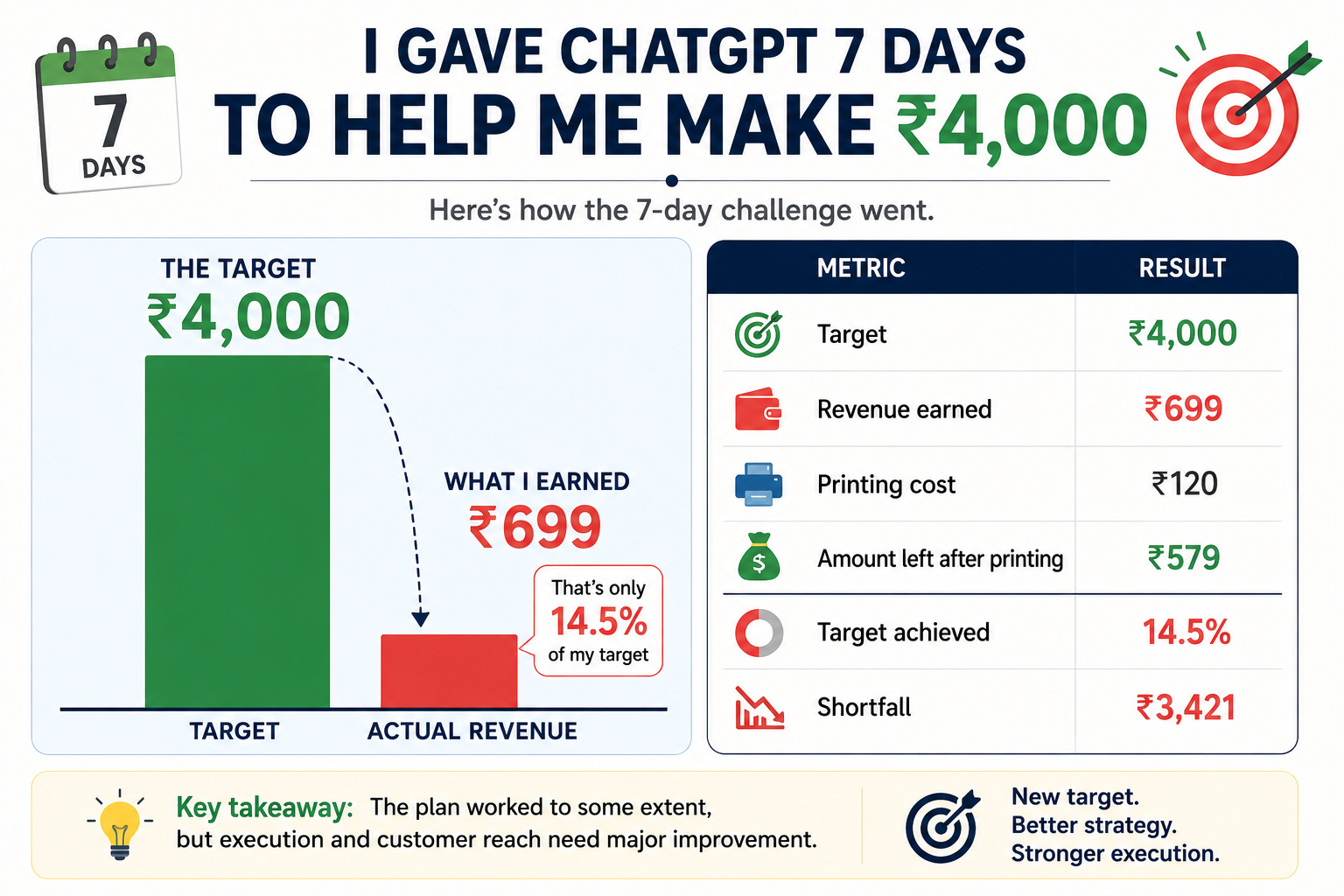
The target was Rs 4,000. I made Rs 579
After seven days, the final number was much lower than my target.
Target: Rs 4,000
Revenue: Rs 699
I had spent Rs 120 on printing.
So the amount left after that expense was:
Rs 699 – Rs 120 = Rs 579
I had missed the target by Rs 3,421.
The distinction matters because Rs 699 was my revenue, not my profit. After deducting the Rs 120 printing cost, Rs 579 remained.
That means I ended the experiment with an amount equivalent to nearly 14.5% of my original Rs 4,000 target.
The result was nowhere close to Rs 4,000. However, even Rs 579 earning made the experiment feel worthwhile.
What ChatGPT got right and what it got wrong
Looking back, ChatGPT got several things right. It correctly advised me against starting a regular tiffin service alongside a full-time job. A limited weekend experiment was more manageable.
It also correctly identified digital products as a low-investment option that could potentially become an income-generating asset over time.
Most importantly, it warned me that earning Rs 4,000 in actual cash within one week would be difficult through digital products alone.
That turned out to be true. It also told me not to spend the entire week creating and to sell while creating.
That was good advice. I simply didn’t execute it well enough. Where the plan fell short was in the difficulty of customer acquisition.
The suggestions looked realistic when considered individually. But I was starting with no established customer base, limited time and only seven days to generate sales.
ALSO READ
Creating a colouring book and finding someone willing to pay for it within the same week are two very different tasks.
The food experiment had the same problem. A menu can be planned quickly. A product can be created. A price can be decided. But none of those things guarantee that someone will buy.
There was also a structural problem: I was trying to run two completely different businesses during a seven-day cash experiment.
A digital-product business requires product creation, distribution, customer acquisition and sales. A food business requires a menu, costing, packaging, delivery and customer acquisition.
I was attempting both while working with extremely limited time.
But I also got something wrong. I treated creation as progress towards a sales target. It wasn’t. The target wasn’t to create two products. The target was to collect Rs 4,000 from customers.
That was probably the most important lesson of the experiment.
Disclaimer: This is a first-person experiment conducted by the author to test whether AI-generated side-hustle suggestions could help generate target income within target time. The ideas and strategies discussed in the story were generated by ChatGPT in response to the author’s personal circumstances and were tested by the author as part of the experiment. They should not be construed as recommendations or advice from Financial Express Digital. Readers should independently evaluate the suitability, costs, risks and legal or tax implications of any business or income-generating activity before acting on them. Financial Express Digital does not guarantee any income, outcome or success from the ideas discussed and is not responsible for any losses, costs or other consequences arising from readers acting on them. Financial Express Digital does not encourage or discourage readers from pursuing any particular side hustle or acting on AI-generated suggestions.

