Can NRIs gift money to HUF and save income tax? Gifting money to an HUF may seem like a simple family transaction, but for an NRI, there are tax rules to consider before making the transfer. The treatment can also depend on what happens to the money after it reaches the HUF.
So, if you are an NRI planning to gift money to an HUF, what should you know about the tax implications?
Can an NRI gift money to an HUF without paying tax?
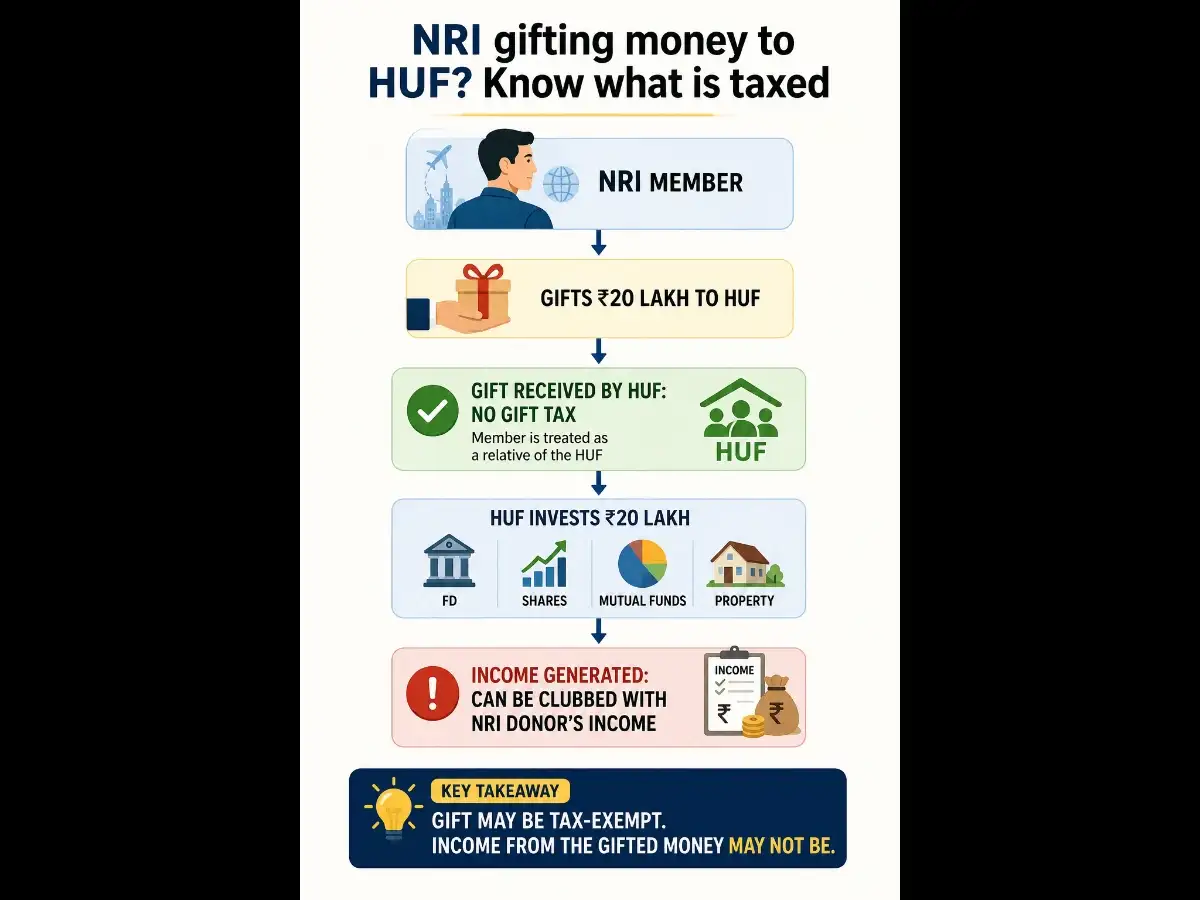
The good news is that a gift made by an HUF member to the HUF can be exempt from tax in the hands of the HUF.
“When an NRI member transfers money to his HUF from an NRO account, the gift itself doesn’t attract any tax, either for him or for the family unit receiving it. The Income Tax Act treats any member of an HUF as a “relative” of that HUF, and gifts from relatives are exempt without any monetary ceiling,” says Aarjav Jain, ED & NRI Tax Expert, Dinesh Aarjav and Associates Chartered Accountants.
NRI gifting money to HUF? Know what is taxed
The exemption applies to an HUF member and is not restricted only to a coparcener.
“It genuinely doesn’t matter whether the NRI is a coparcener with birthright claims over the family property or simply a member by marriage — the exemption is drafted around the word “member,” not “coparcener,” so both are covered identically,” he adds.
Tax treatment of income generated from the gift
But there is an important catch that many families may overlook: the income generated from that gifted money can be taxed in the hands of the NRI donor.
So, while the initial transfer may not create a gift-tax liability, routing investments through an HUF does not necessarily shift the tax burden away from the NRI.
Suppose an NRI member gifts ₹20 lakh to the HUF. The HUF then puts the money into a fixed deposit.
The ₹20 lakh gift itself may be exempt in the HUF’s hands. But what happens to the interest earned on that ₹20 lakh?
“Whatever income that invested money throws off, whether it’s FD interest, dividends, capital gains on shares or mutual funds, or rent from a property bought with it, gets clubbed straight back into the NRI member’s own personal income,” says Jain.
The income generated from property transferred by a member to the HUF can be subject to the clubbing provisions.
Jain’s key point is that the tax law follows the source of the money rather than simply looking at whose name the eventual investment is held in.
What if the HUF reinvests the money?
Changing the investment does not necessarily break the link with the original gift.
For example, suppose an NRI gives ₹20 lakh to the HUF and the HUF puts it into an FD. After two years, the HUF withdraws the money and invests the proceeds in shares.
The fact that the original FD has been replaced by shares does not automatically mean that the income from the original gifted property is now outside the clubbing provision.
This is why families should maintain a clear record of the source and movement of the money.
Jain says the clubbing consequence can continue while the HUF holds the asset created from the member’s transferred property.
Does the NRI’s non-resident status change the clubbing rule?
Being an NRI does not, by itself, provide an exemption from the clubbing provisions.
Where the underlying investment generates Indian-source income, the NRI’s residential status does not simply remove the Indian tax liability, explains Jain.
This means an NRI should not assume that transferring money to an HUF will make the resulting Indian investment income tax-free merely because the donor lives overseas.
The tax treatment of the income still needs to be examined under the applicable provisions.
Why should an NRI maintain a clear paper trail?
An exempt gift can still be questioned by the tax authorities if there are doubts about its identity, genuineness or source.
NRI’s checklist before gifting money to HUF
This is particularly important when a sizeable amount moves from an NRI’s personal account into an HUF account.
The exemption under the gift provisions protects the transaction from tax as a gift but does not remove the need to establish who made the gift, whether the transaction was genuine and whether the donor had the financial capacity to make it, says Sanyam Goel, Director, Accorp Partners.
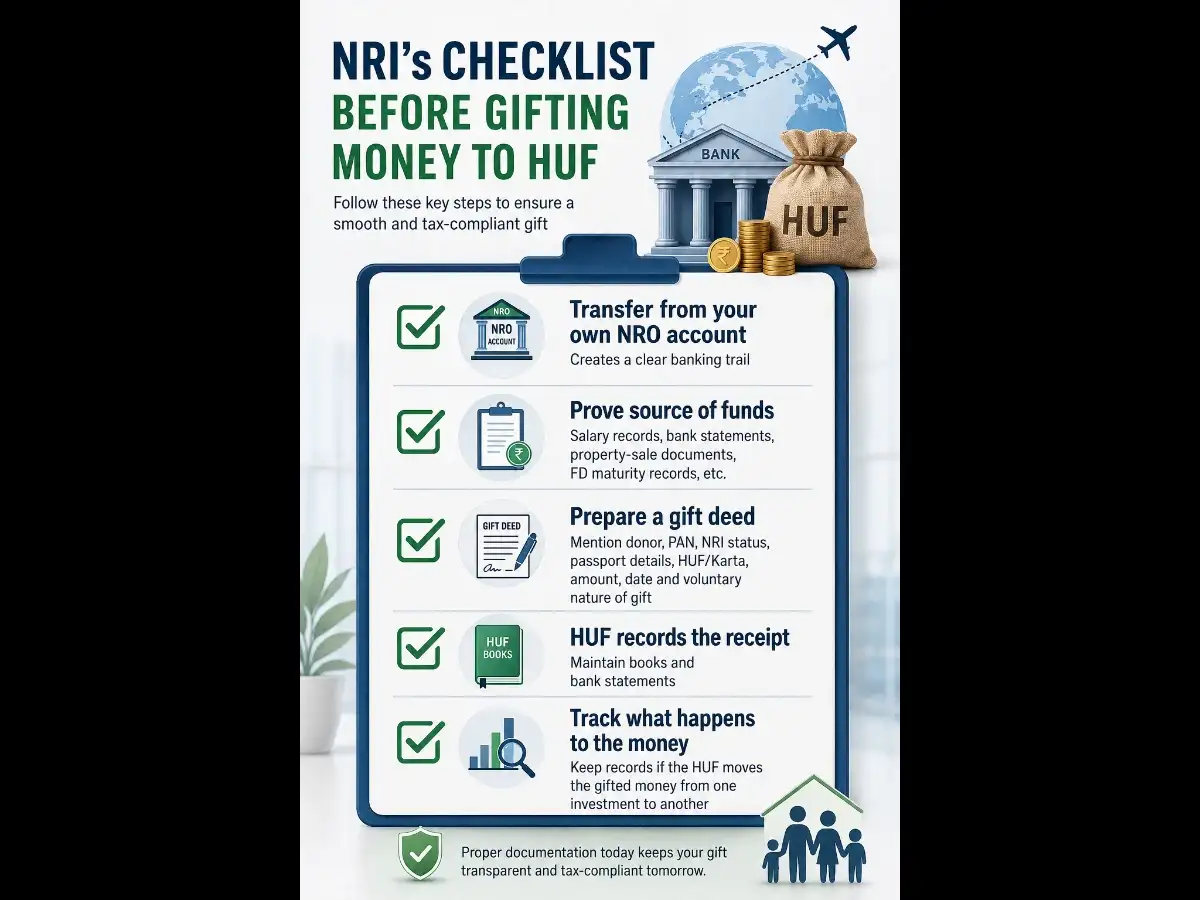
For an NRI, a transfer directly from the donor’s own NRO account to the HUF’s bank account creates a useful banking trail.
The donor should therefore preserve the NRO bank statement showing the debit, along with documents establishing how the money was accumulated. Depending on the source, this could include salary or employment records, bank statements, property-sale documents, FD maturity records or other evidence showing the legitimate source of funds.
A properly prepared gift deed can also help establish the nature of the transaction.
“The deed should state the donor’s full name, PAN, NRI status and passport details, the donee (the HUF, through its Karta), the relationship of the donor to the HUF, the amount gifted, the date, and an explicit statement that the gift is made voluntarily and without consideration,” says Goel.
The HUF should also record the receipt properly in its books and retain the relevant bank records and supporting documents.
Before transferring a substantial amount, establish the source of the money, document the gift properly, maintain a clean banking trail and understand how the subsequent investment income will be taxed.
For large transactions, obtaining advice from a tax professional before making the transfer can help avoid an expensive mistake later.

