Tata Sons directors are divided over how to formally respond to chairman N Chandrasekaran’s decision not to seek reappointment, with some favouring a board vote and others wanting him to reconsider, people familiar with the matter said. Sir Dorabji Tata Trust has urged the board to begin succession planning.
Mumbai: A debate is underway among some Tata Sons directors on how the board should formally respond to chairman N Chandrasekaran’s decision not to seek reappointment, people familiar with the matter told ET. Opinion is split on whether the issue be put to a vote at a board meeting, while some directors believe the board should not accept Chandrasekaran’s decision and rather ask him to reconsider, they said.Sir Dorabji Tata Trust (SDTT), one of the two principal trustee shareholders of Tata Sons, is understood to have written to the Tata Sons board asking it to take note of his decision and suggested the start of the process of constituting a selection committee to identify his successor.
Also read: Chandrasekaran, Noel Tata separately briefed govt on rift, concerns before chairman’s exit
Lack of quorum
Chandrasekaran’s sudden decision not to offer himself for reappointment has jolted a section of the Tata Sons board, with the issue continuing to simmer among key stakeholders, people familiar with the matter said.
“Since the Tata Sons chairman has conveyed his decision to voluntarily not seek reappointment to the board, the fiduciary duty of the directors would be to focus on succession planning,” an official close to SDTT said.
The Tata Sons board comprises six directors, including two Trust nominees and the chairman.
Meanwhile, the Tata Sons AGM is scheduled August 18 (Tuesday), and while other stakeholders will likely join in the online meeting, given the inability of Sir Ratan Tata Trust (SRTT) to jointly nominate a representative with SDTT, it will be called off for want of quorum, officials said.
If the AGM, likely to be held in the afternoon, is called off, it would be a first in the history of Tata Sons. Amid the crisis, speculation is rife about separate meetings by Tata Trusts chairman Noel Tata and N Chandrasekaran with a cabinet minister in New Delhi.
No voting precedent
Board-level voting on such matters as Chandrasekaran’s offer to exit is unusual and the board had almost come to a vote in February and June this year over the matter, officials said.
“A letter from SDTT does not bind Chandra to his statement about stepping down in February 2027,” said another official close to the development.
A director close to the matter said it is unlikely that Chandrasekaran’s decision will come to a vote because it is a personal decision taken by him.
“One can persuade or request him to reconsider, but such matters cannot come to a vote,” the official said.
Also read: The Chandra Chronicles: Tracing the chairman’s journey since 2017
Tata Sons and Noel Tata did not comment.
The developments come amid speculation that N Chandrasekaran was called to Delhi by a senior cabinet minister to reconsider his decision not to seek reappointment.
While it remains to be seen whether the board will ultimately vote on the matter, the discussions reflect the unease around a leadership transition that has unfolded more abruptly than some stakeholders had anticipated, the people said.
Ashish K Singh, managing partner, Capstone Legal, said board approval is not required for resignation, unless the Articles of Association of the company mention it.
“In my view, as per Companies Act, the Board has no option but to accept the decision of not seeking reappointment and accept the resignation,” Singh said.
Power struggle
Chandrasekaran had informed the Tata Sons board that he would not seek another term, citing the lack of unanimous support for his reappointment. The development came after a prolonged standoff over his proposed third five-year term.
NEXT STORY
SECTIONS
ET BureauLast Updated: Aug 18, 2026, 12:49:00 AM IST
Investors are channeling significant funds into small and mid-cap stocks this fiscal year. Small-cap funds have seen inflows nearly matching last year’s total in just four months. Mid-cap funds also show strong investor interest, attracting substantial capital inflows. Large-cap funds, conversely, have experienced considerably lower investment amounts. This trend reflects improved earnings momentum and increased market liquidity for smaller companies.

Listen to this article in summarized format
×
Subscribe to

Unlock AI Briefing and Premium ContentSubscribe Now
Already a member? Sign In

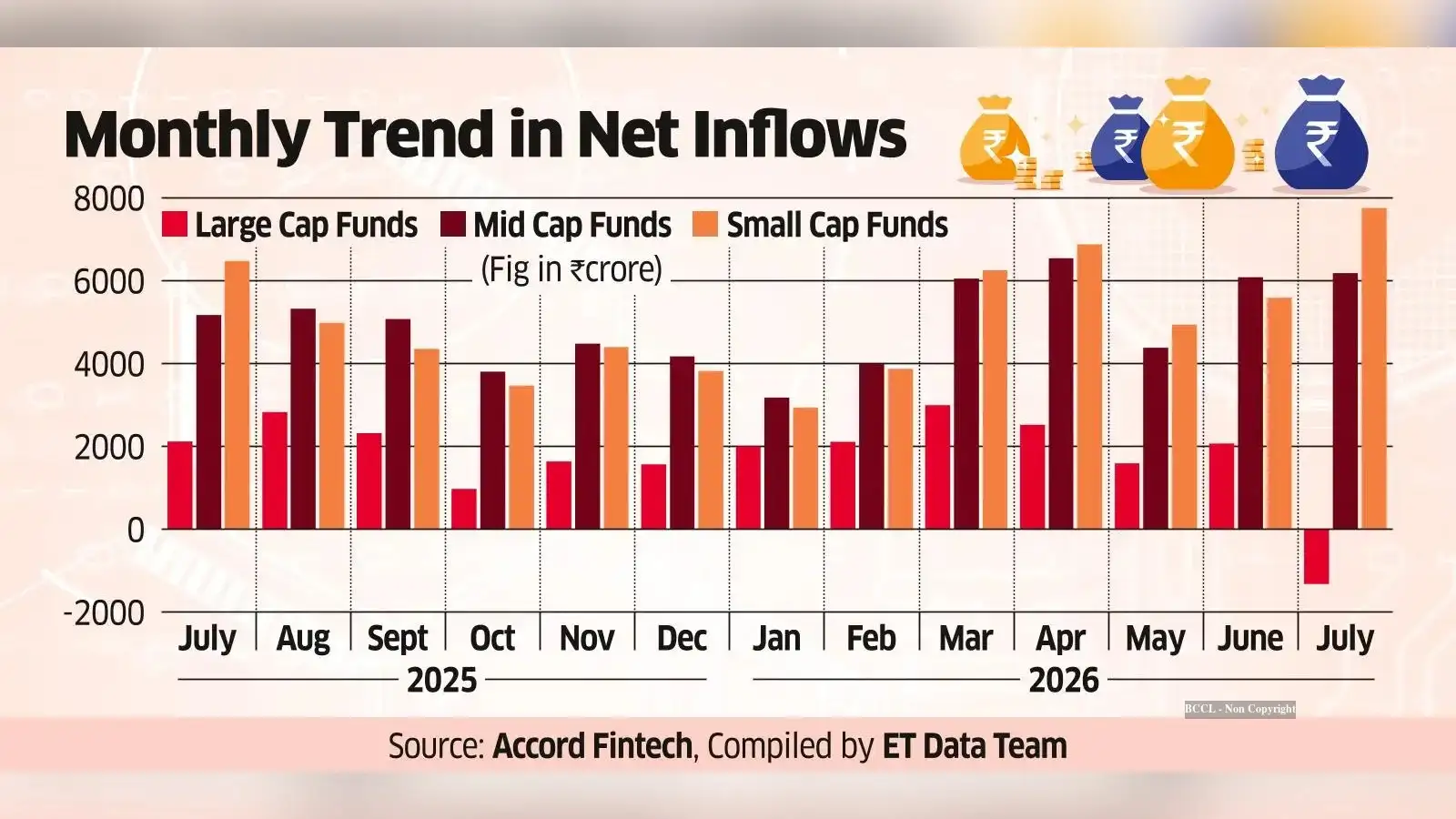
ET Intelligence Group: Investors are favouring small-cap and mid-cap stocks over their large-cap counterparts amid improving earnings momentum and higher market liquidity. This is visible from the trend in inflows in the current fiscal year. Investors have pumped nearly ₹25,200 crore into small-cap funds in the first four months of FY27, almost half of nearly ₹51,000 crore invested during the entire FY26.This is also the highest amount invested in small-cap funds during the first four months of any financial year so far. Mid-cap funds garnered ₹23,218 crore, nearly 44% of the ₹52,800 crore invested in FY26. In contrast, large-cap funds attracted just ₹4,863 crore during the period, only about 20% of the ₹24,000 crore inflow in the previous financial year.
The pace of inflows has been stronger this fiscal year compared with FY26. In the first four months of the past year, small-cap funds attracted 42% of their full-year FY25 inflow compared with 36% for mid-cap funds and 33% for large-cap funds. In FY26, small-cap funds attracted ₹17,723 crore in the first four months, mid-cap funds received ₹15,059 crore while large-cap funds collected ₹7,741 crore.
“Since September, many small-cap companies have strengthened balance sheets, reduced leverage and improved debt-to-equity ratios, making them better positioned to withstand business cycles,” Dinshaw Irani, CEO, Helios Capital Asset Management, told ET. He added that the large-cap universe includes several sectors facing earnings pressure, particularly IT and FMCG. This divergence in earnings prospects is making small-caps and mid-caps relatively more attractive to investors, despite their higher inherent risk.
Small-cap and mid-caps stocks tend to be more volatile and therefore riskier than large caps, implying that investors are showing greater appetite for risk. The rise in inflows into mid-cap and small-cap funds mirrors the strong performance of small- and mid-cap stocks over the past 12 months.

Live Events
The BSE 250 SmallCap Index rose 6.8% while the BSE 150 MidCap Index gained 9.4%. The BSE Sensex, on the other hand, fell by 4.4% during the period whereas the BSE 100 Index remained flat. Experts attribute the increased appetite for small caps to a combination of improving earnings, relatively attractive valuations and strong domestic liquidity.
Small-cap funds also recorded the highest net inflows among the three categories in July. They attracted ₹7,767.5 crore, compared with ₹6,192.3 crore for mid-cap funds, while large-cap funds saw a net outflow of ₹1,321.7 crore.
Stories you might be interested in

