Nobody experiences life as a financial year. A job changes because a better one is available. A fixed deposit renews because the bank was instructed to do so years ago. Mutual fund units are sold because money is needed. A flat remains vacant for a few months and is rented later. Dividends enter an account without attracting much attention.
Only at the time of filing do these unrelated events acquire tax labels. The job change becomes salary from two employers. The deposit becomes interest income. The redemption becomes a capital-gains calculation. The rented flat becomes house-property income.
The return does not merely ask how much a person earned. It asks the taxpayer to reconstruct an entire year and place every ordinary financial event in the correct box.
Today is July 31, 2026. For most salaried individuals, the due date to file their ITR for the year to March 31, 2026 (i.e PY 2025-26 or AY 2026-27) is July 31, 2026. (PY stands for the previous year and AY stands for assessment year and the income earned in PY 2025-26 will be mostly assessed in AY 2026-27.)
Rahul’s Story
Rahul assumed the process would be straightforward. His salary and tax details were pre-filled, and the portal showed a refund. He filed without checking the complete financial trail.
The refund was later held up because FD interest, dividend income, and the sale of mutual fund units had not been included correctly in the return.
This year, there is an additional twist. Just remember this: AY 2026-27 is not “tax year” 2026-27.
Rahul is filing for income earned during FY 2025-26. The return belongs to AY 2026-27 and is governed by the Income-tax Act, 1961. The new Income-tax Act, 2025, introduces the term “tax year” from April 1, 2026. It applies to income earned during FY 2026-27 onwards and does not change the return Rahul is currently filing.
Do You Even Need to File an ITR?
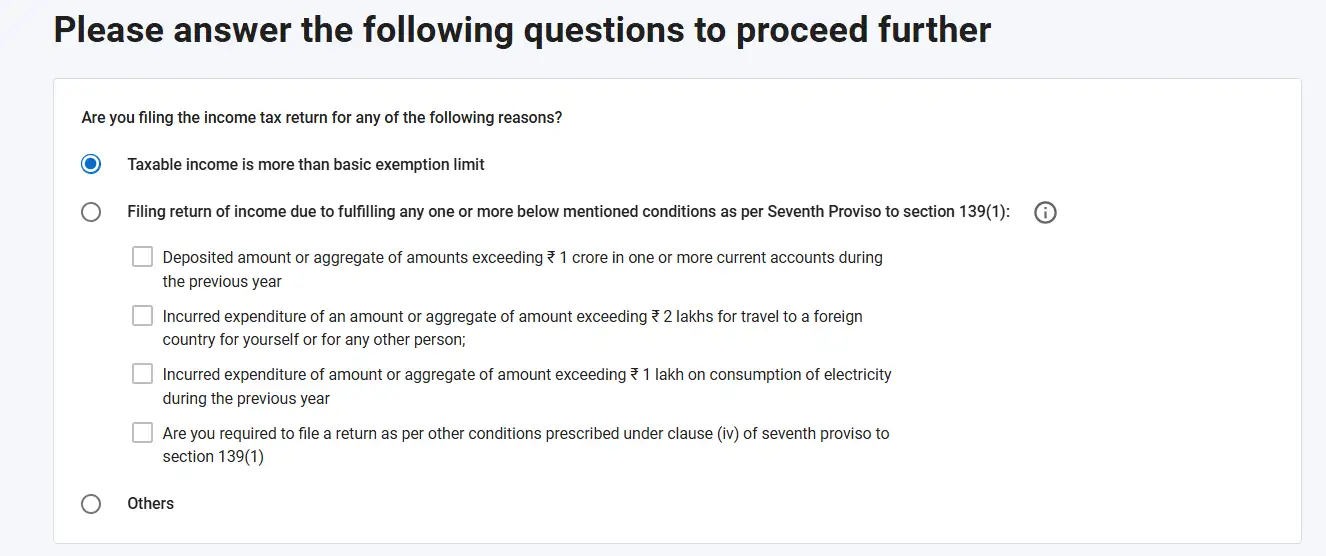
But first, a question: Does Rahul even have to file an ITR? ITR filing is generally mandatory if a person’s total income, computed before claiming Chapter VI-A deductions such as Sections 80C and 80D and specified capital-gains exemptions, exceeds the applicable basic exemption limit. It can range from Rs. 2.5 lakh to Rs. 5 lakh, depending on age and the tax regime being followed.
Remember: We are talking about filing returns, not about paying tax.
Coming back to Rahul. Salary is only one part of this calculation. Interest, dividends, rent, capital gains, business or professional income, and other taxable receipts must also be considered.
Here’s another thing to remember: A return may still be compulsory even when income is below the exemption limit.
Specified triggers include deposits above Rs. 1 crore in current accounts, foreign-travel spending above Rs. 2 lakh, electricity expenditure above Rs. 1 lakh, business turnover above Rs. 60 lakh, professional receipts above Rs. 10 lakh, aggregate TDS or TCS of Rs. 25,000 or more, or savings-bank deposits above Rs. 50 lakh. For resident senior citizens, the TDS or TCS threshold is Rs. 50,000.
Source: efiling, Income tax
A return should also be filed within the due date if the taxpayer wants to carry forward eligible capital or business losses.
Documents You Need
Now that Rahul is sure that he has to file his ITR, let’s begin the process. But even before he starts, he should keep his basic details ready: PAN, Aadhaar, mobile number linked with Aadhaar, bank account number, IFSC code, and login details for the income-tax portal, etc.
He should also check whether his bank account is validated on the portal. This is important because an income-tax refund is credited only to a validated bank account.
The next step is to download Form 26AS, the Annual Information Statement (AIS), and the Taxpayer Information Summary (TIS) from the income-tax portal.
Form 26AS mainly shows taxes linked to Rahul’s PAN, including TDS, TCS, advance tax, and self-assessment tax. AIS is broader. It brings together specified financial information reported to the Income-Tax Department by employers, banks, companies, mutual funds, brokers, depositories, property registrars, and government bodies. TIS presents a summarised view of this information.
Because AIS depends on information reported by third parties, it may contain errors, duplication or omissions. Rahul should match it with his own records instead of treating it as the final income calculation.
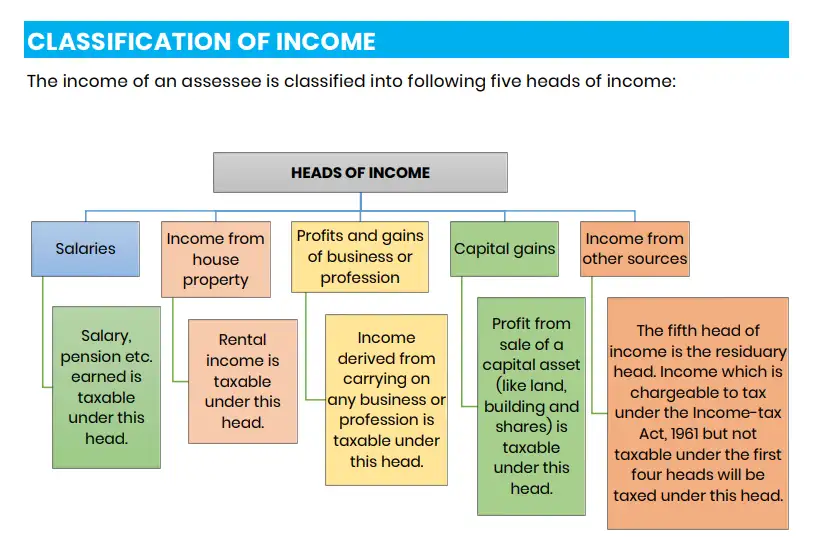
Now, income is reported under five heads, and the required documents depend on the source.If Rahul wants to claim deductions under the old regime, he should keep proofs for 80C investments, health insurance premia, National Pension Scheme (NPS), education loan interest, donations, HRA rent receipts, and other eligible deductions. These records should be collected before figures are entered on the portal.
Preparing Your Total Income
The documents must now be converted into income under the appropriate head.
Source: ICAI
Salary Income: Start With Form 16
Form 16 shows salary, exemptions or deductions considered by the employer, TDS, and the tax regime used for payroll. If Rahul changed jobs during the year, he must combine the salary details shown in Form 16 from every employer.
Consulting or freelance receipts are generally not salary because they do not arise from an employer-employee relationship.
Salary is generally taxed when due or received, whichever is earlier. Therefore, March salary received in April normally belongs to the earlier financial year, while advance salary may be taxed on receipt.
Rahul should check taxable salary, bonus, allowances, perquisites, and retirement-related payments. HRA and LTA exemptions are generally unavailable under the new regime.
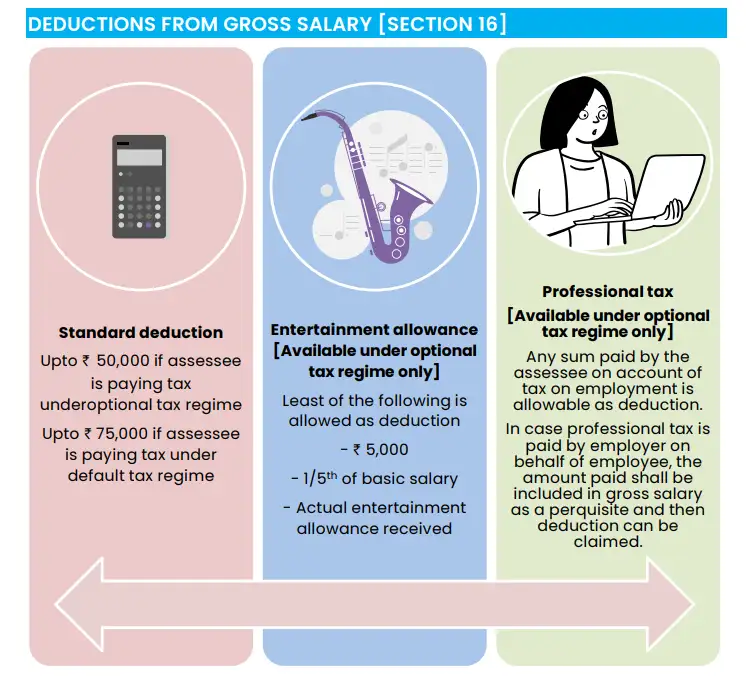
For AY 2026-27, the standard deduction is Rs. 75,000 under the new regime and Rs. 50,000 under the old regime. In short:
Gross salary – standard deduction = taxable salary income.
House Property Income
This head covers income from buildings and land attached to them. Up to two self-occupied or unoccupied properties can have nil annual value.
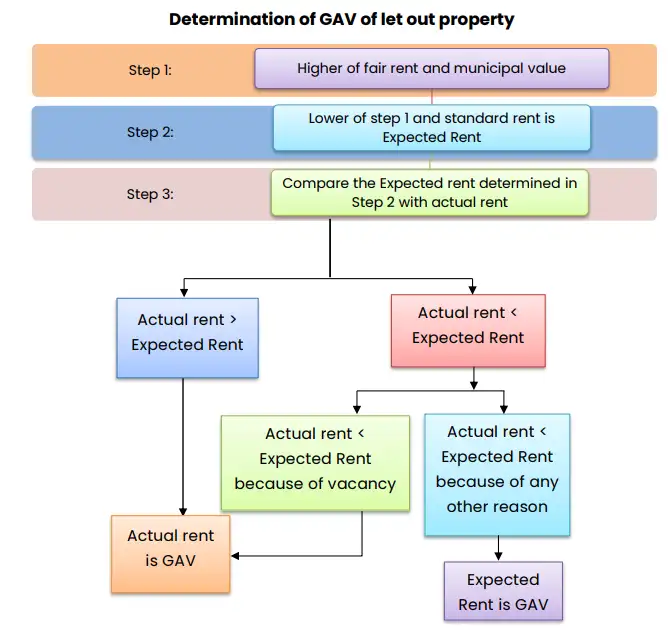
If Rahul owns more than two, he may select any two as self-occupied and the others may be treated as deemed let out, even if no rent was received. For rented or deemed let-out property, gross annual value is calculated first.
Source: ICAI
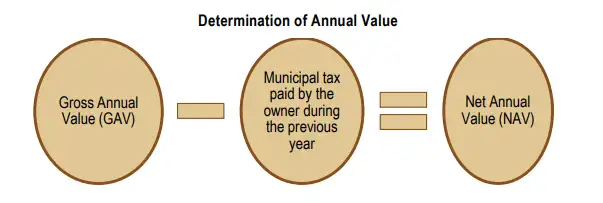
Municipal taxes borne and actually paid by the owner are deducted to arrive at net annual value.
Source: ICAI
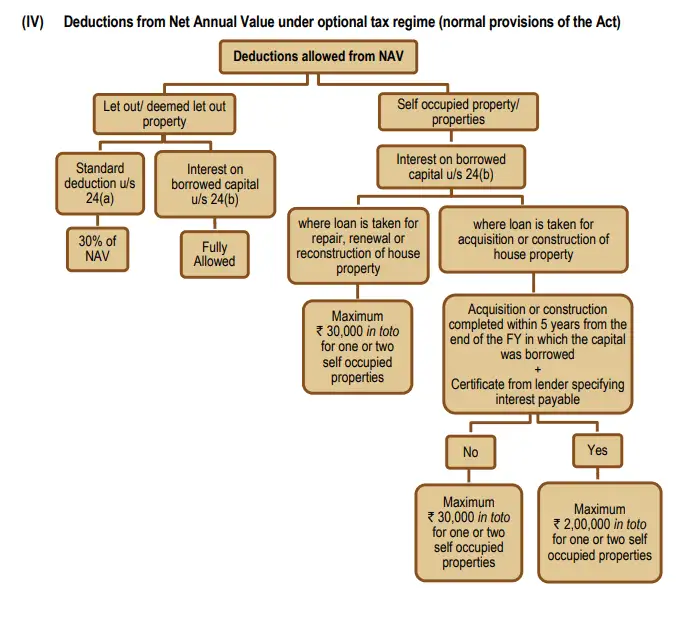
The deductions available then depend on the tax regime.
Source: ICAI
A flat 30% deduction is allowed on the net annual value of let-out or deemed let-out property.
Under the new regime, interest on a loan for a self-occupied house does not reduce taxable income. Interest may be deducted for a let-out property, but the resulting loss cannot be set off against salary or other income under this regime.
Under the old regime, interest on a self-occupied home loan can be claimed up to Rs. 2 lakh, subject to conditions.
Rahul should therefore identify each property as self-occupied, let out or deemed let out, and then apply the municipal-tax and interest rules of the selected regime.
PGBP: Profits & Gains from Business & Profession
Business, freelance, consulting, commission, and professional receipts are generally reported under PGBP rather than salary or other sources. The classification matters because it can change the ITR form, expense claims, record-keeping, and due date.
If Rahul had business or professional income and no tax audit, and had to file ITR-3 or ITR-4, his due date would be August 31, 2026.
Income tax broadly allows two ways to calculate PGBP income. The first is the normal method. Under this, Rahul calculates actual profit. He starts with business or professional receipts and reduces eligible expenses incurred for earning that income. These may include rent, salary, internet, software, travel, depreciation, professional charges and other work-related expenses. The basic working is:
Gross receipts – eligible expenses = taxable profit
This method needs records, bills, bank statements, and books of accounts, wherever applicable. Personal expenses cannot be claimed as business expenses.
The second is the presumptive method. This is a simplified method for eligible small businesses and professionals. Here, Rahul does not calculate profit by listing every expense. Instead, income is presumed at a prescribed rate of turnover or receipts, subject to conditions.
For an eligible small business, income may be declared at 6% or 8% of turnover, as applicable. For an eligible professional, income may be declared at 50% of professional receipts.
The idea is simple: Less detailed bookkeeping and simpler tax calculation. But presumptive taxation is not available to everyone. Eligibility, turnover limits, profession type, and other conditions have to be checked before using it.
This story does not cover F&O, derivatives, speculative income or detailed PGBP rules.
Capital Gains: What You Sold
After salary, house property and business/profession, Rahul should check whether he sold any asset during the year. This may include shares, mutual funds, ETFs, bonds, property, gold, jewellery, zero coupon bonds, or any other capital asset. Tax is not charged on the full sale value. It is charged on the gain.
This is again where many taxpayers make mistakes. AIS may show the sale value of shares or mutual funds. But sale value is not the same as taxable gain. The taxable gain has to be calculated after considering purchase cost, sale value, holding period, and eligible transfer expenses.
For shares and mutual funds, Rahul should download the capital gains statement from his broker, mutual fund platform, CAMS/KFintech, and also check the demat statement. If securities are held in demat form, the cost and holding period are generally worked out on FIFO basis, account-wise.
Now, here the first step is to decide whether the gain is short-term or long-term. If the asset is held for more than the prescribed period, it becomes a long-term capital asset. The gain is called LTCG. If it is sold within that period, it is a short-term capital asset. The gain is called STCG.
For Indian listed shares, equity-oriented mutual funds, units of UTI, and zero coupon bonds, the holding period is one year. For unlisted shares and immovable property, the holding period is two years.
For other assets, the rule changed from July 23, 2024. Earlier, many such assets needed a holding period of three years to become long-term. Now, the holding period is generally two years.
So Rahul should first ask: What asset did I sell, when did I buy it, when did I sell it, and was it held as investment or stock-in-trade?
This last question matters. If shares are held as investments, the profit may be capital gains. But if shares are held as stock-in-trade, the income may fall under business income.
After this, Rahul has to calculate the gain. The basic formula is:
Sale value – expenses related to sale – cost of acquisition – cost of improvement = capital gain
Sale-related expenses can include brokerage, transfer charges, or other expenses directly connected with the sale. However, securities transaction tax, or STT, is not allowed as a deduction while calculating capital gains.
If an asset was bought before April 1, 2001, Rahul may have to be extra careful. In such cases, the taxpayer may be allowed to take the higher of actual cost or fair market value as on April 1, 2001, as the cost of acquisition.
In case of immovable property, the fair market value cannot exceed the stamp duty value as on April 1, 2001, if that value is available.
Indexation also needs care. Earlier, for long-term capital gains, indexation helped increase the cost by using the cost inflation index. This reduced the taxable gain.
But from July 23, 2024, indexation benefit is generally not available for long-term capital assets. Long-term capital gains are generally taxed at 12.5% without indexation, subject to specific rules.
There is one important exception for property. For land or buildings acquired before July 23, 2024, resident individuals and HUFs can compare tax under both methods: 20% with indexation and 12.5% without indexation. The lower tax is payable. So property cases should not be calculated casually.
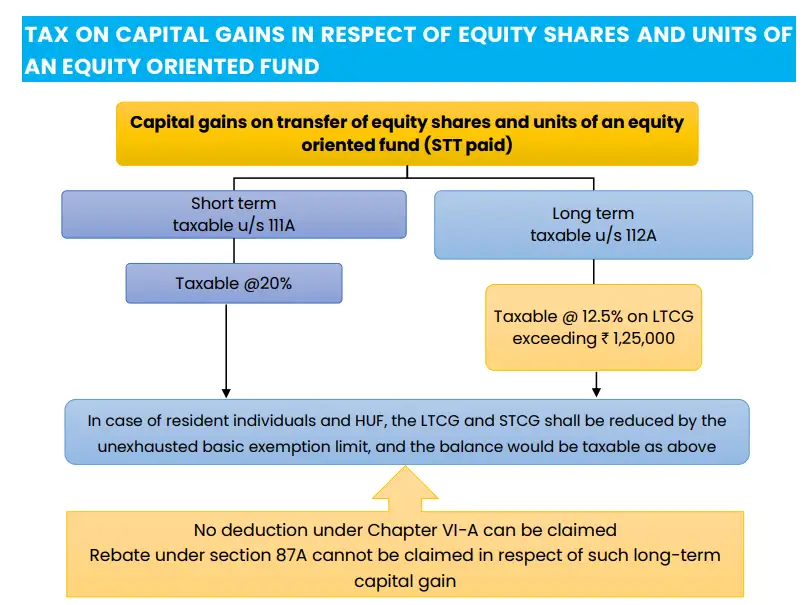
For AY 2026-27, these are the broad capital gains tax rates Rahul should know.The Rs. 1.25 lakh limit is important. If Rahul has long-term capital gains from listed shares or equity mutual funds of Rs. 1 lakh, it may not be taxed under Section 112A. But if the gain is Rs. 2 lakh, tax applies only on Rs. 75,000.
Source: ICAI
Capital gains taxed at special rates should not be mixed casually with salary income. Deductions under Chapter VI-A are not adjusted against these gains in the usual way. Rebate rules also need care, especially where special-rate income is involved.
There is one relief for resident individuals and HUFs. If their normal income, excluding special capital gains, is below the basic exemption limit, the unused part of the basic exemption limit can be adjusted against eligible capital gains.
Rahul should take extra care if he sold property, inherited an old asset, sold unlisted shares, redeemed debt mutual funds, sold market-linked debentures, received taxable ULIP or insurance maturity proceeds, entered a joint development agreement, or had large capital losses. These cases can have special rules.
Income From Other Sources
This head covers taxable income that does not fall under salary, house property, business or capital gains.
Common examples include savings account interest, FD interest, recurring deposit interest, dividend income, family pension, royalty income, director sitting fee, income tax refund interest, gifts, lottery income, and winnings from games or online platforms.
Savings-account interest, FD interest, recurring-deposit interest and interest on an income-tax refund may be taxable even if no TDS has been deducted.
Dividend income is also reported under income from other sources. If Rahul has borrowed money to invest and earns dividend, only interest expense may be allowed as deduction, and that too subject to the prescribed limit. Other expenses are not casually allowed against dividend income.
Winnings from lottery, puzzles, card games, online games or similar platforms need extra care. They are not taxed like normal interest income. Such winnings are taxed at special rates, and expenses are generally not allowed against this income.
Gifts also need attention. Some receipts are not taxable. For example, gifts received on the occasion of marriage, gifts received from specified relatives, gifts received under a will or inheritance, or amounts received in contemplation of death are generally not taxed.
But all gifts are not automatically tax-free. If money is received from non-relatives and the total value crosses Rs. 50,000, the whole amount may become taxable. If certain movable property (such as shares, securities, jewellery, drawings, paintings, sculptures, bullion or virtual digital assets) is received without consideration and the fair value crosses Rs. 50,000, tax may apply.
If immovable property is received without consideration and stamp duty value crosses Rs. 50,000, that can also be taxed. If property is bought for inadequate consideration, the difference may be taxable if the prescribed conditions are met.
There is one more distinction. A gift from an employer because of employment is not treated as a normal personal gift. It may be taxed under salary. Similarly, a benefit arising from business or profession may be taxed under business income.
So Rahul should check three points before ignoring any receipt: What was received, who gave it, and why it was received.
Importance of Gross Total Income
Gross total income is the combined income under salary, house property, business or profession, capital gains, and other sources before eligible deductions.
TDS, TCS, advance tax, and self-assessment tax are tax credits. They are adjusted against the final tax liability only after the income and tax have been calculated.
He should also check whether clubbing provisions apply, such as income of a minor child or income from assets transferred to a spouse or daughter-in-law without adequate consideration.
Losses follow separate set-off rules. Short-term capital loss can be adjusted against short-term or long-term capital gains, while long-term capital loss can be adjusted only against long-term gains. Under the old regime, house-property loss can be set off against other income up to Rs. 2 lakh. This set-off is not available under the new regime.
Deductions & Taxable Income
Gross total income – Eligible deductions = Taxable income
The new regime is the default. It offers lower slab rates but fewer deductions, while the old regime allows benefits such as Section 80C, Section 80D, HRA, LTA, education-loan interest, donations, and eligible interest on a self-occupied home loan.
Source: ICAI
For a regular salaried taxpayer, the most common benefit under the new regime is the standard deduction of Rs. 75,000. If there is family pension, deduction may also be available within the prescribed limit. Employer’s NPS contribution may also be allowed, if applicable.
One more point: Chapter VI-A deductions are restricted to gross total income. They cannot create a loss or be carried forward. Also, these deductions are generally not allowed against incomes taxed at special rates, such as certain capital gains.
Rahul should also check small deductions that often get missed. Under the old regime, deduction may be available for savings account interest.
Donation claims also need care. If Rahul wants to claim deduction, he should not rely only on the payment receipt. He should check whether the donation is eligible, whether the payment mode is allowed, and whether the required donation certificate or details are available.
There are also losses that do not get normal treatment. Losses from lottery, crossword puzzles, card games, gambling, betting or similar winnings cannot be set off or carried forward. These winnings are taxed separately at special rates, but losses from such activities do not give the same tax benefit.
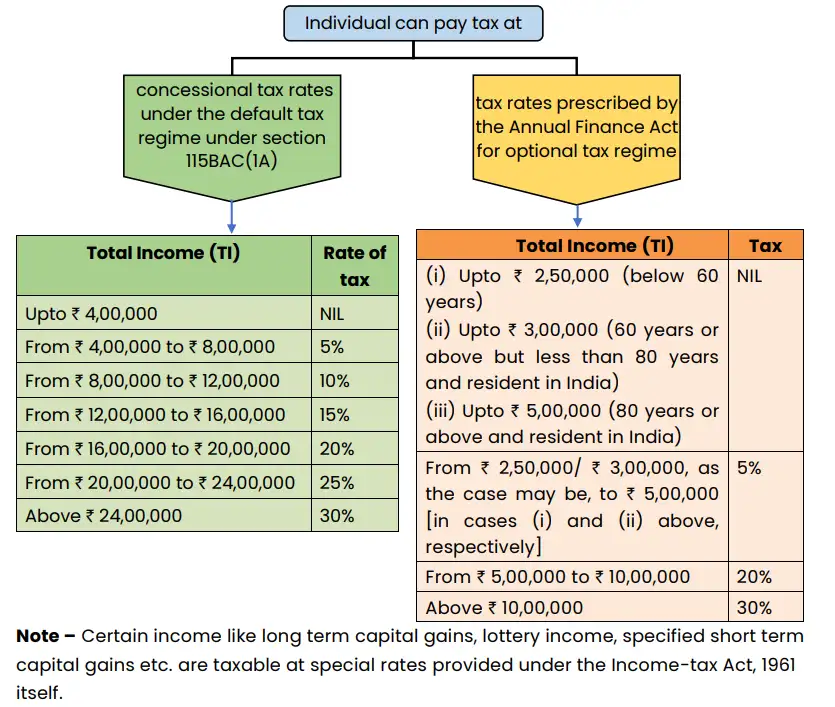
In short: Rahul should compare the final tax liability under both regimes before filing. Now, once taxable income is ready, Rahul has to apply the tax rates. For AY 2026-27, the slab rates are as follows:
Source: ICAI
But the slab table is not the full story. Under Section 87A, an eligible resident individual under the new regime can receive a rebate where taxable income does not exceed Rs. 12 lakh. Under the old regime, the corresponding limit is Rs. 5 lakh.
Marginal relief under the new regime reduces the sudden increase in tax where income slightly exceeds Rs. 12 lakh. It does not extend the full rebate beyond that limit. A salaried person with gross salary of Rs. 12.75 lakh and no other income may reach taxable income of Rs. 12 lakh after the Rs. 75,000 standard deduction and may therefore have nil tax on normal income.
After slab tax and rebate, he should check surcharge, if applicable. Surcharge generally applies only at higher income levels.Surcharge applies at higher income levels, as shown in the table. Marginal relief may apply near surcharge thresholds, and surcharge is capped for specified income such as dividends and certain capital gains. A 4% health and education cess is then added. The final working is:
Tax as per slab and special rates – Rebate + surcharge + cess – taxes already paid = refund or tax payable
Any balance tax should be paid before filing. A refund arises only when taxes already paid exceed the final liability.
Choose the Correct ITR Form
The correct form depends on the taxpayer’s income and disclosures, not on which form appears easiest. Filing the wrong form can make the return defective.
ITR forms also have detailed conditions. Rahul should still check the form instructions before filing, because residential status, foreign assets, brought-forward losses, unlisted shares, capital gains, business income and presumptive income can change the correct form.
ITR-1 generally covers eligible resident individuals with total income up to Rs. 50 lakh from salary or pension, up to two house properties and specified other-source income. It is not available for cases including business income, short-term capital gains, Section 112A long-term gains above Rs. 1.25 lakh, more than two house properties, foreign assets or income, unlisted shares, or brought-forward and carry-forward losses.
ITR-2 is generally for individuals and HUFs without business or professional income who may have salary, house-property income, capital gains, and other-source income.
ITR-3 generally applies where business or professional income is present and ITR-4 is not available. This can apply where regular books, detailed profit and loss, balance sheet or more detailed reporting is required.
ITR-4 is a simpler form for eligible taxpayers using presumptive taxation. It can be used by resident individuals, HUFs and firms other than LLPs, if their total income is upto a certain prescribed limit and their business or professional income is computed on a presumptive basis.
Next: Verification
Submitting the return is not the final step. Rahul must verify it through an available mode such as Aadhaar OTP, net banking, bank or demat EVC, or a Digital Signature Certificate.
Verification is required within 30 days of filing. Otherwise, the return may become invalid, and late verification may affect the filing date.
After verification, Rahul should track processing and any refund. The amount displayed while filing is only a claim and is paid after processing. The intimation may confirm the return, reduce the refund or raise a demand.
He should check whether income, deductions and tax credits were correctly considered. A refund may also be adjusted against an old demand. If there is a clear processing error, such as eligible TDS not being considered, he can seek rectification.
Correcting Mistakes
The remedy depends on the stage at which Rahul notices the error. An unverified return may be discarded and filed again where the portal permits.
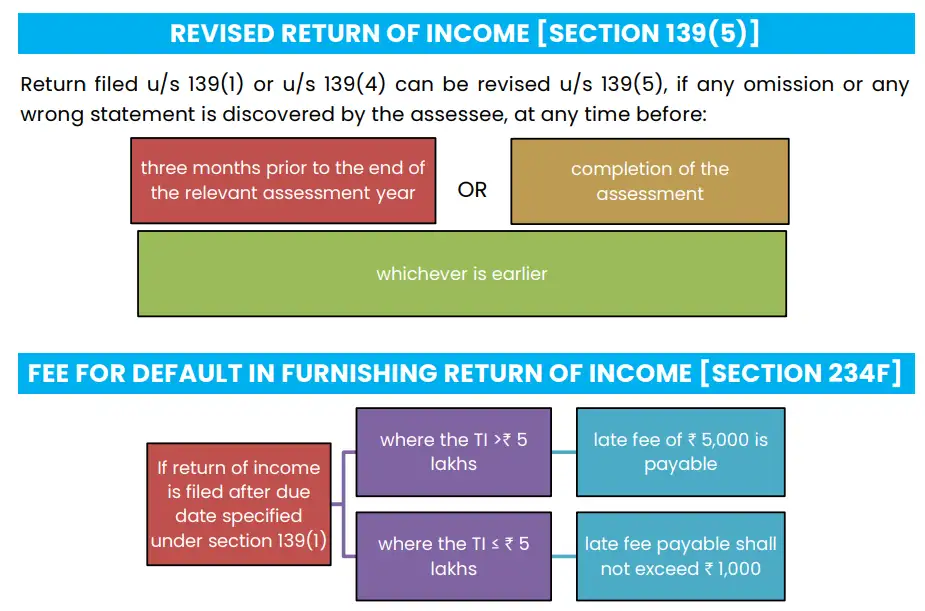
A belated return for AY 2026-27 can ordinarily be filed by December 31, 2026, or before completion of assessment, whichever is earlier. A late fee under Section 234F may apply: up to Rs. 5,000 where total income exceeds Rs. 5 lakh and up to Rs. 1,000 where it does not.
A return filed within the original due date, as well as a belated return, can be revised if the taxpayer later discovers an omission or an incorrect statement. For AY 2026-27, a revised return can be filed up to March 31, 2027, or before completion of the assessment, whichever is earlier.
However, if the revised return is filed after December 31, 2026, a fee of Rs. 1,000 where total income does not exceed Rs. 5 lakh and Rs. 5,000 in other cases is applicable.
Source: ICAI
After processing, a clear system-level error may be corrected through rectification. If the time for a belated or revised return has passed, the taxpayer may check eligibility for ITR-U. It generally cannot be used to reduce tax, claim or increase a refund, or file a loss return.
A defective-return notice asks the taxpayer to correct or clarify the return within the allowed time. Ignoring it may make the return invalid.
Rahul should therefore choose the remedy based on the stage: Discard, revise, file belatedly, rectify, respond to a notice, or check ITR-U.
The Final Check
Before submission, Rahul should confirm that all income is reported, tax credits are matched, the correct regime and form are selected, and deductions are supported. He should then verify the return within the deadline and review the final intimation after processing.
This guide covers common cases. Foreign assets, complex capital gains, business income, special-rate income and carried-forward losses may require separate review.
This article is intended only as a general guide and does not constitute tax, legal or professional advice. Income-tax rules may differ depending on a taxpayer’s income, residential status, investments, deductions, losses and other circumstances. Taxpayers should verify the applicable provisions, ITR form, tax regime and disclosures, and consult a chartered accountant or qualified tax professional before filing their return.
20 mins read, Last Updated:
Nobody experiences life as a financial year. A job changes because a better one is available. A fixed deposit renews because the bank was instructed to do so years ago. Mutual fund units are sold because money is needed. A flat remains vacant for a few months and is rented later. Dividends enter an account without attracting much attention.
Only at the time of filing do these unrelated events acquire tax labels. The job change becomes salary from two employers. The deposit becomes interest income. The redemption becomes a capital-gains calculation. The rented flat becomes house-property income.
The return does not merely ask how much a person earned. It asks the taxpayer to reconstruct an entire year and place every ordinary financial event in the correct box.
Today is July 31, 2026. For most salaried individuals, the due date to file their ITR for the year to March 31, 2026 (i.e PY 2025-26 or AY 2026-27) is July 31, 2026. (PY stands for the previous year and AY stands for assessment year and the income earned in PY 2025-26 will be mostly assessed in AY 2026-27.)

