Read more at: https://taxguru.in/goods-and-service-tax/180-day-payment-condition-gst.html?utm_source=follow.it
Copyright © Taxguru.in
The article explains the 180-day payment condition for Input Tax Credit (ITC) under the second proviso to Section 16(2) of the CGST Act read with Rule 37 and Section 16(4). It states that where the recipient does not pay the supplier the value of supply along with GST within 180 days from the invoice date, proportionate ITC is required to be reversed or paid with applicable interest, and the credit may be re-availed after payment to the supplier. It distinguishes between first-time availment of ITC governed by Section 16(4) and re-availment under Rule 37(4), which it states is not restricted by the Section 16(4) time limit where the original ITC was validly availed. The article also discusses proportionate reversal for partial payments, interest computation under Section 50 and Rule 88B, GSTR-3B reporting, audit procedures, Rule 37A, practical scenarios, documentation, suggested audit reply language, and a working format. It further refers to judicial decisions and CBIC Circular No. 170/02/2022-GST while discussing the statutory framework and reporting of ITC reversal and re-availment.
Cases Discussed
- Sunny Jain v. Union of India (Delhi High Court)
- HCC-VCCL JV v. Union of India (Delhi High Court)
- Utpal Das v. State of West Bengal (Calcutta High Court)
- Larsen & Toubro Ltd. v. State of West Bengal (Calcutta High Court)
- Deepak Sales Corporation v. Union of India (Punjab & Haryana High Court)
- D.Y. Beathel Enterprises v. State Tax Officer (Madras High Court)
- Suncraft Energy Pvt. Ltd. v. Assistant Commissioner (Calcutta High Court)
- Thirumalakonda Plywoods v. Assistant Commissioner (Andhra Pradesh High Court)
- M. Trade Links v. Union of India (Kerala High Court)
- National Plasto Moulding v. State of Assam (Gauhati High Court)
Section 16(2) Second Proviso read with Rule 37 and Section 16(4)
1. Introduction
Input Tax Credit is the lifeline of GST. But this lifeline is not unconditional. Section 16 of the CGST Act, 2017 creates the basic entitlement to ITC, and then attaches conditions to it.
One such important condition is the famous “180 days wala condition”.
In simple words:
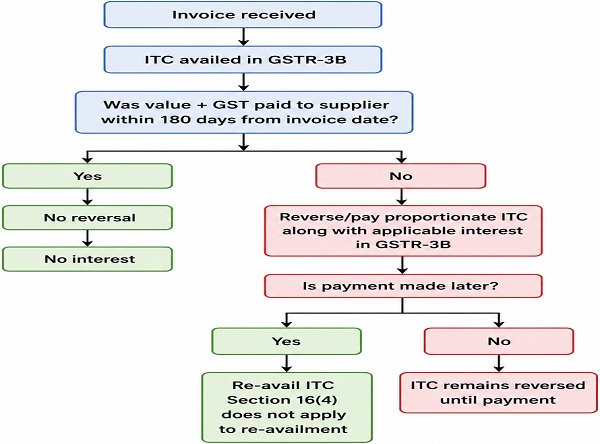
If the recipient has availed ITC on an invoice but does not pay the supplier the value of supply plus GST within 180 days from the invoice date, then the recipient has to reverse/pay the proportionate ITC along with applicable interest. Once payment is later made to the supplier, such ITC can be re-availed.
This issue becomes more sensitive when the non-payment is identified much later, either by the taxpayer during internal review or by the audit officer during departmental audit. The immediate question arises:
If Section 16(4) time limit has already lapsed, can the taxpayer re-avail the ITC after making payment to the supplier?
The answer requires a careful reading of Section 16(2), Rule 37, Section 16(4), Section 50 and Rule 88B.
2. Statutory Framework — Quick Snapshot
| Provision | What it says | Practical effect |
| Section 16(2), second proviso | If payment of value plus tax is not made to supplier within 180 days from invoice date, ITC availed has to be paid back with interest. | Non-payment beyond 180 days triggers ITC reversal/payment. |
| Rule 37(1) | ITC is to be reversed/paid proportionately to the unpaid amount, along with interest, in GSTR-3B for the tax period immediately following 180 days. | Reversal is not optional. It is proportionate. |
| Rule 37(2) | On subsequent payment of value plus tax to supplier, ITC can be re-availed. | Re-credit is allowed after payment. |
| Rule 37(4) | Section 16(4) time limit shall not apply to re-availment of credit reversed earlier. | Re-availment can be made even after the normal time limit, if original credit was validly availed and later reversed. |
| Section 16(4) | ITC cannot be taken after 30th November following the financial year of invoice/debit note or filing of annual return, whichever is earlier. | This controls first-time availment, not lawful re-availment under Rule 37. |
Rule 37 specifically covers failure to pay the supplier within the time mentioned in the second proviso to Section 16(2), and Rule 37(4) expressly protects re-availment from the time limit under Section 16(4).
3. The Core Legal Position
The 180-day condition does not merely create an interest impact.
It creates three possible consequences:
| Situation | Consequence |
| Payment made within 180 days | No reversal. No interest. |
| Payment not made within 180 days | Proportionate ITC reversal/payment is required. |
| Payment made later | ITC can be re-availed after payment. |
Therefore, the correct statement is:
Non-payment within 180 days creates reversal plus interest exposure, but the reversal is temporary. Re-credit is allowed once payment is made to the supplier.
4. Flow Chart — 180-Day Condition
5. Does Section 16(4) Restrict Re-availment?
This is the most important issue.
5.1 Where ITC was never availed within Section 16(4)
If the taxpayer never availed ITC within the time limit prescribed under Section 16(4), then he cannot take such ITC later merely because payment has now been made to the supplier.
Section 16(4) applies to first-time availment of ITC.
5.2 Where ITC was availed within time and later reversed under Rule 37
If ITC was originally availed within the time limit of Section 16(4), and later reversed because of non-payment within 180 days, then re-availment is allowed after payment to supplier.
Rule 37(4) clearly provides that the time limit under Section 16(4) shall not apply to re-availing credit reversed earlier.
5.3 Correct legal distinction
| Case | Whether re-availment allowed after Section 16(4) date? | Reason |
| ITC never availed before Section 16(4) time limit | No | It is fresh availment after limitation. |
| ITC availed within time, then reversed under Rule 37 | Yes | It is re-availment, protected by Rule 37(4). |
| ITC availed after Section 16(4) time limit and then reversed | No strong defence | Original availment itself was time-barred. |
| ITC availed within time, reversal made late during audit, supplier later paid | Re-availment defendable | Original availment was within time; Rule 37 permits re-availment after payment. |
6. Various Practical Possibilities
| Possibility | Treatment | Interest impact | Re-credit |
| Full invoice paid within 180 days | No reversal | No interest | Not applicable |
| Part payment made within 180 days | Proportionate reversal for unpaid portion | Interest on proportionate ITC, if applicable | Re-avail proportionately when balance paid |
| No payment within 180 days | Full ITC reversal/payment | Interest exposure | Re-avail after full payment |
| Payment made after 180 days but before audit | Reversal was technically required earlier; compute delay impact | Interest may apply for period of delay | Re-avail allowed after payment |
| Audit officer identifies old unpaid invoices | Reverse/pay ITC with applicable interest | Interest to be computed carefully | Re-avail after payment, even if Section 16(4) has lapsed |
| Supplier payment already made before detection, but 180-day reversal was missed | Conservative approach: show reversal and reclaim with proper trail; pay interest for delay if applicable | Interest exposure remains for delay period | Re-avail allowed because payment condition is now fulfilled |
| Reverse charge inward supply | Rule 37 does not apply | No Rule 37 interest | ITC governed by RCM provisions |
| Schedule I supply without consideration | Deemed paid for this purpose | No Rule 37 reversal | ITC subject to general eligibility |
| Amount covered by Section 15(2)(b) addition | Deemed paid for this purpose | No Rule 37 reversal to that extent | ITC subject to general eligibility |
| Commercial discount/settlement without GST credit note and recipient no longer liable to pay | Document carefully; possible defence that no amount is payable | Fact-specific | Depends on documentation |
| Retention money withheld | Conservative view: proportionate reversal if value plus tax not paid within 180 days | Interest exposure | Re-avail after release/payment |
7. Partial Payment — How to Compute Reversal?
Rule 37 now recognises proportionate reversal where payment is partly unpaid.
Formula
ITC to be reversed =
ITC availed × Unpaid gross amount / Total invoice gross amount
Example
| Particulars | Amount |
| Taxable value | ₹10,00,000 |
| GST @ 18% | ₹1,80,000 |
| Gross invoice value | ₹11,80,000 |
| ITC availed | ₹1,80,000 |
| Amount paid within 180 days | ₹5,90,000 |
| Amount unpaid | ₹5,90,000 |
Since 50% of the gross invoice remains unpaid, 50% of ITC should be reversed.
ITC to be reversed = ₹1,80,000 × ₹5,90,000 / ₹11,80,000
= ₹90,000
If the balance amount is paid later, ₹90,000 can be re-availed.
8. Interest — Rate and Calculation
8.1 Rate of interest
The applicable rate is generally 18% per annum under Section 50 read with the relevant notification framework. Section 50 and Rule 88B provide the statutory basis for interest calculation; Rule 88B prescribes the manner of calculating interest, including cases of wrongly availed and utilised ITC.
8.2 Conservative calculation method
Where reversal was required but not made in time:
Interest = ITC required to be reversed × 18% × Number of days / 365
8.3 From which date?
There are two views.
| View | Interest period |
| Conservative compliance view | From the due date of GSTR-3B in which Rule 37 reversal should have been made till actual reversal/payment |
| Technical/litigation view after Section 50(3) and Rule 88B | Interest only from the date of utilisation of such wrongly availed ITC till reversal/payment |
Rule 88B provides that where interest is payable on wrongly availed and utilised ITC, interest is calculated from the date of utilisation till reversal or payment. It also explains when wrongly availed ITC is deemed to have been utilised.
8.4 Example of interest
| Particulars | Amount |
| ITC required to be reversed | ₹90,000 |
| Delay | 100 days |
| Interest rate | 18% |
Interest = ₹90,000 × 18% × 100 / 365
= ₹4,438 approximately
8.5 Important litigation point — interest only if ITC is utilised?
After the retrospective amendment to Section 50(3), a strong legal position exists that interest is payable only where ITC is both wrongly availed and utilised.
In Utpal Das v. State of West Bengal, the Calcutta High Court quashed interest and penalty where ITC was wrongfully availed but not utilised. The Court relied on Larsen & Toubro Ltd. v. State of West Bengal and similar reasoning of the Punjab & Haryana High Court in Deepak Sales Corporation v. Union of India.
Therefore, in suitable cases, if the electronic credit ledger always had sufficient balance and the disputed ITC was never actually utilised, the taxpayer can contest interest.
9. GSTR-3B Reporting
CBIC Circular No. 170/02/2022-GST clarified the reporting structure of ITC reversal and re-claim in GSTR-3B. Temporary reversals, including reversals under Rule 37, are to be reported in Table 4(B)(2), and re-claimed ITC is to be reported in Table 4(A)(5) and also disclosed in Table 4(D)(1).
| Event | GSTR-3B table | Reporting |
| Original eligible ITC on normal inward supply | Table 4(A)(5) | All other ITC |
| Temporary reversal due to 180-day non-payment | Table 4(B)(2) | ITC reversed — Others |
| Re-availment after payment to supplier | Table 4(A)(5) | Add back as ITC |
| Disclosure of re-claimed ITC | Table 4(D)(1) | ITC reclaimed which was reversed earlier under 4(B)(2) |
| Ineligible/time-barred ITC not to be taken | Table 4(D)(2), where applicable | ITC not available |
| Interest payment | Table 5.1 / cash ledger / DRC-03, as applicable | Interest must be paid in cash |
GST portal also maintains an Electronic Credit Reversal and Re-claimed Statement to track ITC reversed in Table 4(B)(2) and subsequently reclaimed through Table 4(A)(5) and Table 4(D)(1).
10. Practical 3B Flow Chart
Eligible ITC appears / identified
↓
Avail in Table 4(A)(5), if otherwise eligible
↓
Check supplier payment ageing invoice-wise
↓
Invoice unpaid beyond 180 days?
↓
Yes
↓
Reverse proportionate ITC in Table 4(B)(2)
↓
Pay applicable interest in cash
↓
Maintain invoice-wise reversal working
↓
Later payment made to supplier?
↓
Yes
↓
Reclaim ITC in Table 4(A)(5)
↓
Report same in Table 4(D)(1)
↓
Match with Electronic Credit Reversal and Re-claimed Statement
11. If Audit Officer Identifies the Issue Today
This is a very common situation.
Situation
An old invoice was booked. ITC was availed. Supplier payment remained outstanding beyond 180 days. No Rule 37 reversal was made. The issue is now found by internal audit or GST audit.
Correct approach
| Step | Action |
| Step 1 | Prepare invoice-wise ageing from invoice date. |
| Step 2 | Identify unpaid amount as on 180th day. |
| Step 3 | Compute proportionate ITC reversal. |
| Step 4 | Check whether ITC was utilised for interest calculation under Rule 88B. |
| Step 5 | Reverse/pay ITC through GSTR-3B Table 4(B)(2) or DRC-03, depending on stage of proceedings. |
| Step 6 | Pay interest in cash, if payable. |
| Step 7 | On payment to supplier, re-avail ITC in Table 4(A)(5) and disclose in Table 4(D)(1). |
| Step 8 | Keep a separate reconciliation note for departmental audit. |
Can reversal and re-availment be done in the same month?
Legally, if payment to supplier has already been made before filing the current GSTR-3B, the taxpayer has a basis to re-avail. However, from a documentation and audit-trail perspective, it is better to avoid casual netting.
A safer approach is:
First show reversal with interest clearly
Then reclaim after payment with proper disclosure
If both are reported in the same return period, maintain a detailed working note explaining:
1. original ITC was availed within Section 16(4),
2. reversal is made because payment was delayed beyond 180 days,
3. supplier has now been paid, and
4. re-availment is claimed under Rule 37(2) read with Rule 37(4).
12. Important Case Laws and Principles
| Case | Court | Principle relevant to this issue |
| Sunny Jain v. Union of India | Delhi High Court | Recipient is entitled to avail ITC initially even if supplier payment is pending; if payment is not made within 180 days, reversal with interest under Rule 37 follows. |
| HCC-VCCL JV v. Union of India | Delhi High Court | Rule 37 and Section 16(2) payment condition were examined; ITC relating to unpaid consideration beyond 180 days can create interest/reversal consequences. |
| Utpal Das v. State of West Bengal | Calcutta High Court | Interest is not leviable merely on wrongful availment unless ITC is also utilised. |
| Larsen & Toubro Ltd. v. State of West Bengal | Calcutta High Court | Interest under Section 50(3) requires availment and utilisation of ITC. |
| Deepak Sales Corporation v. Union of India | Punjab & Haryana High Court | Similar principle: interest cannot be demanded where ITC is availed but not utilised. |
| D.Y. Beathel Enterprises v. State Tax Officer | Madras High Court | In supplier default cases, Department should examine/proceed against supplier and cannot mechanically saddle buyer without enquiry. |
| Suncraft Energy Pvt. Ltd. v. Assistant Commissioner | Calcutta High Court | No automatic reversal from buyer merely because of supplier default, except cases like collusion, missing supplier, closure or non-recoverability. |
| Thirumalakonda Plywoods v. Assistant Commissioner | Andhra Pradesh High Court | Section 16(2) conditions and Section 16(4) time limit are independent; ITC is conditional. |
| M. Trade Links v. Union of India | Kerala High Court | Constitutional validity of Section 16(2)(c) and Section 16(4) upheld; strict condition approach recognised. |
| National Plasto Moulding v. State of Assam | Gauhati High Court | Bona fide purchaser protection line; Section 16(2)(c) read down in genuine cases. |
13. 180-Day Reversal vs Supplier Default under Rule 37A
Do not confuse Rule 37 and Rule 37A.
| Particulars | Rule 37 | Rule 37A |
| Trigger | Recipient does not pay supplier value plus tax within 180 days | Supplier reports invoice in GSTR-1/IFF but does not file GSTR-3B by prescribed date |
| Default by whom? | Recipient | Supplier |
| Reversal by whom? | Recipient | Recipient |
| Re-availment | After recipient pays supplier | After supplier files GSTR-3B |
| Section 16(4) impact | Not applicable to re-availment under Rule 37(4) | Re-availment mechanism separately recognised under Section 41/Rule 37A |
Section 41 read with Rule 37A also recognises that supplier default can be a temporary defect and permits re-availment after supplier compliance.
14. Key Professional Takeaways
14.1 This is not only an interest issue
The impact is:
Reversal/payment of ITC
+
Interest, where applicable
+
Re-availment after supplier payment
14.2 Section 16(4) does not kill re-availment
If ITC was originally availed within time and later reversed under Rule 37, Section 16(4) does not apply to re-availment.
14.3 Original availment must be within time
Rule 37(4) cannot revive an ITC which was never taken within the Section 16(4) time limit.
14.4 Maintain invoice-wise documentation
For every re-availment, keep:
| Document | Purpose |
| Tax invoice | Basic ITC document |
| GSTR-2B extract | Supplier reporting support |
| Ledger of supplier | Payment ageing |
| Bank payment proof | Proof of payment |
| Rule 37 reversal working | Computation of reversal |
| Interest calculation | Defence during audit |
| GSTR-3B screenshots | Reporting trail |
| Re-claim working | Support for Table 4(A)(5) and 4(D)(1) |
15. Suggested Working Format
| Invoice No. | Invoice date | Taxable value | GST | Gross value | ITC availed | Amount paid within 180 days | Amount unpaid | ITC to reverse | Date of reversal | Interest | Date of later payment | ITC re-availed |
| 001 | 01.04.2024 | 10,00,000 | 1,80,000 | 11,80,000 | 1,80,000 | 5,90,000 | 5,90,000 | 90,000 | 20.01.2025 | 4,438 | 15.03.2025 | 90,000 |
16. Suggested Audit Reply Language
Where the issue is raised by audit, the following language may be used:
The input tax credit under reference was originally availed within the time limit prescribed under Section 16(4) of the CGST Act. Due to non-payment/partial payment to the supplier within 180 days from the invoice date, the proportionate amount of ITC has been reversed/paid in accordance with the second proviso to Section 16(2) read with Rule 37 of the CGST Rules, along with applicable interest, if any. Subsequently, upon payment of the value of supply along with tax to the supplier, the said ITC is eligible for re-availment under Rule 37(2). Further, Rule 37(4) specifically provides that the time limit under Section 16(4) shall not apply to such re-availment of credit reversed earlier. Therefore, the re-availment is legally permissible and should not be treated as fresh availment of time-barred ITC.
17. Conclusion
The 180-day payment condition is not a penalty provision. It is a temporary credit discipline mechanism.
The law says:
Pay supplier within 180 days
↓
If not paid, reverse proportionate ITC with interest
↓
Pay supplier later
↓
Re-avail ITC
↓
Section 16(4) does not apply to such re-availment
The most important professional distinction is:
Section 16(4) restricts first-time availment. It does not restrict re-availment of ITC validly availed earlier and reversed under Rule 37.
Thus, where the original ITC was validly availed within time, delayed payment to the supplier does not permanently destroy the credit. It only suspends the credit till payment is made.
*****
Disclaimer: This article is for professional education, discussion and knowledge sharing. GST law is highly fact-specific and subject to amendments, circulars, portal changes and jurisdictional judicial interpretation. Readers should verify the latest statutory provisions and applicable case law before taking any position. The views expressed are personal and should not be treated as legal opinion for any specific matter without examining complete facts and documents.

