The due date to file an income tax return (ITR) for students, pensioners, salaried individuals, and others who are not liable for a tax audit is July 31, 2026, for AY 2026-27. However, for individuals with business income or those requiring a tax audit, the due date for filing ITR is August 31.
There are about three ITR forms (ITR-1, ITR-2, and ITR-3) which most students, salaried employees, and pensioners need to file depending on their source of income.
Who is eligible to file ITR-3?
ITR-3 is to be used by an individual or a Hindu Undivided Family (HUF) who is having income under the head ‘profits or gains of business or profession’ and who is not eligible to file Form ITR?1 (Sahaj), ITR?2, or ITR?4 (Sugam).
Chartered Accountant Abhishek Soni, Co-Founder of Tax2Win, says that ITR-3 also applies when business income exists alongside other sources of income. Thus, apart from business income, taxpayers filing ITR-3 can also report income from:
- Salary or pension
- House property
- Capital gains
- Other sources of income
- Foreign assets and foreign income
Since it captures multiple income sources and detailed financial information, ITR-3 is considered one of the most comprehensive income tax return forms.
Who cannot file ITR-3?
Soni says that that the following taxpayers are not eligible to file ITR-3:
- Companies
- LLPs
- Partnership firms
- Trusts
- Individuals eligible to file ITR-1
- Individuals eligible to file ITR-2
- Taxpayers opting for presumptive taxation under ITR-4
Also read: ITR filing: Received Section 143(1) intimation with tax demand? Respond within 30 days or risk being treated as an ‘assessee in default’; know how to do it
How to file ITR-3 online through e-filing ITR portal
According to the income tax department’s website, ITR-3 has the following sections that you need to fill up (applicable schedule) before submitting the form:
- Part A- General
- Part B-TI
- Part B- TTI
- Schedule-IT
- Schedule TDS
- Schedule TCS
- Manufacturing account
- Trading Account
- P&L
- Balance sheet
- Schedule OI
- Schedule QD
- Schedule S
- Schedule HP
- Schedule BP
- Schedule DPM
- Schedule DOA
- Schedule DEP
- Schedule CG
- Schedule OS
- Schedule CYLA
- Schedule BFLA
- Schedule CFL
- Schedule VI-A
- 80G
- Schedule SPI
- Schedule SI
- Schedule EI
- Schedule PTI
- Schedule FSI
- Schedule TR
- Schedule 5A
- Schedule FA
- Schedule AL
Also read: How to select the right ITR form based on your income for AY 2026-2027
Step-by-step guide:
Step 1: In the Part A General section of the ITR, you need to verify the pre-filled data from your e-Filing profile. You will not be able to edit some of your personal data directly in the form. However, you can make the necessary changes by going to your e-Filing profile.
You can edit your contact details, filing status, residential status, and bank details in the form itself.
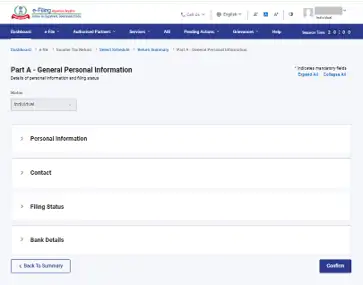
Source: Income Tax e-filing portal
Step 2: Fill up the respective schedules as mentioned above.
Step 3: Once submitted, you need to e-verify the ITR within 30 days; else, it will be discarded.

