For millions of small businesses, retailers, professionals, freelancers, consultants, F&O traders, content creators and social media influencers, presumptive taxation regime has been one of the most attractive features of India’s income tax law. Instead of maintaining detailed books of account and preserving every invoice and expense voucher, eligible taxpayers can simply declare income at prescribed percentages of turnover or gross receipts and pay tax accordingly.
Under the scheme, eligible small businesses with turnover up to Rs.3 crore can declare income at 6% of turnover where 95% of the total receipts are received via banking channels or digital modes, and at 8% if otherwise. Similarly, specified professionals such as doctors, lawyers, architects, engineers and consultants with receipts up to Rs.75 lakh can declare income at 50% of their gross professional receipts. The principal attraction of the scheme has always been simplicity. Taxpayers accepting the prescribed presumptive income are generally relieved from maintaining detailed books of account and are not usually required to undergo tax audit.
What changes under the new law
Under the Income Tax Act, 1961, the presumptive taxation regime operates through three separate provisions: Section 44AD for eligible businesses, Section 44ADA for specified professionals and Section 44AE for goods carriage operators. They continue to govern the income tax return (ITR) filings in ITR Form 4, up to financial year 2025-26 (assessment year 2026-27).
The new Income Tax Act, 2025 substantially retains the presumptive income thresholds and tax rates from the old Act, but consolidates these three provisions into a single Section 58. The erstwhile standalone sections now appear as separate serial numbers in a table forming part of Section 58, making the law more compact and easier to navigate. While this structural consolidation is welcome, it also introduces substantive changes that can raise taxable income and create fresh compliance issues for many taxpayers opting for the presumptive taxation scheme in tax years 2026-27 and onwards.
Ambit of disallowance widened
Under the 1961 Act, the only disallowance under the presumptive taxation scheme was with respect to deductions allowable while computing income under the head ‘Profits and Gains of Business or Profession’, since such business and professional expenses were deemed to have been allowed in arriving at the prescribed presumptive income.
However, this deeming fiction did not ordinarily extend to losses, allowances and deductions available under other provisions of the old Act. Consequently, taxpayers could generally continue to claim benefits such as deductions under Sections 80C and 80D, set-off of eligible intra- head losses and other permissible allowances, besides the consequential benefit of rebate under Section 87A where the reduced taxable income fell within the prescribed threshold.
In the 2025 Act, Section 58(4) fundamentally alters this position by imposing a blanket ban on claiming any loss, allowance or deduction allowable as per the new law against income computed under the presumptive taxation provisions, thereby potentially resulting in a higher taxable income and tax liability.
Key insights at a glance
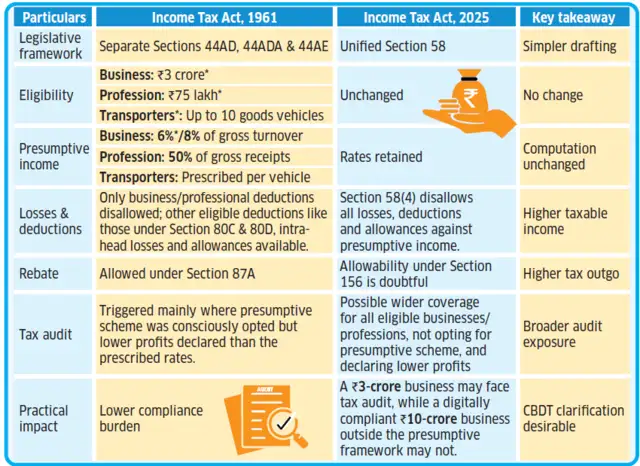
*Enhanced turnover thresholds with reduced presumptive tax rate apply where aggregate cash receipts and cash payments do not exceed 5% of the respective totals.
Practical illustration
Consider a social media influencer earning Rs.3 crore from digital receipts. Presumptive income is computed at 6%, resulting in income of Rs.18 lakh, with short-term capital loss assumed to be Rs.6 lakh. Under the old Act, the loss could generally reduce taxable income to Rs.12 lakh, potentially enabling rebate under Section 87A, and thereby reducing income tax liability to zero. Under the new Act, the loss cannot be adjusted, taxable income remains Rs.18 lakh and the rebate threshold may no longer be reached. The result is a higher taxable income and tax liability.
Tax audit concern
Businesses with turnover exceeding Rs.1 crore are generally subject to tax audit. However, where cash receipts and cash payments do not exceed 5% of the respective totals, the threshold increases to `10 crore. Under the 1961 law, tax audit in presumptive taxation cases is generally applicable where a taxpayer consciously opted for the presumptive scheme but declared profits below the prescribed rates.
In contrast, the 2025 law uses a different language to suggest that taxpayers who merely fall within the presumptive taxation category, even without consciously opting for the scheme, can face audit exposure if their actual profit margins are lower than the deemed benchmarks. This interpretation could create a curious situation where a small taxpayer with turnover of `3 crore faces greater compliance scrutiny than a larger taxpayer operating outside the presumptive framework.
The bottomline
The consolidation of presumptive taxation under the Income Tax Act, 2025 is undoubtedly a positive drafting reform. A single, unified framework is easier to navigate than multiple scattered provisions. However, the success of presumptive taxation has never been measured merely by the number of sections in the statute book. Its true value lies in certainty, simplicity and reduced compliance burden.
If taxpayers begin worrying about restrictions on losses, possible rebate implications and expanded audit exposure, the regime risks moving away from its original objective. As implementation begins, taxpayers and professionals alike will be hoping for timely clarification to ensure that simplification does not inadvertently create a new layer of complexity.
The Author is Founder, Taxaaram India And Partner, SM Mohanka & associates
(Disclaimer: The opinions expressed in this column are that of the writer. The facts and opinions expressed here do not reflect the views of www.economictimes.com.)

