By Bhaskar Dutta, Subhadip Sircar and Anup Roy, BloombergLast Updated: Jul 10, 2026, 09:22:00 AM IST
RBI faces a challenge unwinding its large bearish dollar bets. The central bank has begun trimming its massive short dollar forward position. This unwinding must be carefully managed to avoid currency market destabilization. Recent measures aim to attract foreign capital and support the rupee. Forecasters predict continued pressure on the Indian currency for the year.
Over the past two years, India’s central bank built one of the world’s largest bearish dollar bets to support a persistently weak rupee. It now faces the challenge of unwinding that position without destabilizing the currency market.With a spate of recent measures expected to attract foreign capital, the Reserve Bank of India has started trimming its massive short dollar forward position, a stock of commitments to sell the greenback at a future date. The book had ballooned to a record $106.7 billion in May, as per Bloomberg calculations based on RBI data.
The balancing act lies in the pace and extent of the unwind. Leaving the contracts in place for too long can be costly and prolongs the RBI’s forward exposure, while scaling them back too quickly risks diluting the positive impact fresh overseas inflows would otherwise have on the rupee. A misstep could potentially stoke volatility, complicating the RBI’s currency defense just as a renewed flareup in US-Iran tensions drives oil prices higher.
Also read: India’s richer middle class is living a more dollar-linked life while earning in rupees
The conundrum has come up in internal meetings at the central bank, where officials have discussed how to reduce the position, according to people familiar with the developments, who asked not to identified discussing private matters. The rupee, which strengthened last month following the support measures, has resumed declines in July and remains on track for an unprecedented ninth straight year of losses.
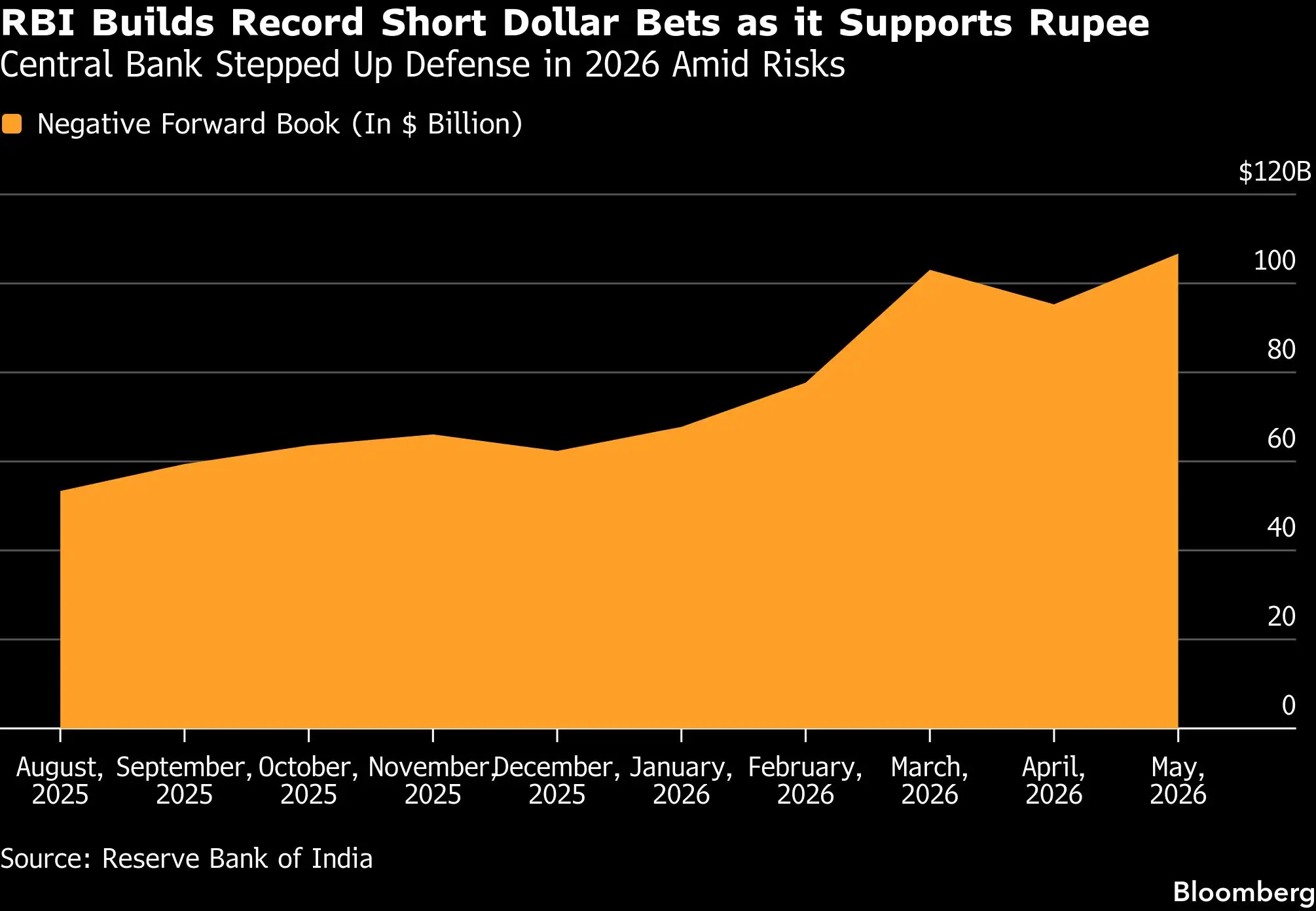
A short dollar forward position is essentially a commitment by the RBI to sell the US currency and buy rupees at a future date. The transactions can ease pressure on the rupee and have the benefit of not immediately depleting foreign-exchange reserves. Unwinding the position is the equivalent of buying dollars with rupees, which can return pressure on the Indian currency.
Authorities in Indonesia, Malaysia and elsewhere have also relied on derivatives to manage exchange rates. However, the RBI’s forward book has grown at a “remarkable” pace, faster than is typical even among emerging-market central banks known for heavy intervention, said Rajeswari Sengupta, an associate professor at Indira Gandhi Institute of Development Research.
“A large net short forward position is effectively deferred dollar demand and at some point the RBI will need to buy dollars to settle the forward book — it cannot keep rolling it over forever,” she said. “This unwinding itself may become a fresh source of rupee depreciation pressure, over and above existing pressures.”
For investors, how quickly the RBI pares the short dollar forward book will also be a gauge of its confidence that the rupee can weather external shocks with less official support.
Last year, it reduced the positions by about $35 billion in six months through August while allowing the exchange rate to move more freely than under previous governor Shaktikanta Das’ regime. The rupee weakened 0.8% during the period, making it the only currency in emerging Asia to depreciate against the dollar.
Rupee Troubles
India’s central bank intervenes in both the offshore and onshore currency market. It deepened its presence offshore in late 2024, ramping up its trading of non-deliverable forwards to buoy the rupee in the face of a resurgent dollar. Then, punishing US tariffs on India in 2025 and the Middle East war early this year piled further pressure on the rupee, forcing the RBI to keep adding to its forwards book.
Some of that strain eased last month as India relaxed rules for foreign investments in government bonds and cut taxes on debt returns. Sentiment was also boosted by the slump in oil prices after the US and Iran signed an interim peace deal.
Seizing on the improved backdrop, the RBI is estimated to have trimmed the offshore portion of its short dollar forward book by $10 billion to $15 billion since mid-June, according to traders familiar with the developments, who asked not to be identified because they aren’t authorized to speak publicly.
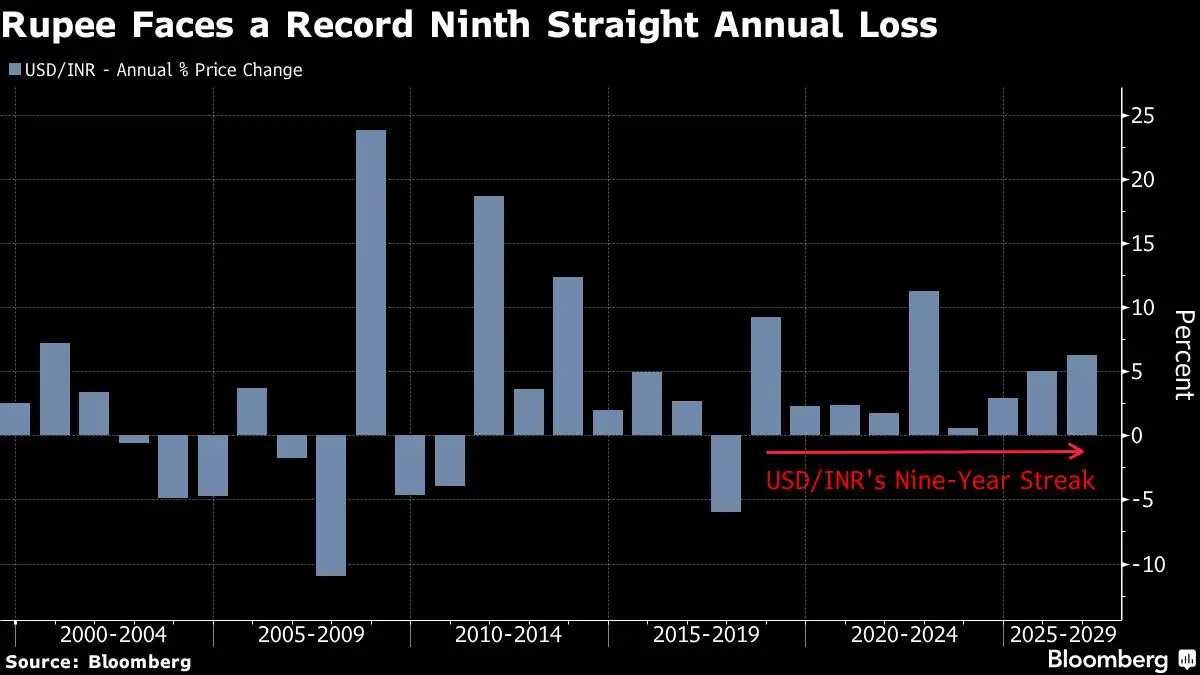
But the rupee’s renewed weakness underscores the challenge the RBI is facing. The currency is down 0.8% against the greenback so far in July, after gaining 0.4% last month.
“In the past fortnight, short-term FX maturities worth about $20 billion are expected to have rolled off the central bank’s forward book,” DBS Bank Ltd. strategists including Philip Wee wrote in a report. “Oil-sensitive currencies, especially the rupee, face renewed volatility as Brent prices extend gains” they said, adding that recent losses defy “expectations of a near-term appreciation bias on inflows.”
The central bank didn’t respond to an email seeking comments.
In response to a question at the June post-policy media briefing on whether the RBI’s interventions in the forward market and rupee support measures signaled expectations of future strain on the currency, Governor Sanjay Malhotra said the central bank does not anticipate such pressure but remains prepared for any eventuality.
The RBI has adequate reserves and sufficient buffers, and would take necessary steps to ensure healthy capital flows and maintain “orderly movement” in the rupee, he said at the time.
To attract capital, the RBI has offered to fully cover hedging costs for banks raising three- to five-year foreign-currency deposits from non-resident Indians. While this will “enhance headline foreign-exchange reserves, it will create equal future liabilities that will require repayment,” said Ananth Narayan, a former board member of the Securities and Exchange Board of India, the capital markets regulator.
“In effect, through a subsidized swap window, the RBI is effectively borrowing expensive 3-to-5-year dollars from the market,” he said. “If the rupee weakens against the greenback over this period, the central bank would face mark-to-market losses on these fresh forward commitments.”
Currency forecasters see little respite for the rest of the year.
Claudio Piron, head of Asia FX & rates strategy at BofA Global Research, estimates the rupee at 98 per dollar by the end of 2026. That reflects expectations of three US rate hikes totaling 75 basis points, which would bolster the dollar.
More broadly, the median estimate in a Bloomberg survey of forecasters is for the rupee to end the year at 95.40 per dollar. That’s versus 95.39 on Thursday. The currency is the worst performer in Asia this year after Indonesia’s rupiah, having lost close to 6%.
“The RBI’s net short forward position is heavily front-loaded, with nearly $29 billion maturing within three months (as of May) and about $51 billion over a one-year horizon,” said Madhavi Arora, chief economist at Emkay Global Financial Services Ltd. “This concentration creates a material overhang and policy conundrum.”
View 3 Comments on this Story
NEXT STORY
SECTIONS
By , ET OnlineLast Updated: Jul 09, 2026, 12:20:00 PM IST
Dollar spending India: The country’s expanding middle class now spends more on foreign goods and services. International travel and overseas education are becoming regular annual expenses for many families. Digital subscriptions, AI tools, and imported electronics also contribute to this growing dollar demand. While oil imports remain the largest driver, household spending is a significant factor. This trend reflects India’s deeper integration with the global economy.

From overseas holidays and foreign degrees to AI subscriptions and premium gadgets, India’s growing middle class is increasingly spending on products and services linked to foreign currencies. As aspirations become more global, economists say Indian households are also becoming more exposed to currency movements, raising an important question: Is the country’s consumption story quietly becoming more dollar-intensive?When Prime Minister Narendra Modi in May 2026 urged Indians to avoid non-essential foreign travel, postpone discretionary gold purchases for at least a year to help conserve foreign exchange amid disruptions caused by the West Asia conflict, the appeal reflected more than a temporary response to geopolitical uncertainty. It underscored a structural shift underway in India’s consumption economy.
A growing middle class—larger, wealthier and more globally connected than ever before—is increasingly spending on goods and services priced directly or indirectly in dollars. International holidays, overseas education, AI subscriptions, streaming platforms, premium electronics, imported luxury products and even fuel consumed through greater mobility all carry a foreign exchange footprint.
The phenomenon comes as India’s middle class itself expands rapidly.
Rajesh Shukla, Managing Director and Co-Founder of think tank People Research on India’s Consumer Economy (PRICE), in a February 2025 analysis, stated that this segment— comprising households earning between ₹6 lakh and ₹36 lakh annually at 2024-25 prices—has grown to encompass over 560 million people across 126 million households. Earlier, in a 2023 report, Shukla had projected the middle-class population to reach 715 million by 2030-31 and cross one billion by 2046-47, making it one of the world’s largest consumer markets.
A new source of forex demand
For decades, India’s foreign exchange demand was largely shaped by crude oil imports, capital goods and corporate trade.
“A decade ago, India’s dollar demand was largely driven by crude oil imports, corporate borrowing and merchandise trade. Today, the middle class has become a meaningful contributor to forex demand,” Ponmudi R, CEO of Enrich Money, told ET Online.
He highlighted that overseas travel, international education, global OTT platforms, AI subscriptions, cloud software, gaming, imported electronics and cross-border e-commerce have together created a structural shift in household consumption.
Jateen Trivedi, VP Research Analyst – Commodity and Currency at LKP Securities, echoed the view. “Consumer-led dollar demand has grown meaningfully over the past decade due to higher spending on overseas travel, education, digital subscriptions and global investments. While oil imports remain the largest driver, household demand for dollars is becoming an increasingly important structural component,” he told ET Online.
Yet both experts caution against overstating the trend. Retail spending alone, they said, is unlikely to dictate RBI policy, as exports, imports, FDI and portfolio flows continue to dominate India’s external account.
However, sustained growth in household dollar demand could become an increasingly important variable over the next decade.
Also read: The ‘little boy’ in the Pacific, India’s monsoon and the big test ahead
Holidays abroad become an annual expense
Perhaps nowhere is the shift more visible than outbound tourism.
International travel, once considered an occasional luxury, is increasingly becoming an annual line item in middle-class household budgets.
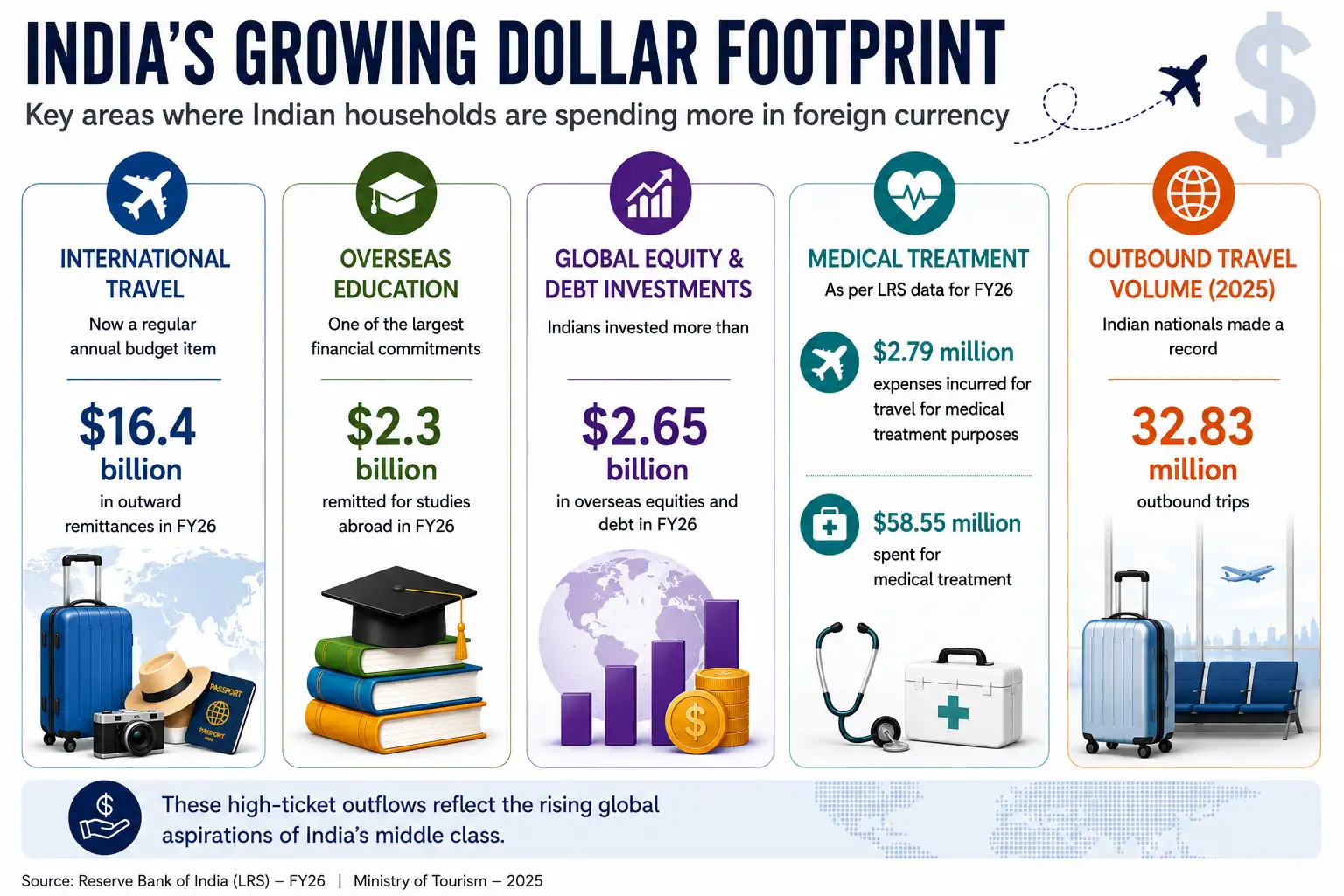
According to the Ministry of Tourism, Indian nationals made a record 32.83 million outbound trips in 2025, up 6.3% from the previous year.
The Reserve Bank of India’s Liberalised Remittance Scheme (LRS) data tells a similar story. Of the nearly $29 billion remitted overseas under the scheme in FY26, travel alone accounted for over $16.4 billion, making it by far the largest category of outward remittances.
Gagan Malhotra, chief operating officer at MakeMyTrip’s forex arm BookMyForex, said the change has been one of the most significant developments in the forex market over the past five years.
“International travel has evolved from being an occasional aspiration for middle-class households to becoming a regular annual expense. Many families are now taking two vacations a year instead of just one,” he told ET Online.
Several factors are driving the trend: higher disposable incomes, easier visa regimes, improved air connectivity and, strikingly, the narrowing price gap between premium domestic vacations and overseas holidays.
Anil Kalsi, vice president of the Travel Agents Federation of India (TAFI), noted affordability has reshaped travel choices.
“If you’re spending Rs 20,000 for a hotel room in India but can stay in Bangkok for Rs 5,000, there’s no comparison. People also want different experiences, different cultures and different lifestyles. Foreign travel has become aspirational,” he told ET Online.
Visa-free entry to destinations such as Thailand, Malaysia and the Philippines, along with expanded flight capacity and strong social media influence, has further widened international travel beyond metro cities.
Malhotra noted that travellers are also buying foreign exchange earlier than before to lock in exchange rates, reflecting greater awareness of currency volatility.
Also read: Indians may be roaming closer to home because of a war far away
Overseas education, healthcare
If foreign holidays are becoming a recurring expense, overseas education remains one of the largest financial commitments that Indian households undertake.
RBI data shows that remittances for studies abroad exceeded $2.3 billion in FY26, while another $450 million was remitted under travel for education, reflecting the multiple channels through which families finance international education.
Healthcare-related remittances, while much smaller, also contribute to household foreign exchange spending.
As per the LRS data, in FY26, resident Indians remitted $2.79 million under ‘Travel for medical treatment’ which covers expenses incurred when an individual travels overseas for treatment. Indians spent another $58.55 million under ‘Medical treatment’, which includes payments for medical services availed from abroad without travelling.
The invisible dollar bill
Unlike travel or education, much of India’s new dollar consumption is invisible.
Streaming subscriptions, cloud storage, software licences and AI tools have quietly become recurring household expenses.
While global streaming giants operate in India, the market is highly mixed with major local entities. According to the FICCI-EY India Media & Entertainment Report, in 2025, total digital subscription revenues increased by 60%, reaching Rs 163 billion. Paid video subscriptions rose to 216 million, spanning 143 million households in India, driven by the introduction of premium sports and films behind paywalls. Paid music subscriptions expanded by 37% to 14.4 million, following measures by music streaming platforms to discourage free usage.
Premium standalone foreign services account for part of this growing subscription market.
Beyond paid subscriptions, Indian consumers also spend increasing amounts of time on global social media platforms.
According to research firm DataReportal, India had 500 million unique social media user identities as of October 2025. While Google parent Alphabet and Meta do not officially disclose country-specific user numbers, DataReportal estimates that India had around 500 million YouTube users, 481 million Instagram users, 403 million Facebook users and 213 million Snapchat users by late 2025.
As AI adoption accelerates, recurring payments for premium software and digital services are expected to become another source of sustained dollar-denominated spending.
“Many digital subscriptions, smartphones, electronics, cloud services, AI tools and software licences are either priced directly in dollars or linked to global dollar-based pricing,” Ponmudi said. Trivedi added that imported electronics, digital entertainment and AI subscriptions are likely to emerge as some of the fastest-growing sources of household dollar demand over the coming decade.
Indians are also increasingly looking at foreign markets for equity investments, creating another form of dollar bill for the economy. According to Reserve Bank of India data, Indians invested more than $2.65 billion in overseas equities and debt in FY26.
In March 2026, under LRS, Indians invested $440 million into global equity and debt investments. This number was up 43% from $306 million in March 2025.
Also read: Middle class, aspirational consumers to drive 93% of India’s spending by 2036: Sitharaman
Beyond remittances: The import dollar drain
Not all foreign exchange linked to consumption appears in outward remittances; much of it arises indirectly through imports. Gold, crude oil and electronics remain among the country’s biggest sources of merchandise dollar outgo, although each reflects a different mix of consumer demand, industrial use and domestic production.
Crude petroleum continued to lead India’s import dependencies in FY26, with the nation’s crude oil import bill climbing to $123.37 billion over the previous fiscal year as New Delhi imported 245.77 million MT of crude, according to PPAC data.
Gold imports, long driven by household demand, moderated after the government raised the import duty from 6% to 15% in May 2026 and tightened rules for gold imports linked to exports. Against this backdrop, gold imports declined 39% month-on-month to $3.4 billion, though they remained 34% higher year-on-year, according to the World Gold Council. As a share of total merchandise imports, gold accounted for around 5%, down from the elevated 14% seen in January–February.
Also read: Modi wants Indians to press pause on gold. But the $5.2 trillion obsession runs deep
The electronics story is more nuanced. While India has reduced smartphone import dependence from around 78% in 2014 to almost negligible levels through domestic manufacturing, electronics imports still crossed the $100-billion mark for the first time in FY26, rising nearly 18% to $116.2 billion. Electronics exports also grew strongly to $48 billion, led by smartphone shipments, but continued to trail imports by a wide margin.
Notably, the electronics bill also includes industrial raw materials, besides consumer electronic devices.
Consumption meets currency
For most Indian households, exchange rates were once relevant mainly to importers or families sending children abroad. Today, a weaker rupee affects everything from international vacations and imported gadgets. Since January 2025, the rupee has depreciated by about 9%. INR was amongst the weakest currencies in Asia during May 2026 when it weakened to 96.96 against dollar, according to a report by The Economic Times.
Experts say essential spending such as education and medical treatment tends to be relatively resilient even when the rupee depreciates. Discretionary expenses, however, including holidays, premium gadgets and luxury purchases, are far more sensitive to exchange-rate movements.
“Rising incomes are enabling greater global consumption, but the growing dependence on dollar-priced products and services also means the Indian middle class is becoming increasingly sensitive to movements in the rupee-dollar exchange rate,” said Trivedi.
Ponmudi agreed, describing the shift as both natural and structural.
“It reflects India’s deeper integration with the global economy, where the US dollar continues to be the dominant currency for international consumption,” he said.
What emerges is not a departure from India’s consumption story, but an evolution of it. As the middle class expands, the geography of its spending is changing just as much as its purchasing power.
India may still earn in rupees, but for millions of middle-class consumers, the aspiration basket is becoming unmistakably global, and with it, increasingly tied to the fortunes of the dollar.
Stories you might be interested in

