he Andhra Pradesh High Court recently ruled that when there are two conflicting claims over a property based on Wills, the registered Will takes precedence over the unregistered one, especially if there are suspicious circumstances are involved. This ruling brought an end to a 36-year-old legal battle over a property in Kakinada.
What led to this property dispute?
The Late Saladi Subbarao had four children (three sons and one daughter). To support his only daughter, Smt. Pamarthi Subbayamma, who was married to the late Pamarthi Venkataswamy of Satyavada Village, Subbarao gifted her some agricultural lands.
Smt Subbayamma used these lands to cultivate crops and with the money she earned, she bought a land via a sale deed on February 14, 1962, and built a house.
This house later became the subject of a dispute among Subbayamma’s brothers. Two of her brothers, Saladi Gangaraju and Saladi Parthasaradhi, argued that Subbayamma had transferred the property to them through a registered Will dated April 18, 1983 and a subsequent unregistered Will dated December 29, 1991.
However, Subbayamma’s other brother, Saladi Hanumantha Rao, contended that she had already executed a registered Will dated August 31, 1990, giving the entire property to him.
Subbayamma had no children and so the central issue on who gets her property came down to a fight between: Registered Will (Hanumantha) vs Unregistered Will (Gangaraju and Parthasaradhi).
An illustration of the family tree is as follows:
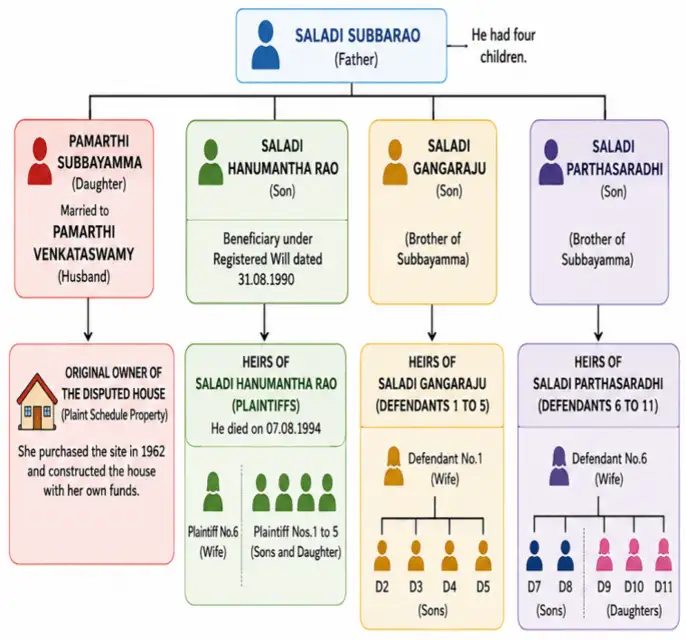
Family Tree
By the time, it came to the Andhra Pradesh High Court to decide who gets Subbayamma’s house, all her brothers had died and the case was continued by their children.
Also read: Husband leaves some properties to sister through Will, excluding wife and children; Supreme Court upholds it for this reason
Gangaraju and Parthasaradhi’s side argued that this property which Hanumantha claimed as Subbayamma’s self-occupied property, actually wasn’t. They claimed that the sale deed was obtained in Subbayamma’s name merely because she was their elder sister and looked after the family members.
According to Gangaraju and Parthasaradhi, they both had decent jobs and and gave the money to Subbayamma to buy the land and construct the house on it. In return, Subbayamma allowed Parthasaradhi to take the front portion of the house to set up his legal office and the rear section was allotted to Gangaraju who at that time worked in the revenue department.
Also read: Forged Will row: Buyer should not face criminal case for purchasing land on the basis of Will which police found to be forged; rules SC
Regarding the two Wills, Gangaraju and Parthasaradhi claimed that the 1986 registered Will allegedly gave the property to them, and it was followed by the 1991 unregistered Will which said that share of Gangaraju will go to his wife and the remaining portion to his sons.
Hanumantha claimed that the 1991 unregistered Will is a rank forged document and his registered 1990 is a genuine document that superseded the 1986 registered Will. Ultimately Hanumantha branch of the family won the case.
Also read: Husband gave his share in joint property to another man via Will; Wife files case for partition of property for her share; SC rules in her favour for this reason
Why did the Hanumantha branch win the case?
Asha Kiran Sharma, Partner at King Stubb and Kasiva, said to ET Wealth Online: What really worked in favour of the Hanumantha branch was not the fact that their Will was registered, but that they were able to convince the Court it was genuine. That’s a distinction people often miss. Registration, by itself, does not decide the validity of a Will. The Court still has to be satisfied that it was executed voluntarily, that the testator understood what they were signing, and that there are no suspicious circumstances surrounding it.
Also read: Can a mother cut a son out of her Will? Kerala HC backs mother who inherited 46 cents of land from her husband and denied son a share
In this case, the plaintiffs were able to back the registered Will with credible witness testimony, and their version remained consistent throughout the proceedings. The Court found no reason to doubt that the document reflected Subbayamma’s final wishes.
The defendants, however, faced a much higher hurdle. The unregistered Will was surrounded by circumstances that raised questions. It was said to have been executed at the home of one of the beneficiaries, despite evidence that the testator was not on good terms with that branch of the family. More importantly, the document was not relied upon in earlier litigation, where one would ordinarily expect it to have been produced if it genuinely existed. The defendants also fell short of addressing these inconsistencies through convincing evidence.
According to Sharma, this judgment is a reminder that succession disputes are ultimately decided on the credibility of the evidence, not on the label attached to the document. Whether a Will is registered or unregistered is only one part of the story. What matters is whether the Court is satisfied that it truly represents the testator’s last and free intention.
Also read: No inheritance for mother under Indian Succession Act if son dies without creating a Will and is survived by his wife and children
Summary of high court judgement
- Judgement date: June 15, 2026
- Case number: APHC010592532016
When the matter reached the Andhra Pradesh High Court, the court examined the evidence of an attesting witness to the alleged 1991 unregistered Will. The witness stated that he met Subbayamma at a marriage function in Kakinada on December 27, 1991. She told him that she was staying at the house of her brother Parthasaradhi and requested him to come there on December 29, 1991 to witness the execution of a Will. The witness said the Will was subsequently executed at Parthasaradhi’s house.
However, the court also observed that Subbayamma had filed a case (O.S.No.72 of 1990) against Subbarao and others, and Gangaraju’s son had also filed a case (O.S.No.34 of 1990) against Subbayamma.
The Andhra Pradesh High Court said: “Therefore, it is evident that there were disputes between Subbayamma and the branch of Gangaraju from 1990 till the date of death of Subbayamma. Therefore, the very execution of the unregistered Will in favour of the branch of Gangaraju on December 29, 1991 is highly doubtful.”
The high court also observed that there is evidence on record to show that Pardhasaradhi and Subbayamma were not in talking terms from 1990 till the death of Subbayamma in 1993. Even when Subbayamma died, Gangaraju and Pardhasaradhi did not attend her last rites and there was evidence that Hanumantha performed her last rites.
The high court said: “Therefore, the execution of the unregistered Will in the year 1991 in favour of their enemies by Subbayamma is highly doubtful and cannot be considered.”
The Andhra Pradesh High Court noted that while Gangaraju and Pardhasaradhi examined one attesting witness and the scribe of the alleged 1991 unregistered Will, they failed to examine the other attesting witness. The high court observed that “the evidence of the scribe cannot be equated with the evidence of an attestor” and held that the 1991 unregistered Will had not been proved in accordance with law.
Thus the Andhra Pradesh High Court came to the conclusion that the 1991 unregistered Will cannot be proved, and the 1990 registered Will is the last testament of Subbayamma as under law, the latest Will prevails over the old Wills.
The Andhra Pradesh High Court also rejected the contention of the Gangaraju and Parthasaradhi branches that the 1990 registered Will was suspicious because it bore Subbayamma’s thumb impression instead of her signature. The court noted that several documents, including court records and registered documents executed around the same period, also contained her thumb impression.
The court accepted Hanumantha branch’s explanation that, owing to her old age, Subbayamma had been using her thumb impression rather than signing documents during her later years.
Thus the high court dismissed the second appeal and upheld Hanumantha branch’s claim to late Subbayamma’s property based on the 1990 registered Will.

