eople spend years carefully building wealth through fixed deposits, mutual funds, insurance policies and shares. But life has a way of getting in the way. Investors move cities, change banks, forget old investments or simply lose track of paperwork. Sometimes, the original investor passes away without telling family members about every financial asset they owned.
Over time, these forgotten investments can become “unclaimed”.
Many people assume that once money is transferred to government-managed funds, it is gone forever. Fortunately, that is not the case.
What is the Government’s Unclaimed Assets Portal?
“The Unclaimed Assets Portal addresses a longstanding pain point by providing a single entry point to search across multiple categories of unclaimed financial assets,” says Adhil Shetty, CEO of BankBazaar.
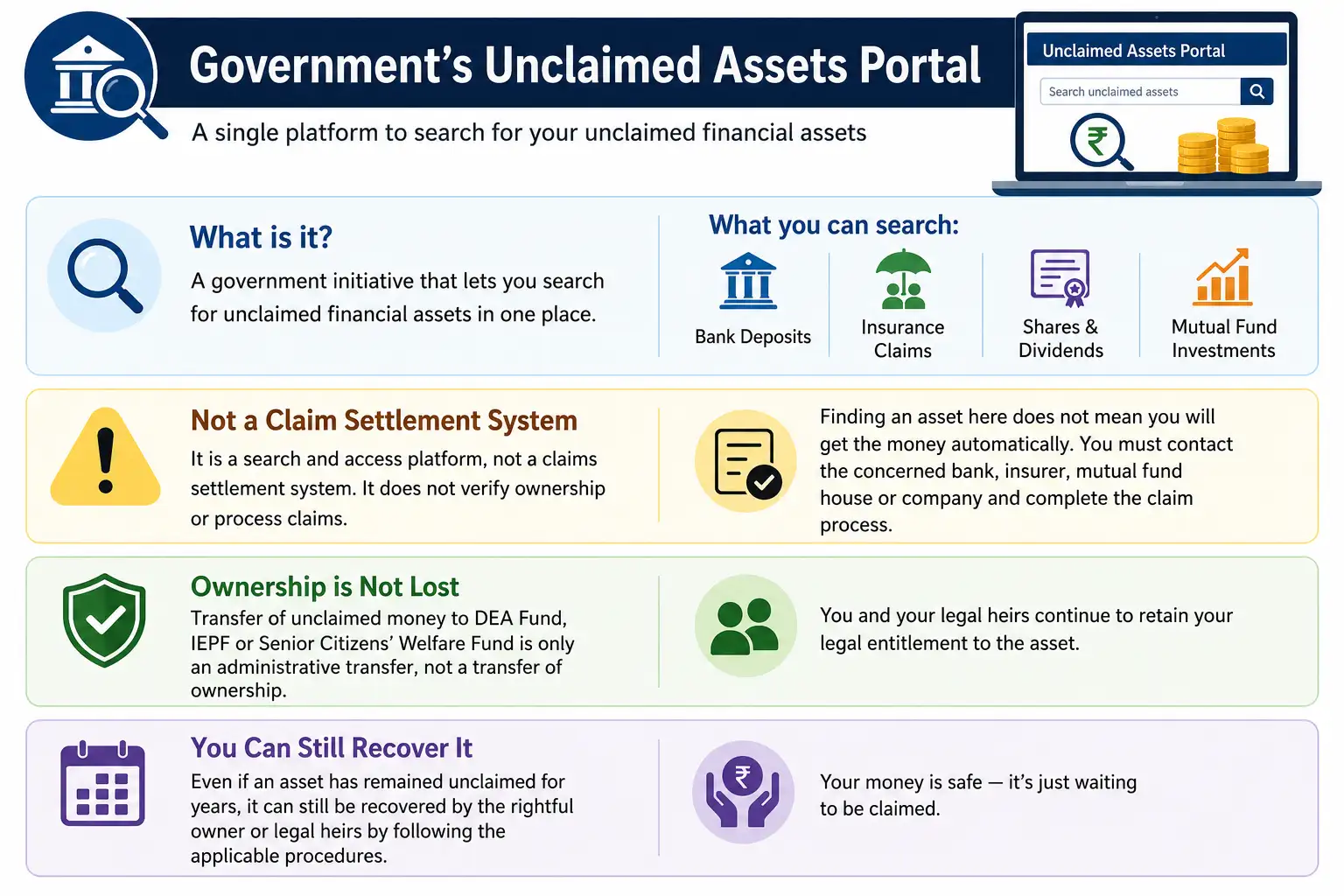
It currently allows users to search for unclaimed bank deposits, insurance claims, shares and dividends, and mutual fund investments through the respective regulators and financial institutions.
However, investors should not mistake the portal for a claim settlement system, cautions Shetty.
“It is a search and access platform, not a claims settlement mechanism. It neither verifies ownership nor processes claims,” he says.
What is the Government’s Unclaimed Assets Portal?
In other words, locating an asset through the portal does not automatically result in receiving the money. Once an asset is identified, the claimant must still approach the relevant bank, insurer, mutual fund house or company and complete the prescribed claim process.
Does money transferred to government funds still belong to you?
Many investors believe that once an unclaimed deposit or investment is transferred to the Depositor Education and Awareness (DEA) Fund, the Investor Education and Protection Fund (IEPF) or the Senior Citizens’ Welfare Fund, they permanently lose ownership.
But that’s not true.
“The transfer of unclaimed money to the DEA Fund, IEPF or Senior Citizens’ Welfare Fund is an administrative transfer, not a transfer of ownership.,” says Shetty.
Investors and their legal heirs continue to retain their legal entitlement to the asset. The transfer merely changes where the money is held until a valid claim is made, he explains.
This means that even if an asset has remained unclaimed for several years, it can still be recovered by the rightful owner or legal heirs after following the applicable procedures.
What documents are usually needed to recover unclaimed assets?
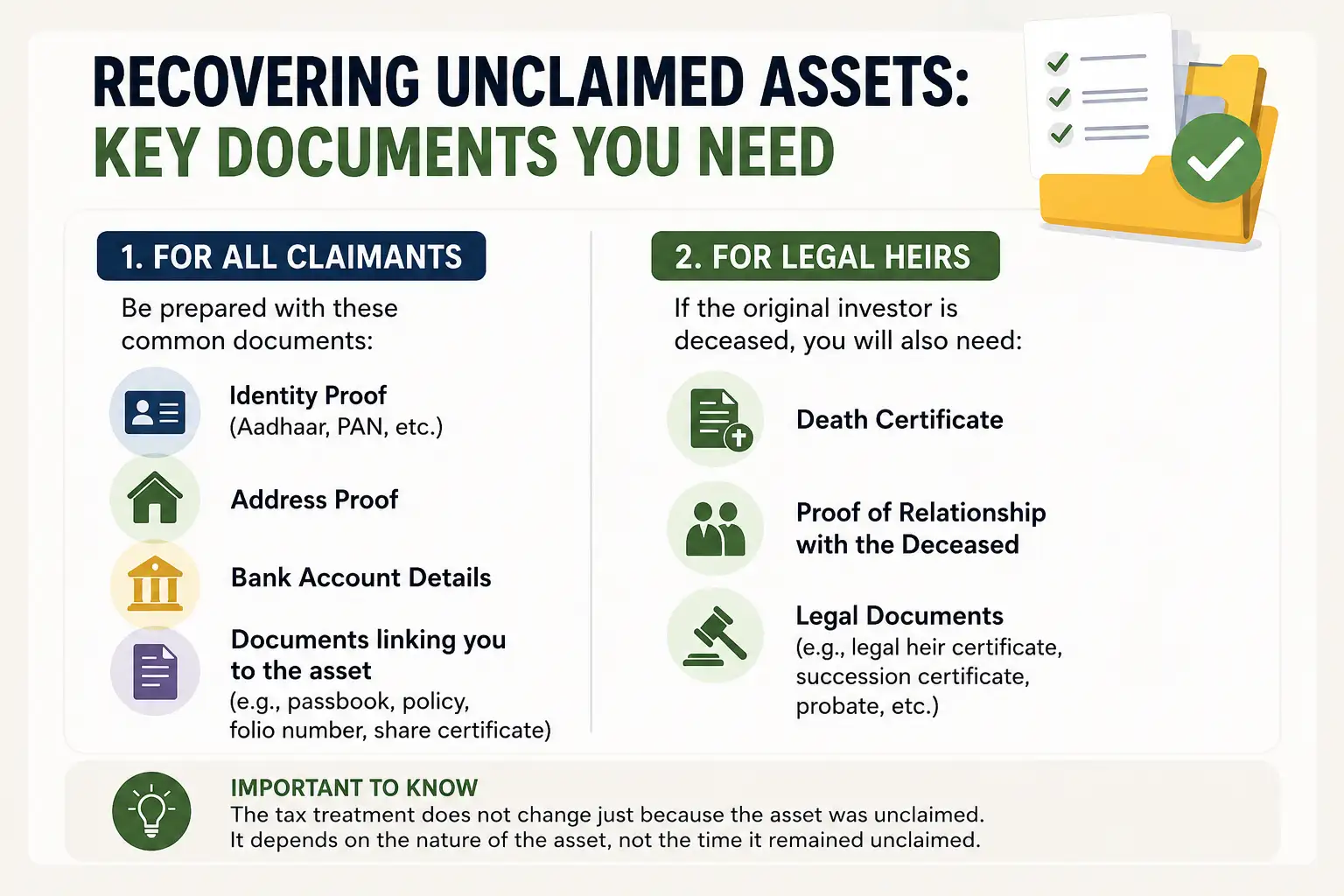
While the documentation varies depending on the type of financial asset, Shetty says claimants should generally be prepared with identity and address proof, PAN, Aadhaar, bank account details and documents linking them to the investment, such as a passbook, insurance policy, folio number or share certificate.
Documents needed to recover unclaimed assets
The process becomes more document-intensive when legal heirs are making the claim.
According to Shetty, where the original investor has passed away, financial institutions generally require the death certificate, proof of identity, proof of relationship with the deceased and, depending on the circumstances, documents such as a legal heir certificate, succession certificate, probate or letters of administration.
The exact requirements vary across institutions and asset classes.
Why do claims often get delayed?
Finding an unclaimed investment is often easier than successfully claiming it.
Name mismatches after marriage, outdated addresses, inactive bank accounts, changed signatures and incomplete KYC frequently trigger additional verification.
“This could be due to a mismatch between the investment records and current KYC details, such as name, signature, bank account, PAN, or other registered information. For the family of someone who has passed away, it is usually a claim filed before the transmission is completed, or without a succession certificate in place,” says Vishranth Suresh, CEO & Co-founder, AssetPlus.
As a result, even genuine claimants may experience delays despite being legally entitled to the money.
Are there any tax implications when unclaimed money is received?
Many investors also wonder whether receiving money after several years changes its tax treatment.
According to Shetty, it does not.
“The tax treatment is determined by the nature of the underlying asset, not by the fact that it remained unclaimed,” he says.
For example, interest received on unclaimed bank deposits continues to be taxed under the Income-tax Act. Insurance proceeds remain subject to the tax rules applicable to the policy, while mutual fund redemptions and dividends continue to follow the prevailing capital gains and dividend taxation provisions.
Where large amounts are involved or claims span several financial years, obtaining professional tax advice may be advisable.
How can investors ensure their money doesn’t become unclaimed?
Experts say most cases of unclaimed assets are preventable.
Regularly updating nominations across every financial product, ensuring KYC details such as PAN, address, mobile number, email ID and bank account information remain current, and maintaining a consolidated record of all investments so family members know exactly what assets exist and where they are held, recommends Suresh.
These simple habits can significantly reduce the chances of investments becoming difficult to trace years later.
The government’s Unclaimed Assets Portal makes it easier for investors and their families to search for forgotten financial assets across multiple categories.
However, the portal is only a starting point. Recovering the money still requires establishing ownership and completing the claim process with the relevant institution.

