Synopsis
The RBI has a toolkit when it comes to protecting the rupee. In the kit is a time-tested tool: Get NRIs to park their dollars in India. Now, with the rupee near a record low, the RBI has once again turned to it. It is a tool that has worked in the past – but for reasons that no longer apply in 2026.
Three times in the past three decades, the RBI has turned to non-resident Indians, or NRIs, and their dollars when the rupee has come under pressure. With the rupee touching a record low near 97 to the dollar this year, the central bank has once again reached for the tool that it keeps in reserve for bad times. The aim is to draw in around $40 billion.
Banks are being offered a sweetened deal to pull in foreign-currency deposits from NRIs. And the RBI will quietly pick up the cost of protecting those deposits against a falling rupee.
India has done a version of this before. In 1998, after the Pokhran nuclear tests triggered global sanctions and the rupee buckled, the government sold what were called Resurgent India Bonds to NRIs and raised $4.2 billion. In 2000, amid surging oil prices, it returned with the India Millennium Deposits and raised $5.5 billion.
In 2013, during the worst scare of the three, it raised more than $34 billion. Now, in 2026, it is back at the same well, hoping to draw up dollars. Each time the money has helped, of course. But each time it has had to be paid back.
The 2013 Playbook
That 2013 rescue is the one worth a close look. Because 2026 is, in many ways, a rerun of it.
The trouble then, as now, began in America. The US Federal Reserve hinted it would slow the flood of cheap dollars it had been pumping into the world. That scared investors. They pulled their money out of emerging markets, India among them. The rupee went into free fall and hit a then-record 68.36 to the dollar in August 2013.
The RBI’s first move was to make rupees scarce, and it pushed up short-term rates to make it painful to bet against the currency. The move not only flopped, it also bruised the economy. And the rupee kept falling. Within weeks, the idea was dropped.
Then came the move that worked. The RBI opened a window for banks to raise three-year deposits from NRIs. It took the currency risk off their hands at a cheap, fixed 3.5% a year. That was far below what such cover cost in the market.
The dollars, naturally, poured in. Over $34 billion in just three months, about $24 billion of it NRI money. The rupee steadied, and the scheme was hailed a success.
Why 2013 Worked (And the Catch)
But here is the part most people miss. Those NRI dollars were not the real rescue act. There was a deeper fix that was happening. And it was to India’s current account deficit, or CAD.
Simply put, the CAD is the gap between what the country spends abroad and what it earns. In 2013-14, that gap collapsed. It fell from about $88 billion, or 4.7% of GDP, to about $32 billion, or 1.7%, in a single year. With the gap closing, the rupee had far less to fear.
The NRI money? It was just a bridge. It bought time while the real repair happened underneath.
But there is a catch with that repair. It was neither healthy nor repeatable. Imports fell by roughly $40 billion in a year. One item, gold, did nearly 60% of that work.
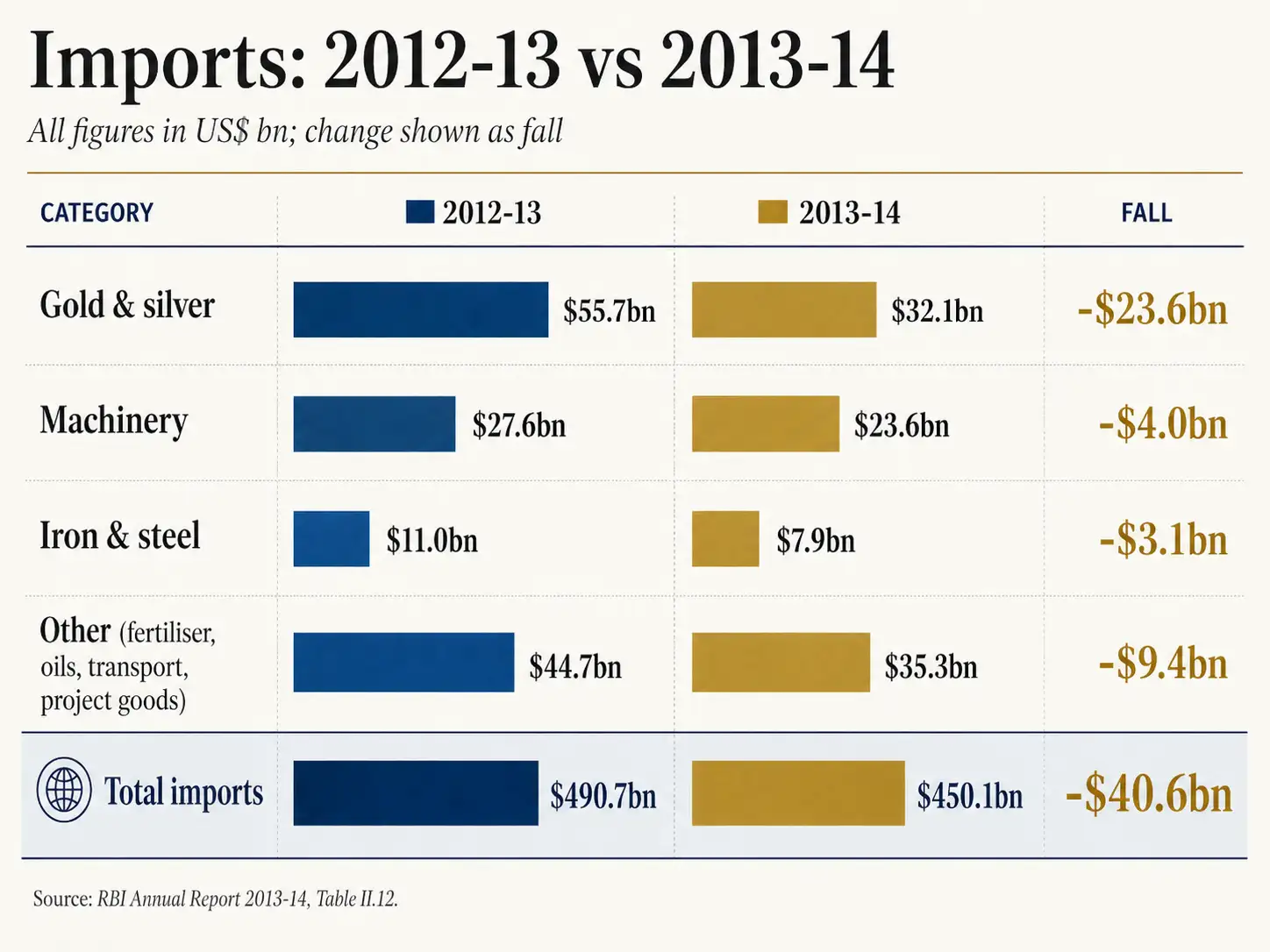
That gold collapse was engineered, of course. The government raised import duties and forced traders to re-export a fifth of any gold they brought in before they could import more. (World prices were falling at the same time. )
The next-biggest drops, in machinery, steel and project goods, were not a sign of strength. They were a sign of weakness. A slowing economy was simply building less, and also buying less from abroad.
In short, the 2013 gap closed because India throttled gold by order, and because investment had stalled. Neither is a lever a country would ever choose to pull again.
Now, here’s the catch that nobody remembers. Those three-year deposits became due in 2016. And the money left. The RBI repaid about $24 billion of it between September and December that year. It managed the exit smoothly. But it had to plan months ahead to find the dollars.
The lesson for 2026 is simple. This kind of NRI money is rented, not earned. It comes for the offer and goes when the offer ends. And while it stays, the RBI keeps paying the bill for the protection it promised.
Why 2026 is Different
So why is this time different? In two ways, and they pull in opposite directions.
First, the good news. India is far stronger today. In 2013, its reserves stood at about $282 billion, enough to cover just 7.8 months of imports, and they were shrinking. Today they are around $700 billion. That is more than double, and enough to cover close to 11 months of imports. India is in no danger of running out of dollars. A 2013-style panic is off the table.
Now the hard news. The problem itself is tougher this time. In 2013, the rupee was weak because of an import surge, and that surge could be switched off. In 2026, it is weak for a reason India cannot simply switch off. Foreign investors are pulling money out, and the US is holding its interest rates high, drawing capital towards America. Neither of those is a problem that corrects itself.
And the gold lever? It is gone. India still buys close to 700 tonnes of gold a year, as much as it did after the 2013 squeeze, and the bill is at a record high as prices soar. But the weakness this time comes from money leaving the country, not from buying too much abroad. Squeezing gold would not touch it.
The Bottom Line
Put it all together and the picture is clear. India is strong enough to stop the rupee from crashing. It is not strong enough to stop it from sliding. A big pile of reserves treats the symptom, not the cause.
So this year’s scheme is a top-up, not a rescue. It lets the RBI bring in dollars without spending its own. But it does not cure the weakness. And it stores up a familiar problem. In a few years, this money too must be repaid. The RBI knows it. That is why it has stretched the new deposits to as long as five years, against three in 2013, to push that day further out.
For anyone who sends money home, studies abroad, or imports for a living, the takeaway is plain. Do not expect this to make the rupee strong again. It is likelier to slow the fall than to reverse it.
So What Would Actually Fix It?
Which leaves the question that the latest RBI scheme to attract NRI money cannot answer. What would actually treat the cause?
The honest answer is that there is no NRI cheque for it. The rupee keeps needing to be rescued because India, year after year, spends more dollars abroad than it earns. So the real work is to spend fewer of them. And the most dollars India spends is on energy. Fix that, and you fix most of the problem. Four moves can do the heavy lifting.
One. Burn less imported oil. India already blends 20% ethanol into its petrol, a target it hit five years early, and that alone has saved more than Rs. 1.4 lakh crore in foreign exchange over the past decade. The next step is concrete: Move to E30. And roll out flex-fuel engines that can run on it.
Also, push electric two- and three-wheelers, which is where most of India’s fuel is actually burned. Every litre of petrol replaced is a dollar that stays home.
Two. Get the kitchen off imported gas. Here is a number that should worry every finance minister. India imports about 60% of its cooking gas, and nearly all of it comes through the Strait of Hormuz, the very chokepoint this year’s crisis exposed. The fix is to move Indian kitchens from imported LPG to electricity: The induction cooktop in place of the gas cylinder.
It is slow work. Cooktops cost money, and the power has to be reliable. And there is a catch India must not miss. In the cooktops themselves, the switch, the chip and the glass top, are imported today. So the move only works if India also makes these at home, under the same kind of scheme that built its phone industry. Swap an LPG import bill for a components import bill, and nothing is gained.
Three. Pull in money that stays. Not all foreign money is the same. The kind leaving now, the “hot” money parked in stocks, runs at the first sign of trouble. The kind India wants is patient money. In 2024, Indian government bonds were finally added to the big global indices, which brings in steady, rules-based money that does not bolt.
The concrete step is to widen the pool. Put more bonds on the Fully Accessible Route. Clear up the tax and paperwork that foreign investors trip over. And chase the index inclusions still pending. More sticky money means less wobble.
Four. Pay in rupees, not dollars. The RBI already lets India settle some trade in rupees, through what it calls Special Rupee Vostro Accounts, and it has signed a local-currency pact with the UAE. The trouble is, though implementation has begun (with reported gold, crude-oil and food-product transactions), usage remains partial and concentrated in select sectors rather than broad-based.
Also, partners take the rupees, then find they have nowhere to spend them. So fix that. Let them park those rupees in Indian government bonds, which feeds the move above. And sign these deals with the countries India actually buys its oil from. Every barrel paid for in rupees is a dollar India does not have to find.
None of this is fast. None of it makes a headline the way a $40 billion NRI scheme does. But together they go at the one thing the NRI dollars never touch: The reason India runs short of dollars in the first place. Until that work is done, the RBI will keep reaching into the same toolkit, and the NRIs will keep being asked to help.
The NRI dollars will come, as they always have. The real question is whether, by the time they leave, India has finally done the quieter, harder work of fixing why its currency keeps needing to be saved.
Disclaimer: The views, scores, research and investment tips expressed herein are not that of Economic Times (“ET”) or its management and have been gathered from various third-party sources. ET does not guarantee the accuracy, adequacy or completeness of any information and is not responsible for any errors or omissions or for the results obtained from the use of such information. The content provided herein including any output of tools/analysis is for informational purposes only and should not be relied upon or construed as an investment advice. ET advises users to check with a certified professional before making any investment decision.

