Synopsis
Taxpayers must correct TDS challans for Tax Year 2026-27 on the old TRACES portal. This is crucial if the challan was mistakenly filed under FY 2025-26. Failure to correct will prevent TDS credit for Tax Year 2026-27, increasing tax liability. The new TRACES portal does not yet support this correction. Timely correction ensures proper tax credit and avoids disputes.

In order to deposit Tax Deducted at Source (TDS) with the Income Tax Department, you need to use a challan on the TRACES online portal. But if you had accidentally deposited TDS challan for FY 2025-26 under Income Tax Act 1961 when it should have been for Tax Year 2026-27 under the Income Tax Act, 2025, you’ll have to use the old TRACES portal to fix this mistake. At present the new TRACES portal cannot be used for making such a correction.
If this correction is not made, then for Tax Year 2026-2027 you will not get the TDS credit, resulting in a higher tax liability. Chartered Accountant Himank Singhla, partner SBHS & Associates says that the new TRACES portal for Income Tax 2025 compliance does not yet support challan correction.
So to make the correction, Singla says that taxpayers need to use the old TRACES portal. Singla shares the process on how to make the TDS correction:
- Old Traces portal (Income Tax Act 1961) to submit correction:
- Go to Statement / Payment › Request for OLTAS Challan Correction
- Existing FY: 2025-26 ? New FY: 2026-27
- Confirm & Submit
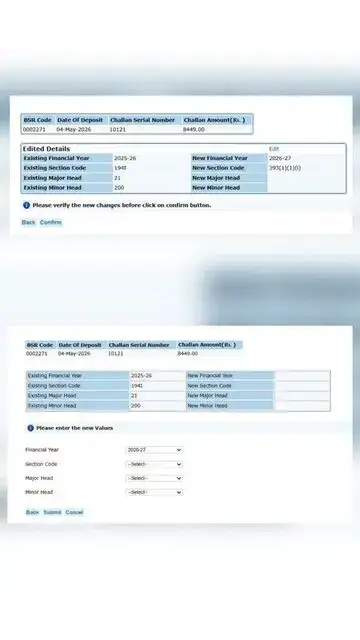
Source: CA Rajendra Sharma on X
Source: CA Rajendra Sharma on X
⚠️ *TRACES Challan Correction — Important Update for FY 2026-27* If you deposited TDS challan in FY 2025-26 (under old IT Act 1961) but it belongs to FY 2026-27 (new IT Act 2025) – here’s how to correct it👇 ✅ The new TRACES portal for Income Tax 2025 compliance does NOT yet Show more
What can happen if TDS statement is not corrected?
Mohit Gupta, Partner, PNAM & Co. LLP said to ET Wealth Online that taxpayers and deductors should carefully review the financial year selected while depositing TDS challans, particularly during the transition from the Income-tax Act, 1961 to the new Income-tax Act, 2025.
Gupta says that in cases where a challan has inadvertently been deposited under FY 2025-26 but actually pertains to FY 2026-27, a correction should be initiated at the earliest to avoid downstream compliance issues.
According to Gupta, at present, the correction functionality for such cases is available only through the legacy TRACES portal. Deductors can access the OLTAS Challan Correction facility, amend the relevant financial year details, and submit the correction request after due verification.
The consequences of not correcting TDS challan is severe. Gupta says: “Delays in rectification may result in mismatches between challan details and TDS returns, leading to difficulties in claiming tax credit, generation of defaults, demands, or unnecessary correspondence from the tax department.”
Gupta says that a timely correction helps ensure proper credit of taxes, accurate reporting in TDS statements, and minimises the risk of avoidable disputes or notices arising from technical mismatches.
(Join our ETWealth WhatsApp channel for all the latest updates)
…more

