Filing the return within the prescribed due date remains the best way to avoid unnecessary costs and compliance hassles.
June 17, 2026 19:13 IST

Searches for “AY 2026-27 ITR due dates” have been trending on Google Trends as the income tax filing season gathers pace. For Assessment Year (AY) 2026-27, corresponding to Financial Year (FY) 2025-26, taxpayers should be aware of the applicable deadlines to avoid late-filing fees, interest, and other compliance issues.
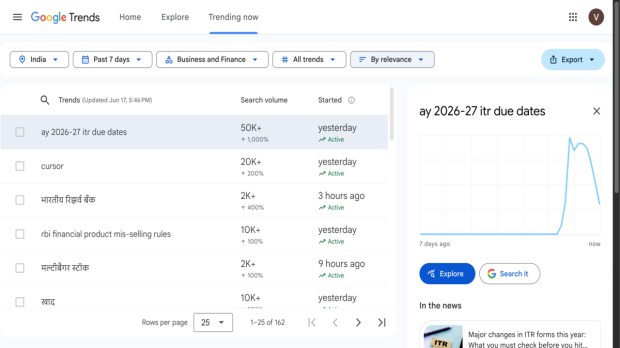
ITR due dates for AY 2026-27
The Income Tax Department has notified different due dates for various categories of taxpayers, which are as follows:
| Category of taxpayer | Due date |
| Individuals and HUFs filing ITR-1 or ITR-2 (non-audit cases) | July 31, 2026 |
| Business and professional taxpayers filing ITR-3 or ITR-4 (non-audit cases) | August 31, 2026 |
| Taxpayers whose accounts are subject to audit | October 31, 2026 |
| Taxpayers covered by transfer pricing provisions | November 30, 2026 |
| Belated return | December 31, 2026 |
| Revised return | March 31, 2027 |
Note: A key change for AY 2026-27 is that non-audit taxpayers filing ITR-3 and ITR-4 have a separate due date of August 31, 2026, instead of sharing the July 31 deadline applicable to most salaried taxpayers.
ALSO READ
What happens if you miss the due date?
Missing the applicable due date does not necessarily prevent a taxpayer from filing a return. A belated return can generally be filed until December 31, 2026. However, taxpayers may face:
Late-filing fees under the applicable provisions of the Income Tax Act.
Interest on unpaid tax liabilities.
Possible restrictions on carrying forward certain losses.
STORIES YOU MAY LIKE
Delays in receiving tax refunds.
Why does ITR filing on time matter?
Timely filing of an ITR offers several advantages:
Faster processing of refunds.
Easier access to loans and credit facilities.
Smooth visa and immigration documentation.
Better compliance with tax laws.
Reduced risk of penalties and notices.
Checklist before filing your ITR
Before submitting your return, taxpayers should:
Select the correct ITR form.
Reconcile Form 26AS, AIS, and pre-filled return data.
Report all sources of income accurately.
Verify bank account details.
Claim only eligible deductions and exemptions.
Review the return carefully before submission.
Complete e-verification after filing.
Key takeaways
Missing the ITR due date does not mean you lose the opportunity to file your return, but it can have significant consequences. Taxpayers may face late filing fees, interest charges, denial of certain deductions, restrictions on carrying forward losses, delayed refunds, and, in extreme cases, prosecution proceedings. Filing the return within the prescribed due date remains the best way to avoid unnecessary costs and compliance hassles.
One of the most immediate consequences of missing the due date is the levy of a late filing fee under Section 234F. The fee can be up to Rs 5,000 for taxpayers whose total income exceeds Rs 5 lakh and up to Rs 1,000 where total income does not exceed Rs 5 lakh.
The fee is payable even if the taxpayer files a belated return later within the permitted deadline.
Disclaimer: This article is for informational purposes only and does not constitute professional tax advice. Tax laws and regimes are subject to frequent changes by the government. Readers should verify details with official Income Tax Department notifications or consult a Chartered Accountant before making any financial decisions.
Read Next
This article was first uploaded on June seventeen, twenty twenty-six, at thirteen minutes past seven in the evening.
© IE Online Media Services (P) Ltd

