India Inc. is profitable. So why isn’t it investing?
Corporate profits are becoming an increasingly crucial driver of India’s economy. Yet it isn’t a chest-thumping accomplishment in policymaking. If anything, it’s the opposite because those surpluses aren’t being plowed back into new physical assets.The aggregate net income of listed Indian firms is approaching a record 6% of gross domestic product. Even so, their capital expenditure has remained flat, hovering at 3.6% to 3.7% of gross domestic product.
The dwindling share of India Inc. in the total pie of national investment is problematic. The good jobs that come with new factories, warehouses, and showrooms are becoming elusive. Since wages support many more people than dividends or stock-market gains, inequality is worsening.
A contrast with neighboring China shines a light on India’s challenge. Listed Chinese-domiciled companies have kept their share of profits in GDP — which at $20 trillion is five times bigger than India’s — steady at about 4%. Yet mainland firms are investing amounts that approach or even exceed their combined net income.
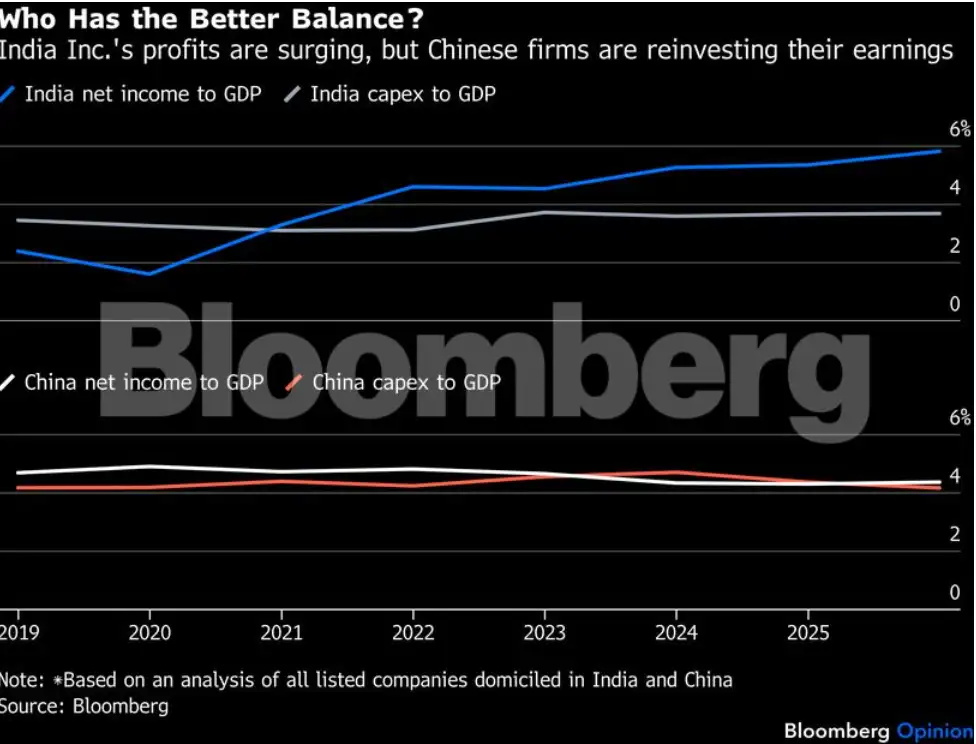
That’s despite concern both at home and abroad. President Xi Jinping has declared war on “involution,” or excessive competition in industries like electric vehicles, solar panels, and even AI models. In markets overseas, particularly Europe, there’s anxiety over local firms’ inability to compete against China’s overproduction. But consumers globally aren’t complaining. Amid ballooning charges for running Western autonomous coding agents, the Chinese tech sector’s heavy investment in low-cost AI models holds the key to lower costs in a potentially inflationary world.
The question then is why India Inc. is being so stingy. After all, the political environment can’t be more stable. Gone are the messy democratic transitions of the past. Prime Minister Narendra Modi just surpassed Jawaharlal Nehru’s record for the longest unbroken hold on power since the first post-independence election. The opposition is cowed and beaten. Something resembling a single-party state has already arrived. Since that’s what corporate titans wanted, why aren’t they investing to make India the world’s next factory like China?
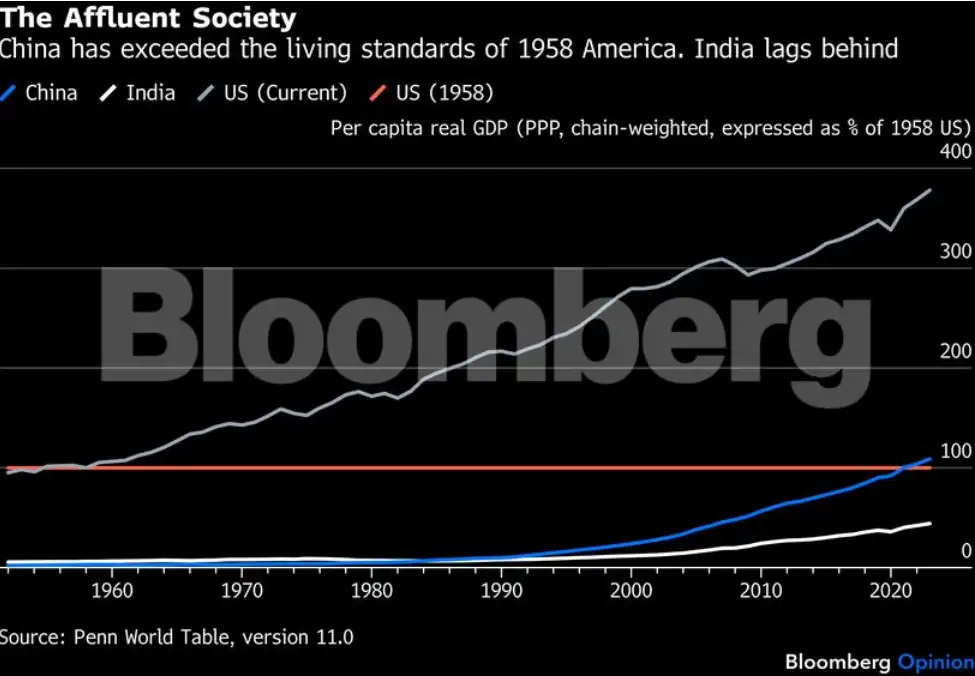
China has already overtaken the average living standards that prevailed in the US when economist John Kenneth Galbraith was writing The Affluent Society, a slim 1958 volume whose core message seems to have resonated more with planners in Beijing than politicians in Washington. Galbraith argued that great private wealth coexisting with public squalor, lawlessness, poor-quality education, and healthcare — all of which is India’s present reality — isn’t a trait of an affluent society, regardless of how rich the corporate sector is.
Intuitively, politicians in New Delhi know this. Attacked by “cockroaches” — the self-assumed identity of a youth movement looking to lodge its protest over unfair exam results — the state finds its legitimacy corroded by the poor quality of publicly provided services.
India’s per-capita real income is less than half of 1950s America. What’s more, the demographic clock is ticking. In about two decades, the working-age population will peak. So what should be the plan? An economy perpetually trapped in scarcity — because the state lacks the money to invest and the private sector the will? Or should New Delhi emulate Beijing and aspire for mass affluence? The choice has to be made now and not when the society has already started aging.
Despite liberal tax breaks and relaxed labor laws, India Inc. can’t find its animal spirits. It may well be that the four fortunes widely considered to be at the helm of India’s national team — Mukesh Ambani, Gautam Adani, the Tata Group, and Sajjan Jindal of the JSW Group — have a view on what’s expected of them, and what they can hope to get in return from the ruling political class.
The Adani Group claims that its $16 billion capital expenditure across utilities, transport, energy, and other infrastructure assets in the last financial year is the largest ever by any Indian company. While both Ambani and Adani are investing in large data centers, Tata is trying to script a semiconductor manufacturing story. Jindal, the country’s largest steelmaker, has an ambitious plan for capacity expansion.
Go down the pecking order, however, and smaller corporate empires are retreating into safer options that don’t require research, innovation, or heavy investments. Take Godrej Industries Group, which started off in 1897 as a maker of high-quality locks and later expanded into soap, food, chemicals, and property development. But for Pirojsha Godrej, the 45-year-old chairman-designate, the next big thing is wealth management.
Some other millennial and Gen Z owners of successful firms are getting out of the game altogether by selling out to private equity and parking their money in family offices. Let someone else create the hard assets that will unleash shared prosperity.
(Disclaimer: The opinions expressed in this column are that of the writer. The facts and opinions expressed here do not reflect the views of www.economictimes.com. )

