
Listen to this article in summarized format
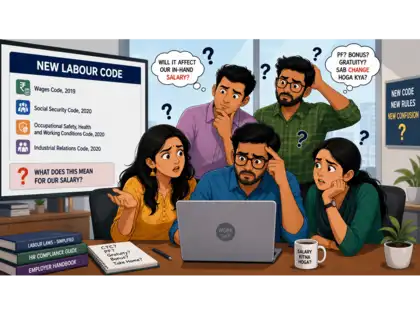
New Income Tax Rules, 2026 rules offer increased tax-free allowances for salaried employees, potentially boosting take-home pay. However, an expanded definition of ‘wages’ under the Code on Social Security, 2020, can significantly increase employer costs for gratuity and provident fund contributions. Employers must carefully balance employee benefits with these rising statutory liabilities.
Income Tax Guide
Income Tax Union Budget FY 2026-27 LiveIncome Tax Slabs FY 2025-26Income Tax Calculator 2025
1. A tax boost that may not fully translate
At first glance, the Income-Tax Rules, 2026, effective from 1st April 2026 appear to offer a clear advantage to salaried employees, particularly those opting for the old tax regime. The extension of HRA exemption from 40% to 50% of basic pay (plus DA) to Ahmedabad, Bengaluru, Hyderabad and Pune (subject to eligibility), along with a substantial increase in :
- Children education allowance (from ₹100 to ₹3,000 per month per child), and
- Hostel expenditure allowance (from ₹300 to ₹9,000 per month per child), creates significant scope for tax-free income, potentially up to ₹2,88,000 annually for employees with two children.
However, this benefit is not automatic. It depends on:
- Inclusion of these allowances in the salary structure by the employer; and
- Actual expenditure being incurred and substantiated by the employee in accordance with tax rules and impact on perqusites valuation .
2. Who benefits and who faces constraints
For Central Government employees, the revised tax exemption limits are broadly aligned with existing reimbursement structures, under which reimbursements are permitted as follows:
- Children education allowance: ₹2,812 per month per child
- Hostel subsidy: ₹8,437 per month per child
Since these reimbursement levels already exceed the earlier exemption limits (₹100 and ₹300, respectively), the revised thresholds provide a direct and tangible benefit for employees opting for taxation under the old tax regime.
A similar benefit may also accrue to other employees, including those in state governments and public sector undertakings, where reimbursement levels already exceed the earlier exemption limits.
However, the position is materially different for other employees governed by the Code on Social Security, 2020 (“the Code”). In such cases, employers generally evaluate the cost–benefit implications before restructuring compensation to incorporate such allowances, given their impact on wage-linked statutory liabilities.
3. The real issue: Expanded definition of “wages”
The core of the dilemma lies in the definition of “wages” under the Code on Social Security, 2020, which directly impacts employer liabilities relating to social security benefits such as gratuity, provident fund contributions, pension, and leave encashment.
Earlier position under labour laws
Under earlier laws such as the Payment of Gratuity Act, 1972 and the Employees’ Provident Funds and Miscellaneous Provisions Act, 1952 (now subsumed within the Code on Social Security, 2020) the definition of “wages” was relatively restrictive.
Under the Gratuity Act, “any other allowance” was excluded, while under the EPF Act, “any other similar allowance” was excluded.
As a result, most allowances, including children-related allowances, were not part of the wage base for computing gratuity and provident fund contributions.
Shift under the Code on Social Security
Section 2(88) of the Code defines “wages” as:
“All remuneration, whether by way of salaries, allowances or otherwise…”
Only specific exclusions are permitted, such as:
- House Rent Allowance (HRA)
- Conveyance allowance
- Employer contributions to provident or pension funds
- Bonus, overtime, commission, etc.
However, where the aggregate of excluded components exceeds 50% of total remuneration, the excess is required to be added back to wages.
Further, Explanation (ii) to Rule 34(2) of the Code on Social Security (Central) Rules, 2025 excludes the following items for the purpose of calculation of gratuity:
- Medical reimbursement
- Stock option benefits
- Crèche allowance
- Telephone and internet reimbursement
- Meal vouchers
4. The legal trigger: What constitutes “wages”
Any payment made by the employer is included in “wages” unless it is specifically excluded under the Code on Social Security, 2020 or the Rules framed thereunder.
Since Children Education Allowance and Hostel Expenditure Allowance are not specifically excluded under Section 2(88), these allowances:
- Form part of “wages, and
- Increase the wage base for computing social security benefits under the Code
These allowances can directly expand the wage base, potentially increasing long-term employer liabilities for social security of their employees, such as gratuity and provident fund contributions.
5. When does salary restructuring increase employer costs?
While the legal framework appears clear, the actual cost impact of salary restructuring is not uniform and depends on how compensation components are designed and reallocated in practice.
A key question for employers is:
Does the introduction of children-related allowances necessarily lead to higher wage-linked liabilities?
The answer is not uniform. It depends on whether the restructuring involves:
- Reallocation from excluded components to included components, or
- Reclassification within components that already form part of “wages”
The real impact becomes evident only when we translate these legal principles into actual salary structures.
The following illustrations demonstrate how the outcomes can differ significantly based on the nature of restructuring.
Illustration 1: When tax optimisation leads to higher employer cost
Reallocating amounts from excluded components to children-related allowances increases the wage base, resulting in higher gratuity and other social security liabilities.
CTC: ₹18,00,000
| Component | Before (₹) | After (₹) | Treatment |
| Basic Pay | 9,00,000 | 9,00,000 | Included |
| Excluded components | 9,00,000 | 6,12,000 | Excluded |
| Children Education Allowance | 0 | 72,000 | Included |
| Hostel Allowance | 0 | 2,16,000 | Included |
| Wages under Code | 9,00,000 | 11,88,000 |
Impact
The restructuring results in a clear increase in the wage base, with monthly wages rising from ₹75,000 to ₹99,000. Under Section 53(2) of the Code on Social Security, 2020, gratuity is calculated at the rate of 15 days’ wages for every completed year of service, based on the last drawn wages. Consequently, any increase in “wages” directly translates into a higher gratuity liability.
On an illustrative basis, assuming a service period of 30 years, the gratuity provision increases from ₹12.98 lakh to ₹17.13 lakh, an increase of over 30% in long-term liability. It is important to note, however, that the actual gratuity payout will ultimately depend on the last drawn wages at the time of retirement, resignation, or any other event specified under Section 53 of the Code.
Illustration 2: When restructuring is cost-neutral
Reclassification within components that are already part of “wages” does not change the wage base and therefore has no impact on gratuity or other social security costs under the Code directly connected with the wage base.
| Component | Before (₹) | After (₹) | Treatment |
| Basic Pay | 5,00,000 | 5,00,000 | Included |
| Excluded components | 9,00,000 | 9,00,000 | Excluded |
| Special Allowance | 4,00,000 | 1,22,000 | Included |
| Children Education Allowance | 0 | 72,000 | Included |
| Hostel Allowance | 0 | 2,16,000 | Included |
| Wages under Code | 9,00,000 | 9,00,000 |
Impact
In this scenario, the restructuring does not result in any change in the wage base, which continues at ₹9,00,000 annually (₹75,000 per month). The absence of any increase in “wages” means that there is no corresponding impact on social security costs under the Code, including gratuity.
This outcome arises because the restructuring involves a reclassification within components that are already included in “wages”, namely, “special allowance” being partially replaced by “children-related allowances”. As a result, the overall wage base remains unchanged, and consequently, there is no increase in employer obligations towards social security benefits, such as gratuity and provident fund contributions.
6. The employer’s dilemma: Tax gains for employees vs higher costs
The two illustrations bring out a fundamental dilemma in salary structuring under the current framework. While tax rules expand employee-friendly allowances, the definition of “wages” under the Code on Social Security, 2020 determines whether such restructuring increases employer costs.
Where restructuring involves shifting amounts from excluded components to children-related allowances, the wage base expands, leading to higher liabilities under the Code. Conversely, where reclassification occurs within components that already form part of “wages,” the overall cost impact may remain neutral.
In practice, however, achieving such neutrality is not always straightforward. Employers must balance multiple considerations, such as enhancing employee take-home pay, maintaining internal pay equity and managing statutory obligations linked to wages.
As a result, salary restructuring is no longer driven solely by tax efficiency. It requires a careful evaluation of long-term cost implications, making it a strategic compensation decision rather than a routine adjustment.
7. A welfare opportunity with a cost constraint
The enhanced tax-free allowances under the Income-Tax Rules, 2026 undoubtedly strengthen the case for improving employees’ take-home pay. However, the expanded definition of “wages” under the Code on Social Security, 2020 compels employers to strike a careful balance between enhancing employee benefits and managing the long-term cost implications under the Code.
What appears to be a straightforward tax advantage for employees can, in practice, translate into higher liabilities for employers under the Code. While selective restructuring may achieve tax efficiency without increasing costs, such outcomes are not universal and require careful structuring.
In this backdrop, employers are likely to proceed with caution, weighing immediate employee gains against enduring cost commitments before reworking compensation structures.
The author, O.P. Yadav, is a former IRS officer with over 36 years of experience in tax administration, education, and training. He is presently working with Prosperr.io as a Tax Evangelist. The views expressed are personal.

