
Listen to this article in summarized format

If you have ever opened a gaming app for “just a quick game” and ended up spending far more time than you planned, you are not alone. Online gaming today is made to be effortless and addictive. A few taps, a small deposit, and you are instantly part of the action. The excitement builds quickly and the thought of taxes rarely crosses the mind.
Income Tax Guide
Income Tax Union Budget FY 2026-27 LiveIncome Tax Slabs FY 2025-26Income Tax Calculator 2025
That easy flow is now being gently, but firmly, interrupted. From 1 May, India’s new online gaming law and rules change one crucial criteria: your legal and tax exposure will depend less on how much you win and more on the kind of game you choose to play. The law has drawn clear categories of games, and each category carries its own legal and tax consequences.
So, before you tap ‘Play’, ask a simple question: what kind of game am I entering?
Law begins with a wider lens
It all starts with “what counts as an online game”. An online game is any game played on a phone, laptop, or digital device, operated through software using the internet or any form of electronic communication. This definition is intentionally broad, ensuring that almost every form of digital gaming falls within its scope. Whether it be a fantasy cricket app, a quiz platform, a multiplayer online battle arena game, or even a learning-based game, all are treated as online games at the first level.
This is only the starting point. The real difference, and the real tax impact, begins when we look at how these games are classified.
Categories matter more than ever
With everything coming under the umbrella of online games, the law draws a clear distinction between different types of participation. These distinctions are not just legal language. They directly shape your tax exposure and even the permissibility of the activity. Online games now fall into three broad categories: online money games, e-sports, and online social games. Each operates very differently and the consequences for a user vary just as sharply.
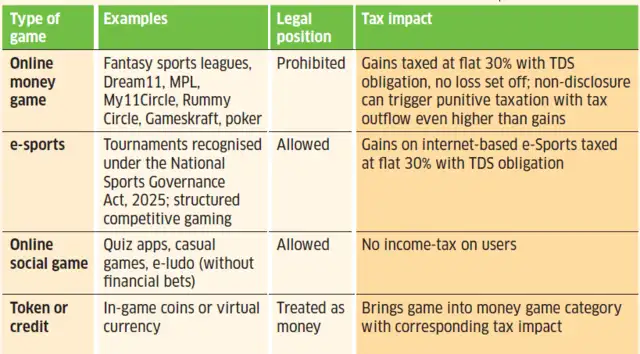
Tax liability cheatsheet
Online money game
An online money game is one in which you participate by paying money or staking something of monetary value, expecting to win money or rewards in return. Money doesn’t mean only cash: it includes coins, tokens, credits, or any virtual items bought with money or convertible into money. What is crucial, and often misunderstood, is that this definition applies irrespective of whether the game involves skill, chance, or a mix of both. Skill does not take a game out of this category if stakes are involved.
Here’s what now counts as an online money game: you join a fantasy cricket contest during a major tournament and pay an entry fee in hopes of winning prize money; or you play online poker using real cash stakes. Even buying in-game coins and using them to enter a paid challenge falls within this category.
Under the new framework, this category faces the strongest regulatory scrutiny. Such games are completely prohibited. Yet, from a tax perspective, the story does not end there.
If you still earn money from such games, that income will be taxed at a flat high rate of 30%, without allowing you to reduce your liability by setting off losses. The situation becomes more serious if the income is not reported. If it is later detected through financial trails, the resulting tax outflow—combined with penalties for misreporting—can exceed the gains themselves. This puts the user in a tough spot: declaring the income may invite regulatory attention, not declaring it exposes you to severe taxation. What once seemed a simple, high-energy form of entertainment now carries layered financial, legal and tax risks.
e-sports
e-Sports represent a clear departure from money-based gaming. These are structured competitions where outcomes depend entirely on skill. They are organised events with defined rules, rankings, and competitive formats not involving any bets or wagers of any kind. The focus is on strategy, reflexes, and consistent performance rather than chance.
To understand the distinction, consider two online chess tournaments that appear similar but are treated differently. In one, players pay Rs.500 each and the pooled amount forms the prize, making it an online money game since money is staked for returns. In another, players pay a small fee only for entry, while prizes are sponsor-funded and the event is conducted under a recognised body like All India Chess Federation. This qualifies as an e-sport.
Online social game
Online social games are the simplest category where there is no staking of money and no expectation of monetary gain. You may pay a subscription or access fee, but that payment is only for using the platform. Think of puzzle apps, quiz platforms, or casual games like e-ludo, used for relaxation. Since there are no winnings, the user incurs no financial risk.
Taxing e-sports & social games
As the law moves away from speculative gaming, the tax treatment of e-sports and social games becomes clearer. Internet-based e-sports tournaments continue to be taxed at a flat 30%, with tax deducted at source (TDS). However, tournaments conducted through closed networks, such as LAN-based events, may fall outside this regime and be taxed under normal income provisions. For professional gamers, income from sponsorships, streaming, or endorsements is treated as business or professional income. Social games remain the simplest for users. Since there are no monetary winnings, there is no income tax implication, while operators are taxed on subscription or access fees in the normal course.
The final takeaway
The most important shift in India’s gaming framework is not about how games are played, but how they are understood. The dividing line is no longer between skill and chance. It is between staking money for returns and participating without stakes. So, the next time you open a gaming app, pause and look beyond the gameplay. Ask yourself a simple question: “am I staking money to win money, or am I paying to compete based on skill?” Under the new rules, that answer quietly decides everything that follows, including your tax bill.
The Author is Founder, Taxaaram India And Partner, SM mohanka & Associates

