Synopsis
The finance ministry has authorized force majeure for govt contracts impacted by the West Asia conflict, treating it as war. This offers relief to companies, including drone manufacturers, facing supply chain disruptions and delivery delays of two to four months. The move shields firms from penalties for missed deadlines due to the ongoing conflict.

Listen to this article in summarized format
The finance ministry has authorised invocation of force majeure for government contracts affected by the West Asia conflict, saying the situation should be treated as war, offering relief to companies such as drone manufacturers which have been severely impacted by supply chain disruptions since the launch of the US-Israeli strikes against Iran on February 28.
The move shields companies from penalties for missing deadlines by two to four months. Force majeure refers to a provision which frees a party from a contractual obligation in the event of unexpected circumstances like war.
“In cases where disruptions arising from the prevailing West Asia situation have directly affected, or consequentially impacted contractual obligations (for goods and services contracts, construction/ works contracts with Government Agencies), the procuring entities may invoke Force Majeure,” said a finance ministry order.
The relief comes with the condition that the extended period of delivery may be two to four months and can only be given to companies that were not in default of their obligations as on February 27. Extension will only be given on a case-by-case basis by the procuring entity.
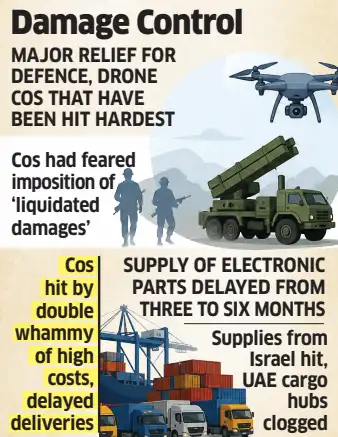
The availability of components from Israel has been badly hit, according to people familiar with the matter, while disruptions in operations at the UAE’s cargo hubs have delayed supplies from other parts of the world as well.
Since all contracts of defence sector companies are with government entities, industry bodies had been working hard to secure force majeure relief.
“Over the past few months, the industry has been dealing with component shortages, logistics delays and tighter export controls, all of which are beyond the control of domestic manufacturers but directly affecting delivery timelines,” said Smit Shah, president, Drone Federation of India.
Industry executives warned that the disruptions could continue well beyond four months, given the demand backlog and pressure on cargo hubs. In some cases, suppliers of critical components such as computing modules and cameras have not only doubled delivery timelines but also increased prices by more than 200%.
Prices of certain edge computing modules have surged 215% and delivery deadlines have been increased from three to six months, according to the executives. Prices of communication equipment have been increased by 50% while there is a general shortage of memory chips, they said.

