Synopsis
The US-led strikes on Iran have shifted focus from damaging military capabilities to dealing with large stockpiles of enriched uranium buried at nuclear sites like Isfahan and Natanz, posing a major security challenge.
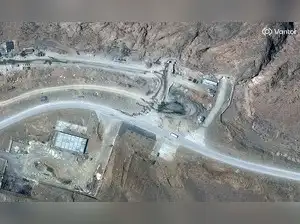
By the time President Donald Trump ordered the US‑Israel air campaign against Iran, the mission had already shifted from simply degrading Tehran’s conventional capabilities to confronting the enduring challenge of its nuclear programme. Buried under rubble in Isfahan and Natanz lie hundreds of kilograms of enriched uranium, potentially capable of forming a nuclear weapon. Securing or neutralising it may prove the most perilous task of Trump’s presidency.
From airstrikes to the rubble dilemma
Trump has repeatedly framed the campaign against Iran as a preemptive strike against an imminent nuclear threat. “They would use it within one hour or one day,” he said last week, underscoring his rationale for the June 2025 attacks on nuclear facilities. He also claimed Iran was “within one month” of being able to build a bomb prior to those strikes, though experts note that while fuel could have been enriched to bomb-grade within a month, creating a functional weapon would have taken several more months at least, NYT reports.
ALSO READ: Russian oil bound for China is diverted as India grabs more
Yet aerial bombardment only destroyed the outer shell of Iran’s nuclear programme. Much of the enriched uranium remains buried under tons of rubble as a result of last year’s bombing of Iran’s nuclear sites. International Atomic Energy Agency Director General Rafael Grossi told WSJ that about half of the 60% highly enriched uranium is believed to lie in the Isfahan tunnels, while some remains in Natanz. Iranian officials, including Foreign Minister Abbas Araghchi, insist they have no plans to retrieve it without IAEA supervision, highlighting the unresolved nature of this strategic challenge.
ALSO READ: India growth outlook dims as oil tops $100, gas crisis deepens
It can be a military nightmare
Experts stress that physically retrieving or destroying the uranium would be a highly complex and hazardous operation. WSJ reports that retired Adm James Stavridis, former NATO commander, called it “potentially the largest special forces operation in history.” Richard Nephew, former Iran director at the National Security Council, warned that the operation would be “very large and very complicated” and might require over a thousand personnel at one site. Eyal Hulata, former head of Israel’s National Security Council, told WSJ, “If the war ends without the US taking care of the fissile material stockpile or an underground tunnel network where Iran could start enriching again, known as Pickaxe, it’s a serious problem.”
Complications go beyond personnel. Explosives, drone attacks, chemical contamination and radioactive hazards all loom. Uranium in gas form can release toxic and radioactive emissions if canisters are breached, and clustering could trigger an accelerating nuclear reaction, according to NYT. Engineers would need to clear rubble, detect mines and secure tunnels while combat troops defend against Iranian forces. Airfield access for extraction and rapid-response contingencies further amplifies logistical challenges.
“It would, by any measure, be one of the boldest and riskiest military operations in modern American history, far more complex and dangerous than the effort to kill Osama bin Laden 26 years ago, or seize Nicolás Maduro from his bed in early January. No one is certain where all the fuel is,” NYT writes.
Matthew Bunn, a Harvard nuclear specialist, told NYT that if the US halted operations now, it “would leave a weakened but embittered regime, possibly more determined than ever to make a nuclear bomb — and still with the material and much of the knowledge and equipment needed to do so.”
Iran’s calculated defence
George Perkovich, senior fellow at the Carnegie Endowment for International Peace, told NYT that Tehran is likely protecting its remaining nuclear material with care. “In their view, they need it more than ever. And they were probably ready to protect it,” he said. Perkovich noted that Iran may have deployed decoy canisters to mislead US special forces, warning that “so when the Special Forces get down there, instead of 20 or so containers, there are hundreds or thousands. They are going to do many things to bedevil anyone trying to get it.”
Despite public assurances, Iran retains the technical capacity to resume enrichment if desired, with centrifuges and the ability to establish new underground facilities. Even leaving the stockpile under rubble poses a latent risk. It represents a fallback capability that could fuel a renewed nuclear programme if diplomacy or containment fails.
The Trump administration’s internal debate
Trump has openly mulled options for dealing with the stockpile. NYT notes that he has shifted from relying solely on aerial strikes to considering ground operations, telling reporters, “I’m really not afraid of that. I’m really not afraid of anything.” Secretary of State Marco Rubio has acknowledged that Iran is not currently enriching uranium, yet US officials continue to weigh whether leaving the material in Iranian hands with warnings would suffice or whether a direct intervention is required.
Diplomatic avenues were previously on the table. Araghchi had proposed blending down the uranium to dilute it under IAEA supervision, keeping it in Iran. The offer was rejected by US negotiators Jared Kushner and Steve Witkoff, NYT reports, leaving military options as the primary path. The US wanted Iran to give up its enriched uranium totally and the US would supply it low-enriched reactor-grade fuel free and indefinitely
Strategic stakes and regional implications
The decision over Iran’s nuclear material is not merely operational but geopolitical. Leaving the stockpile intact risks emboldening Tehran, undermining the US narrative of preemption, and alarming Israel and Gulf allies. Attempting a seizure invites a potentially protracted and bloody ground conflict, raising the specter of expanded war and regional destabilisation.
Rafael Grossi of the IAEA told WSJ that uranium is concentrated in specific underground caches, but assessing or controlling these sites remains a “major verification challenge.” Hulata warned that unresolved caches could provide Iran with a pathway to restart enrichment, a serious problem for US and Israeli security calculations.
Whether the US opts for a high-stakes seizure, controlled destruction or diplomatic containment, the decisions over Iran’s buried stockpile will define the war’s ultimate success and shape Middle East security for years.
 aniltikotekar4sme.com